
Computer Hardware Engineers are the brains behind the design and development of computer systems and components, such as processors, circuit boards, memory devices, and networks.
Their work is crucial for the advancement of computer technology and for ensuring that both individual consumers and organizations have access to powerful and efficient computing resources.
Stats can provide insights into the demographics of computer hardware engineers, including their age, gender, education, and work locations.
| Statistic | Detail |
|---|---|
| Total Employment Worldwide | Over 74,640 |
| Gender Distribution | 9.7% Women, 90.3% Men |
| Average Age | 43 years old |
| Ethnicity Breakdown | White: 50.2%, Asian: 30.3%, Hispanic or Latino: 9.9%, Black or African American: 6.3% |
| Gender Pay Gap | Women earned 98% of what men earned |
| LGBT Representation | 4% |
| Preference for Company Type | 50% more likely to work at public companies |
| Educational Attainment | Bachelor’s Degree: 69%, Master’s Degree: 17%, Associate Degree: 9% |
| Employer Size | > 10,000 employees: 35%, 1,000 – 10,000 employees: 26%, 100 – 500 employees: 16% |
| Company Sector | Public: 50%, Private: 49% |
| Industry Distribution | Technology: 38%, Fortune 500: 13%, Manufacturing: 10% |
| Unemployment Rate | 2.56% |
| Average Tenure | 1-2 years |
| Foreign Languages Spoken | Spanish: 26.3%, Chinese: 14.4%, Mandarin: 11.0% |
Brief Stats on Computer Hardware Engineers:
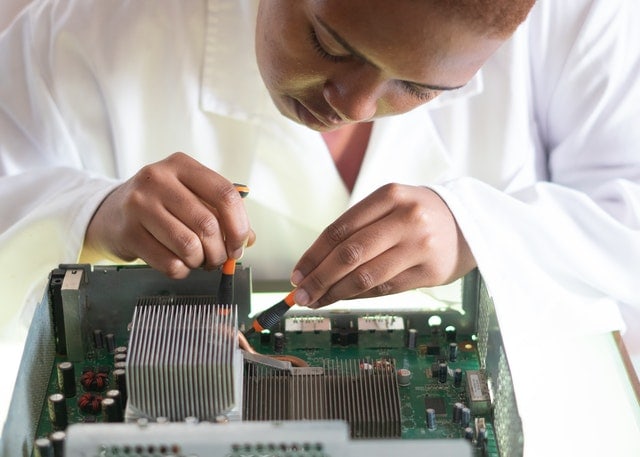
Source: Pexels
- $128,170 per year and $61.62 per hour will be the median pay.
- They require only a Bachelor’s Degree for a Typical Entry-Level Education.
- They don’t require any work experience in a related occupation.
- They don’t require any on-the-job training.
- There were 66,200 jobs in the year 2020.
- The job outlook from 2020 – 2030 is only 2%, which is slower than average.
- As of May 2020, the median annual wage for computer hardware engineers was $119,560.
- 80% of computer engineers work in computer systems design and related services.
- California has the highest number of employed computer hardware engineers at 27,080.
- The demand for computer engineers is projected to increase by 9% from 2014 to 2024.
- Computer engineering jobs make up 63.3% of all IT jobs in the United States.
- The unemployment rate for computer hardware engineers stands at 3.7%.
- 67% of computer engineering graduates secure full-time employment within 6 months of graduating.
- 86% of professionals in the field of computer engineering hold a Bachelor’s degree or a higher level of education.
- 37% of computer hardware engineers are employed in the manufacturing industry, while 8% work in physical and engineering sciences research and development.
- By 2030, it is expected that there will be 28.8 million computer engineers globally.
- There are over 53,155 hardware engineers currently employed in the United States.
- 9.7% of all hardware engineers are women, while 90.3% are men.
- The average age of hardware engineers is 43 years old.
- In 2022, women earned 98% of what men earned.
- 4% of all hardware engineers are LGBT.
- Hardware engineers are 50% more likely to work at public companies compared to private companies.
- The average hardware engineer stays at their job for 1-2 years.

What Does It Take to Be a Computer Hardware Engineer?
A bachelor’s degree from an accredited program is typically required for individuals pursuing a career as a computer hardware engineer.

Source: Pexels
Education:
For entry-level computer hardware engineering positions, a bachelor’s degree in computer engineering or a related field, such as computer and information technology, is required.
Companies may prefer to hire engineers who have completed a program approved by a professional organization such as ABET.
Candidates should have a strong foundation in math and physics to prepare for a degree in electrical or computer engineering.
Additionally, hardware engineers should be proficient in computer programming as they regularly work with computer software systems.
Computer science courses can provide this background. Some major companies or specialized jobs may require a master’s degree in computer engineering.
Experienced engineers may also pursue a Master of Business Administration (MBA) degree. Engineers must continually learn throughout their careers to keep up with technological advancements.
Other Expertise:
Some students participate in internships while in school to gain practical experience.
Advancement:
Some computer hardware engineers move on to manage computers and information systems.
Important Characteristics
- Computer hardware engineers use computer programming tools to optimize digital circuit design.
- Engineers who possess critical thinking skills employ reasoning and logic to examine objectives, investigate assumptions, and assess alternative solutions for their strengths and weaknesses.
- Computer hardware engineers investigate complex hardware problems, design and evaluate potential solutions, and implement the best approach.
- Engineers often work in teams and need to effectively communicate with other developers, programmers, engineers, and non-technical team members.
Pay Package
The average yearly income for desktop hardware engineers was $128,170. Half of the workers in a given profession received more than that amount, while the other half earned less.
The bottom 10% of earners made less than $77,100, while the top 10% made more than $208,000.
The following were the median yearly incomes for desktop hardware engineers in the largest sectors where they worked:
- In Physical, engineering, and biological sciences research and development, around $164,980
- In the Manufacturing of computer & peripheral equipment, around 131,560
- In the manufacturing of semiconductors and other electronic components, around 127,690
- In the design of computer systems and related services, around 127,690
- Around 119,770 in the federal government.
Job Prospects
Computer hardware engineers’ employment is expected to expand 2% between the year 2020 to 2030, which is slower than the median for all occupations.
Despite mild job growth, computer hardware engineers should have about 4,500 opportunities annually on average in the next decade.
The bulk of such opportunities will most probably occur from the need to replace workers who change jobs or leave the profession for other reasons, such as retirement.
Employment
As more companies from various industries continue to research and manufacture their own electronic devices, the demand for electronic engineers is expected to increase.
However, since centralized computing and networking services cover wide networks and geographic areas, fewer engineers might be required.
On the other hand, the rise of hardware startup firms, along with the increasing number of everyday items with computer chips, such as home appliances, medical equipment, and automobiles, could lead to some job growth for electronic engineering professionals.
Data By State and Region:

Source: Pexels
Wage and Employment Statistics by Occupational (OEWS)
The Occupational Employment & Wage Statistics (OEWS) program estimates employment and wages for more than 800 occupations every year.
These figures are accessible for the entire country, particularly states, as well as metropolitan & nonmetropolitan areas. The following links will take you to OEWS data maps of employment and salaries by state and region.
Central Projections
Labor Market Information (LMI) or individual state Employment Prediction agencies generate occupational employment projections for all states projectionscentral.com has all state projections data.
This site’s data allows you to compare anticipated job growth for a given occupation across states or within one state.
Furthermore, states may create projections for specific places; there are references to each state’s website where this information can be found.
CareerOneStop
Hundreds of professional profiles are provided on CareerOneStop, with data organized by state & metro area.
Analyze occupational jobs by state & occupational salaries by local region or metro area using the links in the left-hand menu. There’s also a salary search feature that allows you to look up salaries by zip code.
FAQs
What do computer hardware engineers do?
They make and test the parts inside computers and gadgets. They're the brains behind the tech we use every day.
What kind of projects do computer hardware engineers work on?
They work on all sorts of cool projects, like designing new smartphones, creating faster computers, and even developing tech for space exploration.
What tools do they use?
They use special computer programs to design hardware, test equipment to make sure everything works right, and lots of other high-tech tools.
Which countries have the most jobs for them?
Countries with big tech industries, like the USA, China, and India, have lots of jobs for hardware engineers.
What's the global demand like for computer hardware engineers?
High, especially in countries that are pushing the envelope in tech innovation. Global demand means there are opportunities not just locally but also potentially for international work.
Quick Links:
- Most Important LinkedIn Stats
- Internet Statistics & Facts
- Browser Statistics
- Pinterest Statistics
- Amazing AR Statistics
- Significant Reddit Statistics
- Latest Online Learning Statistics
Conclusion: Computer Hardware Engineers Stats 2026
Computer hardware engineering is a fascinating and ever-evolving field. Tech wizards play a crucial role in shaping our digital future by designing cutting-edge computer components and innovating new gadgets.
The demand for computer hardware engineers is steady, reflecting technology’s vital role in our everyday lives and in the business world.
A career in this field offers a promising and rewarding path for those with a passion for technology and problem-solving skills.
Sources: Bureau of Labor Statistics (.gov), Projectionscentral, abet.org, Zippia, Gitnux

![Jaw-Dropping E-commerce SEO Statistics, Facts and Figures Of [Year]](/_next/image?url=https%3A%2F%2Fcms.jitendra.co%2Fwp-content%2Fuploads%2F2025%2F06%2Fpexels-nataliya-vaitkevich-6214472-1.jpg&w=3840&q=75)

![Video SEO Statistics and YouTube SEO For [Year]](/_next/image?url=https%3A%2F%2Fcms.jitendra.co%2Fwp-content%2Fuploads%2F2025%2F06%2Fpexels-pixabay-270637-1.jpg&w=3840&q=75)
![Graphic Design Statistics, Insights and Trends Of [Year]](/_next/image?url=https%3A%2F%2Fcms.jitendra.co%2Fwp-content%2Fuploads%2F2025%2F06%2Fpexels-tranmautritam-251225-1.jpg&w=3840&q=75)