
Mobile shopping, also known as eCommerce, has revolutionized the way we purchase goods today.
With the majority of people using smartphones and tablets on a daily basis, shopping has become incredibly convenient and accessible from any location.
The rise of mobile shopping is evident from the increasing sales figures and the growing number of people who prefer using their mobile devices to shop.
Mobile shopping is quickly becoming the primary method of purchasing goods, and it’s not just a passing trend.
By examining the mobile shopping statistics for 2026, all can see the extent of its popularity and what it means for the future of online shopping.
| Statistic | Value | Year |
|---|---|---|
| Mobile eCommerce sales | Over $510 billion | 2023 |
| Expected mCommerce sales | $710 billion | 2025 |
| Growth in mCommerce sales during the pandemic | 18% | 2020 |
| Mobile eCommerce as a percentage of total eCommerce sales in the US | 42% | 2022 |
| Forecasted mCommerce share of total sales | More than 43% | 2023 |
| Expected mCommerce share of total sales | 44% | 2025 |
| Active mobile shoppers in the US | 187.5 million | 2024 |
| Mobile users comparing product pricing | 49% | |
| Desktop vs mobile conversion rate | Desktop: 3%, Mobile: 2% | |
| Average order value on desktop vs mobile | Desktop: $155, Mobile: $112 | |
| Time spent in shopping apps globally | 100 billion hours | 2021 |
| Preferred shopping method (in-app vs browser) | In-app: 54% | |
| Top mobile commerce app | Amazon Shopping | 2022 |
Following Are The Most Significant Mobile eCommerce Statistics:
- Seventy-seven percent of Americans own a smartphone.
- Smartphones are owned by over 230 million people in the United States.
- Tablets are owned by approximately 100 million people in the United States.
- In the last six months, 79 percent of mobile users have completed an online transaction using their device.
- During the 2018 festive season, nearly forty percent of total eCommerce purchases were completed on a smartphone.
- eCommerce revenue currently accounts for about 10% of total retail revenue.
- Inside a physical store, 80 percent of customers used their phones to check product reviews, compare pricing, or find alternate store locations.
- There are currently 10 billion mobile-linked devices in use.
- By the end of 2021, the M-commerce market is expected to be worth $3.6 billion.
- When visiting physical establishments, almost 89 percent of grocery buyers utilize their mobile devices.
- In Q2 2021, smartphones accounted for 68 percent of sponsored search clicks.
- E-commerce revenue in the United States is expected to reach $339 billion by 2020.
- Within the last six months, nearly 80% of people had purchased something on the internet using their smartphones.
- In 2022, m-commerce sales are expected to reach $432.2 billion.
- In comparison to other shopping channels, mobile web apps are preferred by more than 51% of consumers. Customers said web apps are easy to use and offer a consistent user interface.
- In 2022, sales of voice commerce are estimated to reach $40 billion.
- E-commerce sales are expected to surpass $510 billion in 2023 and reach $710 billion by 2025.
- US retail e-commerce sales witnessed a significant boom in 2020, growing by 18% from the previous year, primarily due to the COVID-19 pandemic.
- Retail e-commerce sales in the US were projected at $415 billion for 2022 and are expected to nearly double to $710 billion by 2025.
- By 2023, retail e-commerce sales are forecasted to account for over 43% of total e-commerce sales, increasing to 44% by 2025.
- The E-commerce retail share in the US is projected to grow, reaching nearly 9% by 2026.
Ignoring the evolving trends in mobile eCommerce (also known as m-Commerce in the market) could result in you losing out on more and more earnings as time goes on.
Let’s hope that smartphone optimization & conversion optimization are included in your web firm’s SEO offerings.
Mobile Commerce vs Ecommerce

- E-commerce focuses specifically on transactions via mobile devices like smartphones and tablets, whereas e-commerce encompasses all online buying and selling activities.
- By 2024, there will likely be over 187 million active mobile shoppers in the US.
Consumer Behavior and Preferences
- The average daily smartphone usage in the US escalated to over 4.5 hours by 2022.
- 49% of mobile users compare product or service pricing on their smartphones.
- The conversion rate for mobile shoppers stands at 2%, compared to 3% for desktop users.
- The average order value on desktops is $40 higher than on mobile.
- 67% of mobile users cite “pages and links being too small to click on” as a significant barrier to mobile shopping.
- In 2021, consumers globally spent over 100 billion hours on shopping apps.
- Dedicated E-commerce apps are preferred for mobile online shopping, accounting for 54% of complete mobile commerce payments.
- Amazon Shopping and SHEIN are among the most popular mobile commerce apps.
Future of E-Commerce
- In 2024, US retail e-commerce sales are expected to reach $558.29 billion, making up 7.4% of total retail sales.
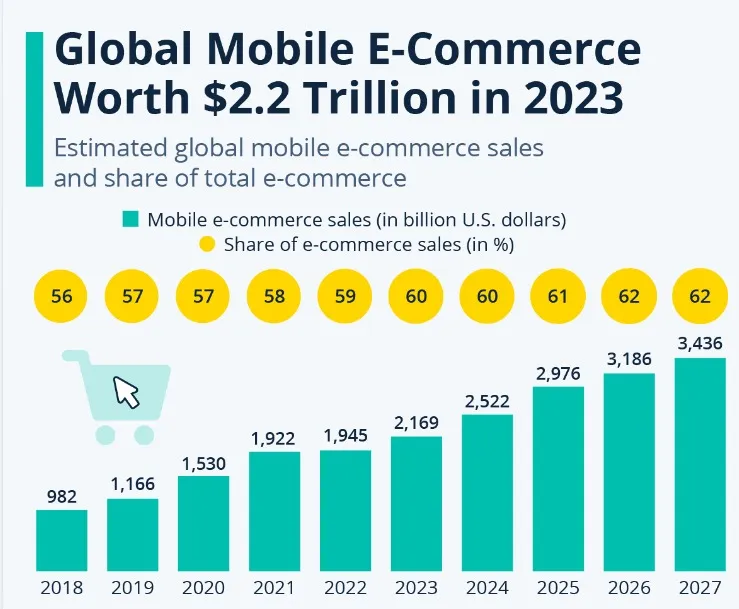
- Mobile e-commerce sales reached $2.2 trillion in 2023, constituting 60% of all e-commerce sales worldwide.
- The share of mobile e-commerce in total e-commerce sales is projected to increase to 62% by 2027, with sales expected to hit $3.4 trillion.
Advantages of Using M-Commerce
The following are the main advantages of employing m-commerce for e-commerce businesses:
Increased Revenue
- Mobile commerce revenues are expected to reach $3.56 billion towards the end of the year, indicating that this buying channel would certainly survive the epidemic.
- Customers are more likely to buy the product via their mobile devices due to a clearer checkout experience, tailored push notifications & seamless online transactions.
- Developing an app for your retail company is a must-have to stay in business in such a saturated industry if you want to satisfy client needs and create more money.
Improved Customer Service
- Customers are more likely to return to apps with intuitive navigation, social network integration for sharing feedback, and personalized push alerts.
- It’s much easier to capture your clients’ attention with a customer-friendly app by offering them a personalized buying experience and a streamlined user journey.
Additional Promotional Opportunities
- You may reach out to your direct customers and incorporate your offering with social media sites using an e-commerce app. You can get your audience to give feedback, engage with one another, and spread the news about your firm by encouraging them to do so.
- When your app gains momentum with your audience and goes viral, you may monetize it by inserting in-app advertisements to generate extra revenue.
Data that is Useful
- Mobile analytics may give you a lot of information about your customers’ browsing habits and behaviors.
- This information may be utilized to increase client retention and give your audience more unique and targeted offerings, such as targeted promotions and recommended products.
- You’ll be able to target your customers using suitable incentives, which are more likely to be converted thanks to this advanced mobile analytics.
FAQs
What's the growth forecast for mobile eCommerce?
Mobile eCommerce sales have surpassed $510 billion in 2023 and are expected to reach around $710 billion by 2025.
How much of online sales do mobile transactions account for?
In 2022, mobile sales constituted nearly 42% of total eCommerce sales in the US, with predictions suggesting an increase to 44% by 2025.
What's the difference between mobile commerce and eCommerce?
eCommerce refers to all online shopping activities, whereas mobile commerce specifically involves transactions through mobile devices like smartphones and tablets.
How many people are shopping on their mobiles?
By 2024, there are expected to be over 187 million active mobile shoppers in the US.
Do people prefer shopping on mobile or desktop?
Desktop currently leads in conversion rates at 3% compared to mobile's 2%. However, as smartphones continue to improve, the gap may narrow.
Which mobile shopping apps are the most popular?
Amazon Shopping and SHEIN lead the pack, with Amazon being the most used mobile commerce platform.
️ What role does social media play in mobile shopping?
Social media platforms like Instagram and TikTok have become vital in mobile commerce by enabling direct purchases through the app.
Quick Links:
- Instagram Statistics
- Video Marketing Stats
- TikTok Statistics
- Fascinating Online Shopping Statistics
- E-Learning Stats and Trends
- Blogging Statistics
- Pinterest Statistics
Conclusion: Mobile eCommerce Statistics 2026
As mobile shopping continues to grow, it’s becoming a huge part of how we buy things online.
By 2025, we’re looking at sales reaching $710 billion, which means that almost half of all online shopping will be done on our phones and tablets.
This shows that people really appreciate being able to shop anytime, anywhere. While desktop shopping currently has a slight edge in how many people actually end up buying things, the gap is closing fast.
With more and more people using their mobile devices to check out products and compare prices, it’s clear that the future of shopping is in the palm of our hands.
Mobile apps like Amazon and SHEIN are leading the way, making it super easy for us to find what we need and buy it on the go. So, it’s safe to say that mobile shopping isn’t just a trend—it’s the future of eCommerce.
Source: Tidio, Insider Intelligence, Statista, Forbes

![Jaw-Dropping E-commerce SEO Statistics, Facts and Figures Of [Year]](/_next/image?url=https%3A%2F%2Fcms.jitendra.co%2Fwp-content%2Fuploads%2F2025%2F06%2Fpexels-nataliya-vaitkevich-6214472-1.jpg&w=3840&q=75)

![Video SEO Statistics and YouTube SEO For [Year]](/_next/image?url=https%3A%2F%2Fcms.jitendra.co%2Fwp-content%2Fuploads%2F2025%2F06%2Fpexels-pixabay-270637-1.jpg&w=3840&q=75)
![Graphic Design Statistics, Insights and Trends Of [Year]](/_next/image?url=https%3A%2F%2Fcms.jitendra.co%2Fwp-content%2Fuploads%2F2025%2F06%2Fpexels-tranmautritam-251225-1.jpg&w=3840&q=75)