The cost of web scraping is rising. The complexity is rising. And the teams doing it are not complaining — they are paying.
65.8% of web scraping professionals boosted proxy usage and 58.3% saw spending rise year over year, driven by aggressive anti-bot systems.
That is a majority of practitioners spending more to do the same work they were doing last year for less. Anti-bot technology is improving faster than scraping tools, and the gap is showing up directly in operational budgets.
Anti-bot systems now use multiple detection vectors, behavioral analysis, advanced fingerprinting, and machine learning models.
As detection becomes more aggressive, the operational lift increases and teams often turn to managed services that specialize in evasion, browser realism, and correct session handling.
The scripts that worked reliably in 2024 are failing on sites they scraped for years. The target sites have not changed their content structure. They have changed their detection logic.
Reddit’s r/web scraping at https://www.reddit.com/r/webscraping/ has fresh threads this week on specific sites that recently upgraded their bot detection and what approaches are working to get back in.
The AI Extraction Shift That Is Coming
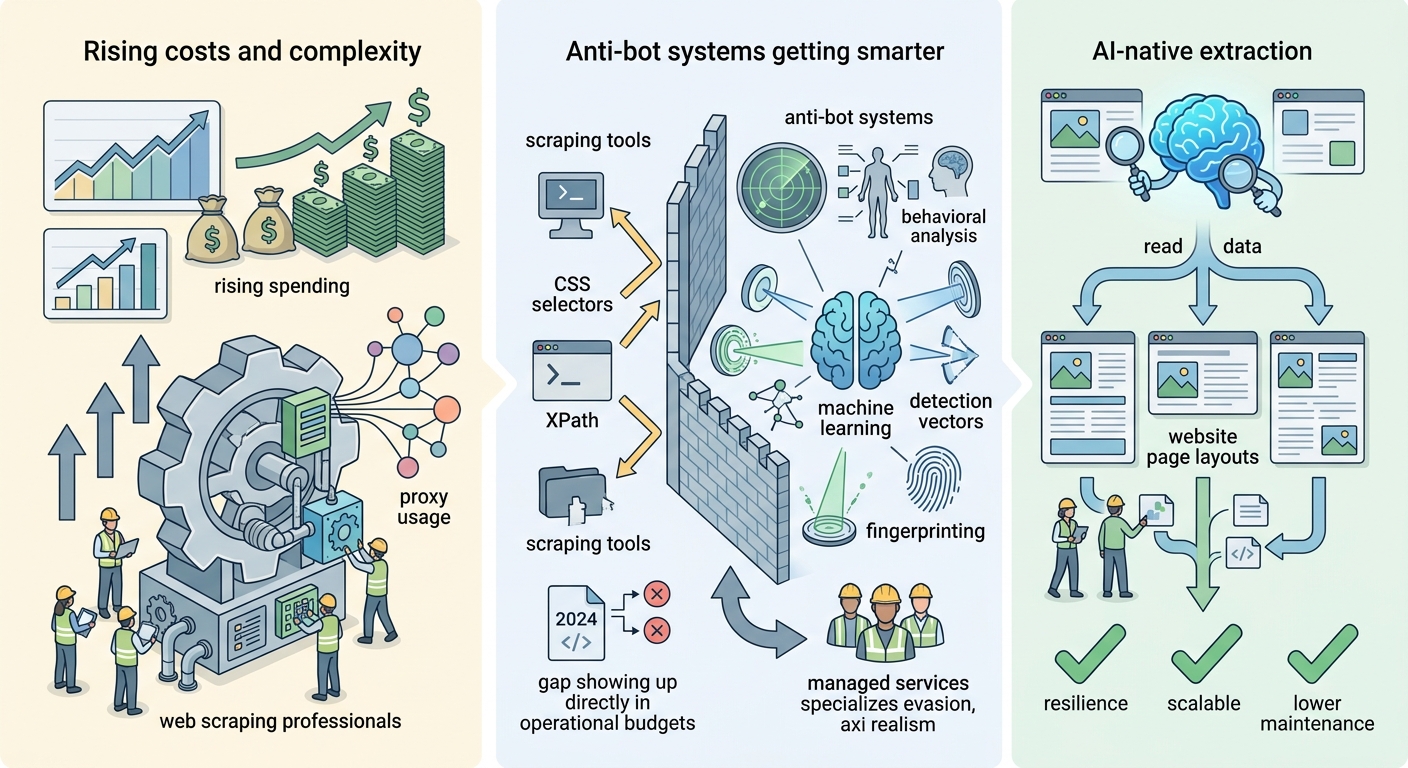
AI-driven extraction will mature quickly in 2026. As AI-native extractors become more reliable, more organizations will rely on natural-language-driven extraction instead of brittle selectors that break every time a website changes its HTML structure.
This is the change that will matter most over the next 18 months. Traditional scraping uses CSS selectors and XPath expressions that break whenever a website redesigns.
AI-native extraction reads the page the way a human would and finds the data regardless of how the HTML is structured. It is more resilient, requires less maintenance, and scales better across a diverse set of target sites.
X at https://x.com/search?q=AI+web+scraping+extraction+2026 has engineers sharing early results from AI-native extraction tools compared to traditional selector-based approaches. The resilience advantage is already visible in sites that change their HTML frequently.
Quora at https://www.quora.com/What-is-the-best-way-to-scrape-websites-in-2026 has updated answers from engineers who have tested both traditional and AI-native extraction approaches on the same targets.
Quick Links: