The best AI detector for most people in 2026 is Pangram, which made almost no false accusations in an independent University of Chicago study. GPTZero is the best pick for teachers, Originality.ai suits SEO and publishing teams, and Scribbr or QuillBot are the best free options. No detector is perfect, so treat every score as a signal, not proof.
Last updated: October 12, 2026. Prices checked on each tool’s official website the same week.
Best AI Detectors: Quick Picks
| Tool | Best for | Free option | Paid from (official) | Standout |
|---|---|---|---|---|
| Pangram | Lowest false positives | Free tier and 7-day trial | $20/month ($15/month billed annually) | Best results in the University of Chicago study |
| GPTZero | Teachers and students | 10,000 words a month | ₹599/month billed annually (India pricing) | Writing replay, now part of Superhuman (Grammarly) |
| Originality.ai | SEO agencies and publishers | 3 scans a day, 2,000 words each | $12.95/month billed annually | Full-site scans, fact checker, API |
| Copyleaks | Multilingual and enterprise use | Free checks on the website | $13.99/month billed annually | AI detection in 30+ languages, AI image detection |
| Winston AI | Schools and publishers | 2,000 credits for 14 days | $10/month billed annually | OCR for handwriting, image and deepfake detection |
| Turnitin | Universities | Through your institution only | Institutional pricing | Built into the tools schools already use |
| Grammarly AI Detector | Writers who already use Grammarly | Free web checker | Grammarly Pro $12/month billed annually | Explains flagged text and suggests rewrites |
| QuillBot AI Detector | Free quick checks | Free | Premium $8.33/month billed annually | Separates AI-generated from AI-refined text |
| Scribbr AI Detector | Students on a budget | Unlimited checks, 1,200 words each | Free | No sign-up needed |
| ZeroGPT | Low-cost bulk checks | Free | $8.99/month billed annually | Batch file uploads, PDF reports |
| Sapling | Short texts and developers | 2,000 characters per check | $12/month billed annually | Simple API for developers |
Sources: official pricing pages and help centers of each tool, checked October 2026. GPTZero showed India pricing from our location.
What Is the Most Accurate AI Detector?
Every AI detector says it is “99% accurate.” Those numbers come from the companies themselves, using their own test sets. So I looked for independent research instead.
The most useful recent test is a 2025 study by Brian Jabarian and Alex Imas at the University of Chicago Booth School of Business (Becker Friedman Institute). They built a dataset of about 2,000 human-written passages across six types of writing: blogs, consumer reviews, news articles, novels, restaurant reviews and résumés. Then they asked four popular AI models to write matching passages, and ran everything through three commercial detectors and one open-source model.
What they found:
- All three commercial tools (GPTZero, Originality.ai and Pangram) kept false positives below 1%. That means fewer than 1 in 100 human texts were wrongly flagged.
- Pangram had the lowest false positive rate, essentially zero across most settings.
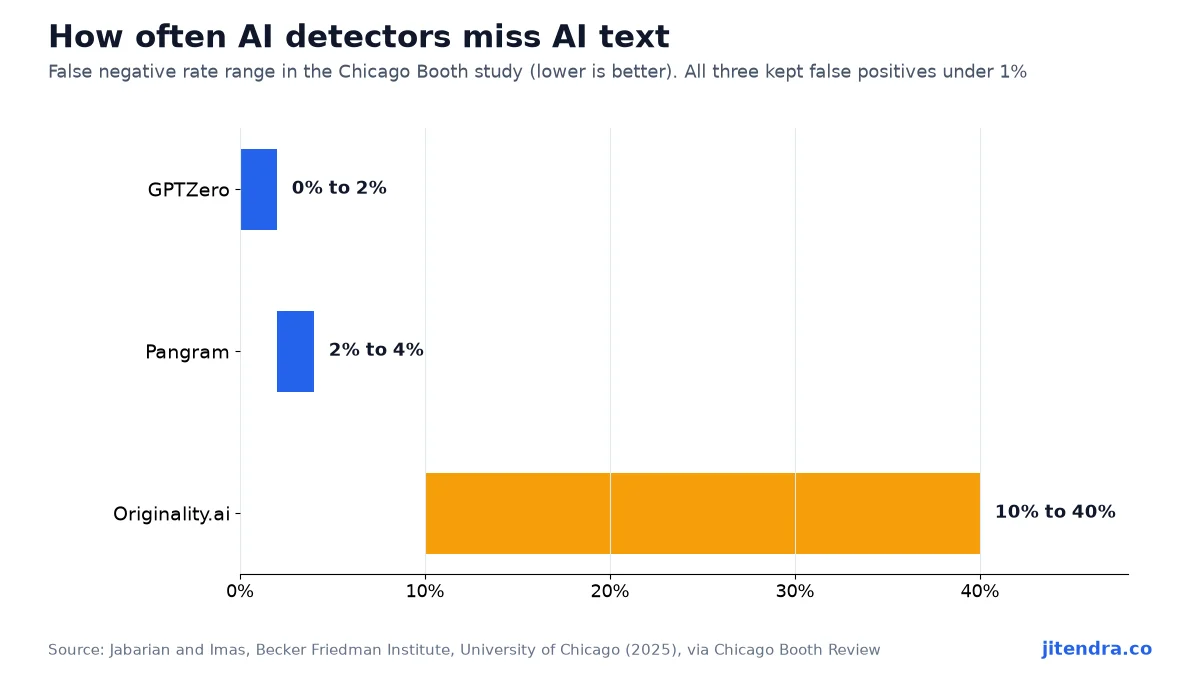
- False negatives (AI text missed) varied more. GPTZero missed about 0% to 2%, Pangram 2% to 4%, and Originality.ai 10% to 40%, depending on the AI model.
- The open-source RoBERTa detector performed close to random guessing in many cases. The authors called it “unsuitable for high-stakes applications.”
- Very short text is hard for everyone. All tools lost accuracy on passages under 50 words.
The researchers concluded that Pangram was the only detector that kept “policy-grade” performance across all four AI models they tested.
Why you should not trust “99% accurate” claims
Here are the accuracy claims each company makes on its own website. I am listing them so you can compare, but remember these are company claims, not independent results.
| Tool | Accuracy claim on its official site |
|---|---|
| Pangram | 99.98% accuracy |
| Winston AI | 99.87% accuracy |
| GPTZero | 99% accuracy |
| Copyleaks | Over 99% accuracy |
| Grammarly | 99% accuracy and ranked #1 on the RAID benchmark |
| QuillBot | 99% detection rate, citing RAID evaluations |
| ZeroGPT | 98.4% detection accuracy and under 1% false positives |
| Originality.ai | “Most accurate AI detector in third-party studies” |
| Scribbr | Says no AI detector can provide complete accuracy |
Sources: each tool’s official website, October 2026.
Notice that Grammarly, QuillBot and others all point to the same public benchmark, called RAID, and more than one claims to rank first. Benchmarks change with each model update, so a “#1” badge can be true on one date and outdated a month later.
Why AI Detectors Get It Wrong
AI detection is a game of probabilities. A detector does not “know” who wrote a text. It looks for patterns that are common in AI writing, such as very predictable word choices and an even rhythm. Human writing can show those patterns too, especially when it is short, formal or written by someone writing in a second language.
Three findings shaped how careful people are with these tools today:
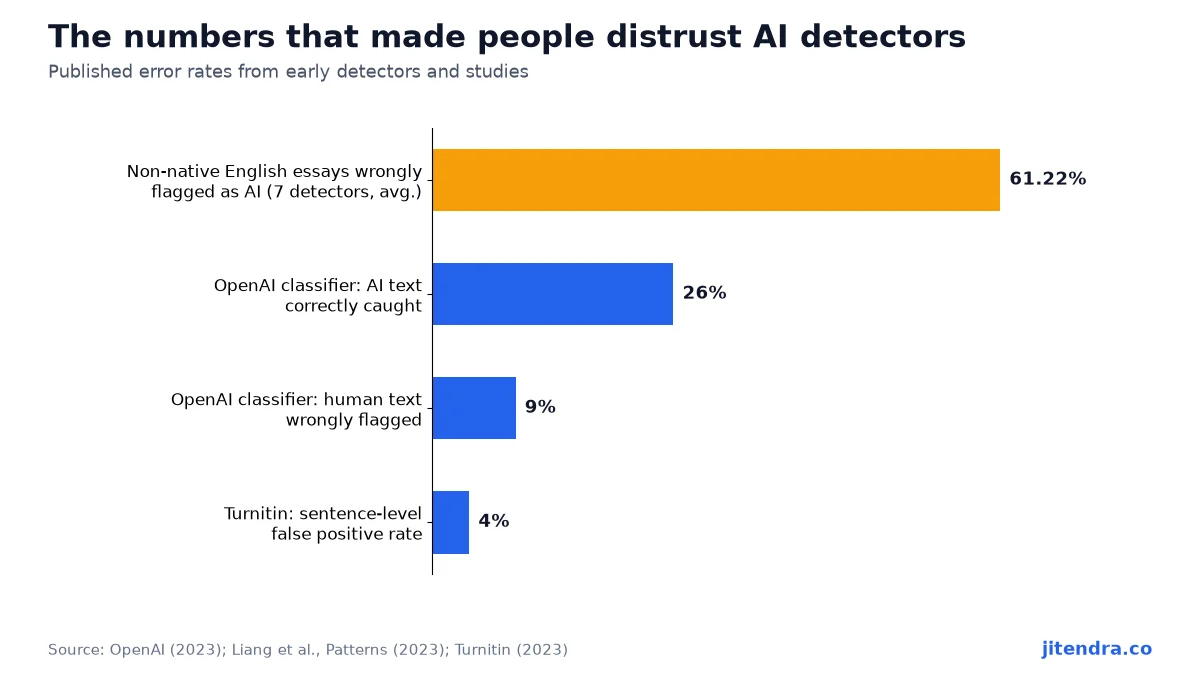
- OpenAI shut down its own detector. OpenAI released an AI text classifier in January 2023. In its own tests, it correctly caught only 26% of AI-written text and wrongly flagged 9% of human text. OpenAI retired it on July 20, 2023, citing its low accuracy.
- Non-native English writers get flagged more. A 2023 Stanford study by Liang and colleagues, published in the journal Patterns, ran essays through seven detectors. On average, they wrongly labeled 61.22% of essays written by non-native English speakers for the TOEFL exam as AI-generated.
- Even Turnitin reports sentence-level mistakes. Turnitin says its document-level false positive rate is under 1% for documents with 20% or more AI writing. But its sentence-level false positive rate is around 4%. Turnitin now shows an asterisk instead of a number when it detects 1% to 19% AI writing, because low scores are less reliable.
The good news is that detectors have improved a lot since 2023, as the University of Chicago study shows. The bad news is that “humanizer” tools that rewrite AI text to dodge detection are improving too. The researchers called it a “technical arms race.”
The 11 Best AI Detector Tools in 2026
Here is each tool in detail, with official pricing and features. I have not run my own lab test, so I lean on published research and each company’s own documentation, and I tell you which is which.
1. Pangram: Best overall for low false positives
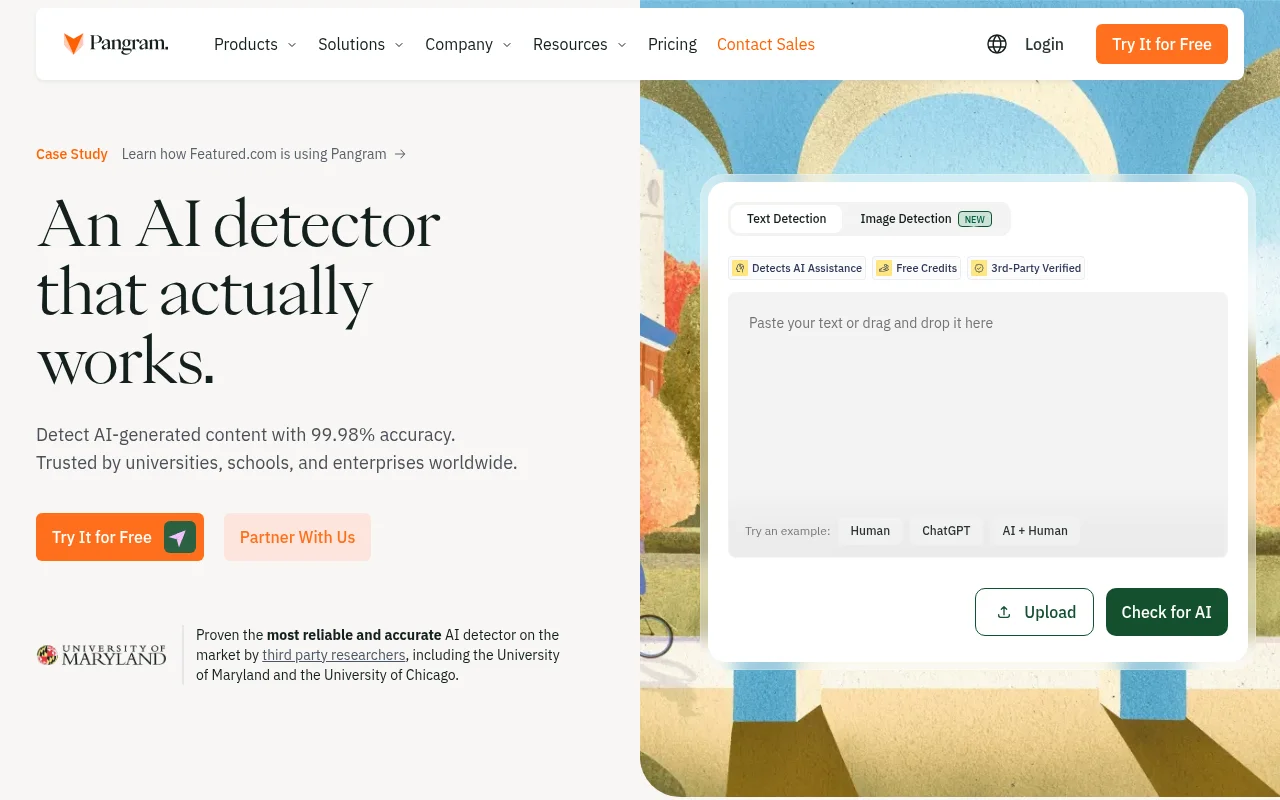
Pangram is a newer detector, but it has quickly built a reputation with researchers. It performed best in the University of Chicago study, with false positives close to zero, and it says its results have also been verified by researchers at the University of Maryland.
Key features
- Detects AI text from major models, with per-model accuracy published on its site
- AI image detection
- Similarity (plagiarism-style) checking on every scan
- Browser extension, Google Docs and Gmail integrations
- File upload with OCR for scanned documents
- Developer API
Pricing (official)
| Plan | Price | What you get |
|---|---|---|
| Free | $0 | Basic scans |
| Individual | $20/month, or $180/year | 300,000 words a month, 100 image scans, 7-day free trial |
| Professional | $65/month | 5x more words and image scans, plus $200 of API credits each month |
| Team | $20 per seat per month (from 2 seats) | Admin dashboard and unified billing |
My take: If you need to make a decision about a person, such as a student or a freelance writer, a false accusation is the worst possible mistake. That is why Pangram is my top pick. It is the tool with the strongest independent evidence of not flagging human writing.
2. GPTZero: Best for teachers and students
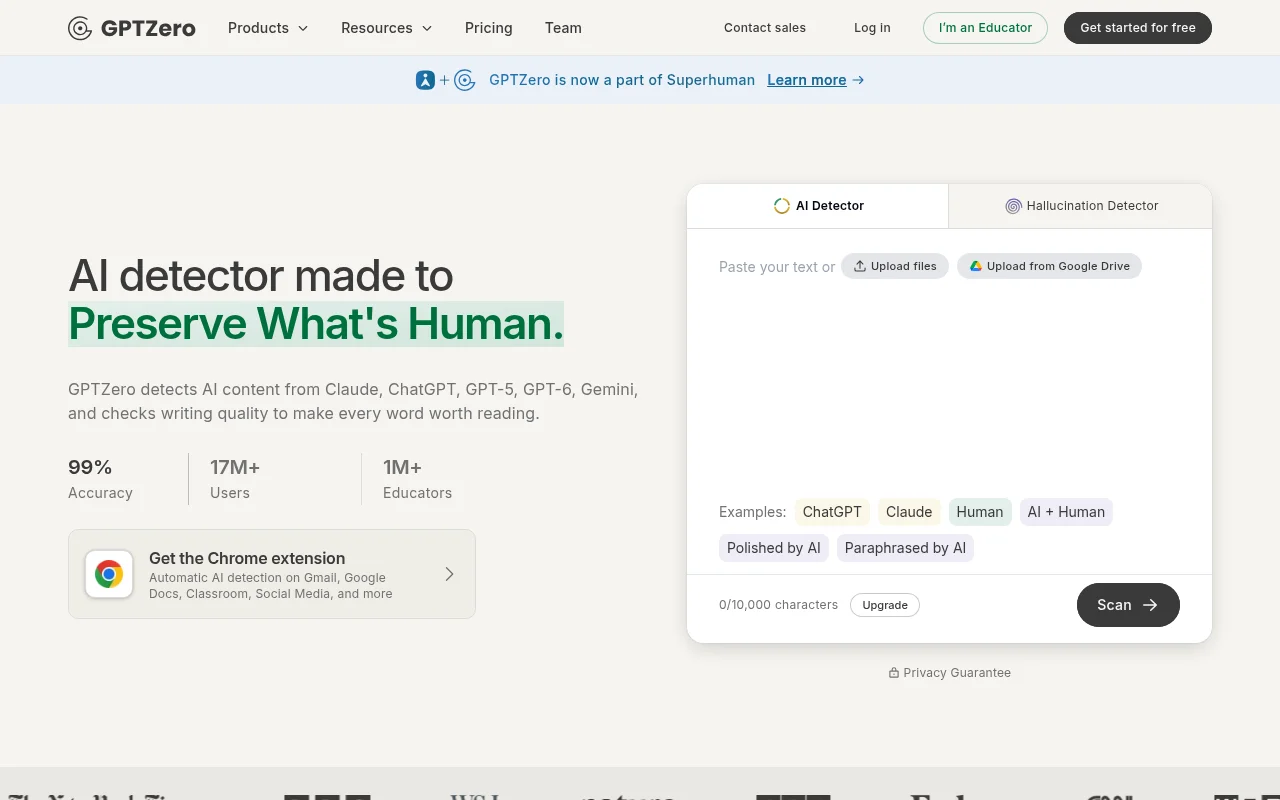
GPTZero is one of the best-known AI detectors and was built with education in mind. Its homepage says it has more than 17 million users and over 1 million educators, and it is an official AI detector partner of the American Federation of Teachers.
There is big news here. Superhuman, the company formerly called Grammarly, agreed to acquire GPTZero on June 23, 2026, and confirmed on September 30, 2026 that GPTZero is now part of Superhuman. GPTZero remains available as a standalone product, and its tools are being added to Superhuman Go.
Key features
- Sentence-level highlighting and mixed AI and human detection
- Writing replay and authorship tools that show how a document was written
- Hallucination and fake-citation detection
- Plagiarism checker
- Chrome extension and LMS integrations (Canvas, Google Classroom)
- API in 17 programming languages
Pricing (official, as shown in India)
| Plan | Price | Words per month |
|---|---|---|
| Free | ₹0 | 10,000 words, basic scan |
| Premium | ₹599/month billed annually | 300,000 words |
| Professional | ₹1,199/month billed annually | 500,000 words, up to 250 files at once |
GPTZero says annual billing saves 45%. Its pricing page shows local currency, so readers outside India will see different prices.
My take: For a teacher, the score is only the start. GPTZero’s writing replay and source checks give you something to talk about with the student, which is a fairer process than a single percentage.
3. Originality.ai: Best for SEO agencies and publishers
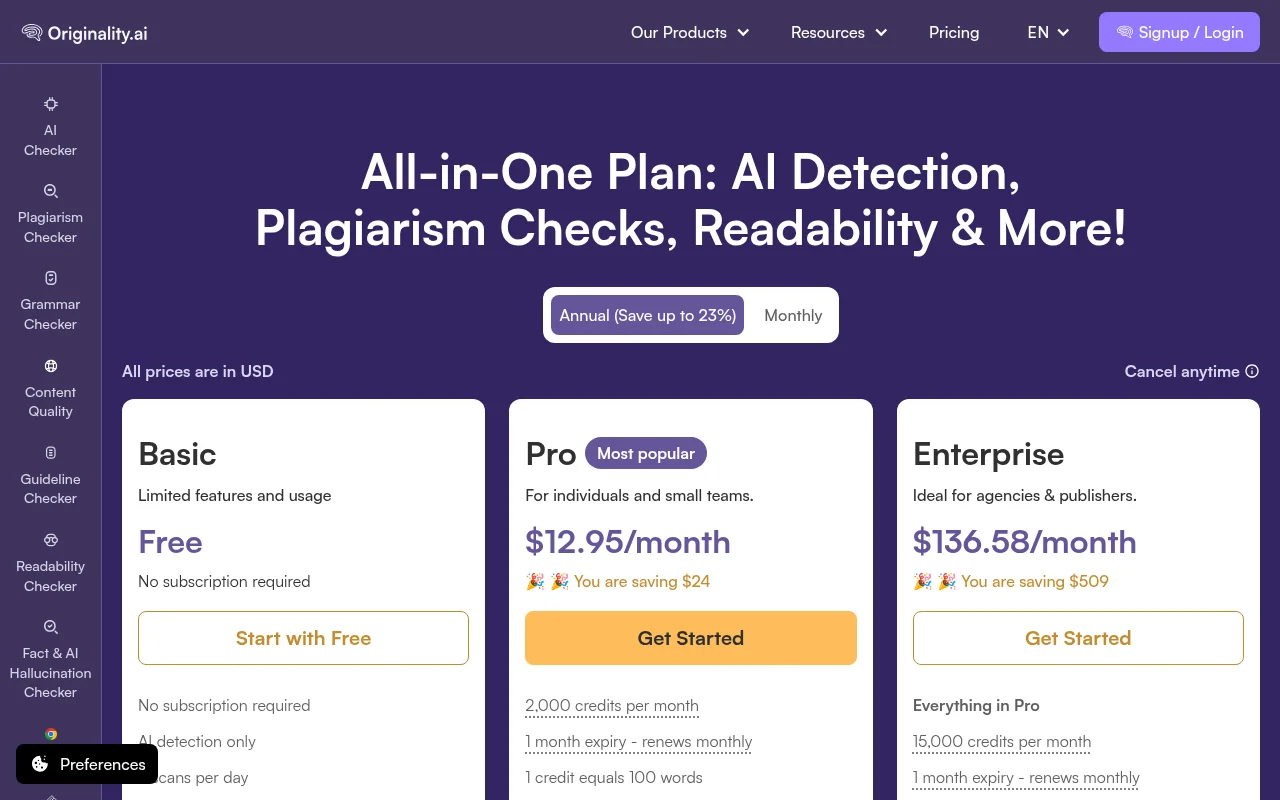
Originality.ai was built for people who buy and publish content: SEO agencies, niche site owners and editors who work with freelancers. It combines AI detection with plagiarism checks, readability scoring and a fact-checking aid.
Key features
- AI detection plus plagiarism, grammar and readability checks in one scan
- Full-site scans: enter a URL and scan a whole website
- Team management and scan tagging
- Chrome extension and API (Enterprise)
- Shareable reports
Pricing (official)
| Plan | Price | Credits |
|---|---|---|
| Free | $0 | 3 scans a day, up to 2,000 words each |
| Pro | $12.95/month billed annually | 2,000 credits a month (1 credit = 100 words) |
| Enterprise | $136.58/month billed annually | 15,000 credits a month, API access, 365-day scan history |
My take: In the University of Chicago study, Originality.ai rarely flagged human writing but missed more AI text than Pangram or GPTZero. For an SEO team, that trade-off is often acceptable. You mainly want to avoid accusing a good writer, and site-wide scans save real time when you audit a content library.
4. Copyleaks: Best for multilingual and enterprise teams
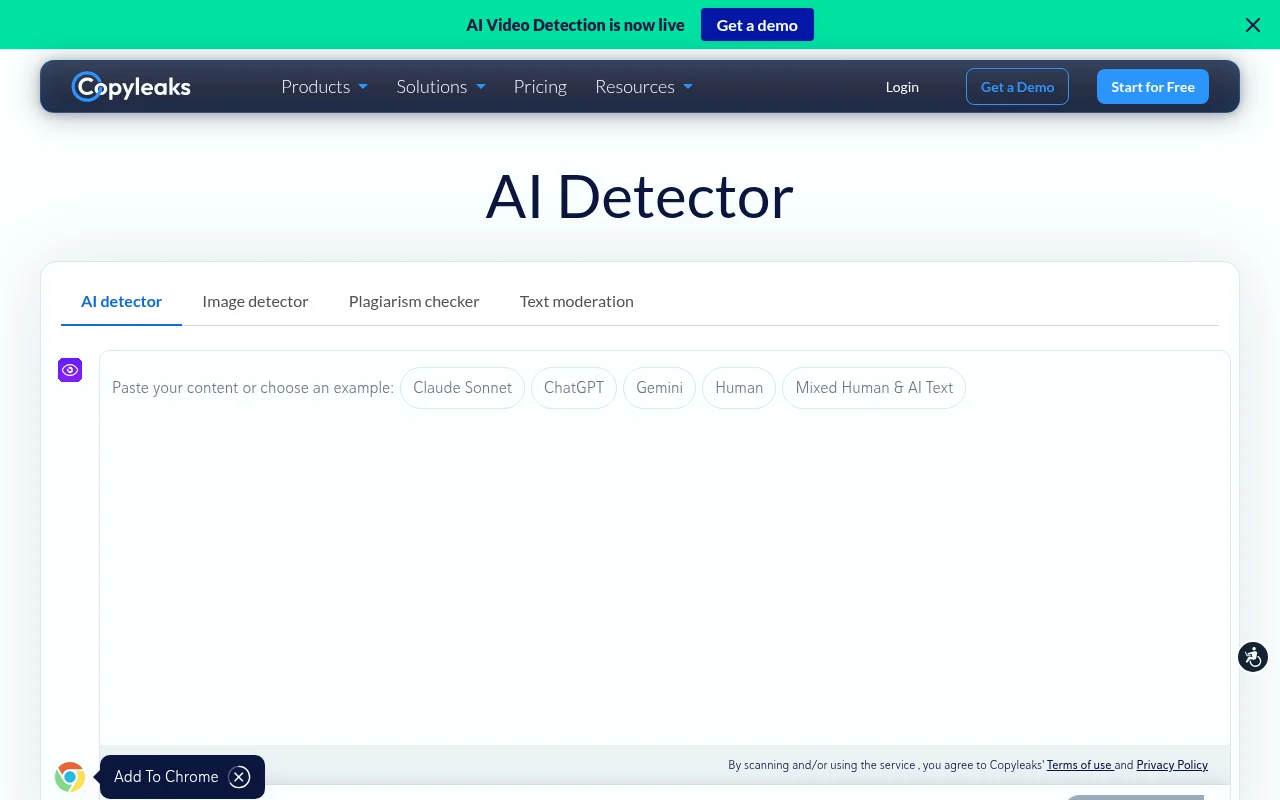
Copyleaks is a long-standing plagiarism company that added AI detection early. Its strength is breadth: it supports AI detection in more than 30 languages and plagiarism detection in more than 100.
Key features
- AI detection and plagiarism detection in a single report
- AI image detection
- Browser extension and Google Docs add-on
- Scan whole websites (Pro)
- Cross-language translation detection (Pro)
Pricing (official)
| Plan | Price | Credits |
|---|---|---|
| Personal | $13.99/month ($167.88 billed annually) | 1,200 credits: up to 300,000 words or 1,200 images |
| Pro | $74.99/month ($899.88 billed annually) | 12,000 credits: up to 3,000,000 words, 25 user seats |
My take: If your content team writes in Hindi, Spanish or German as well as English, Copyleaks is one of the few tools that clearly lists that coverage.
5. Winston AI: Best for schools that need OCR and image checks
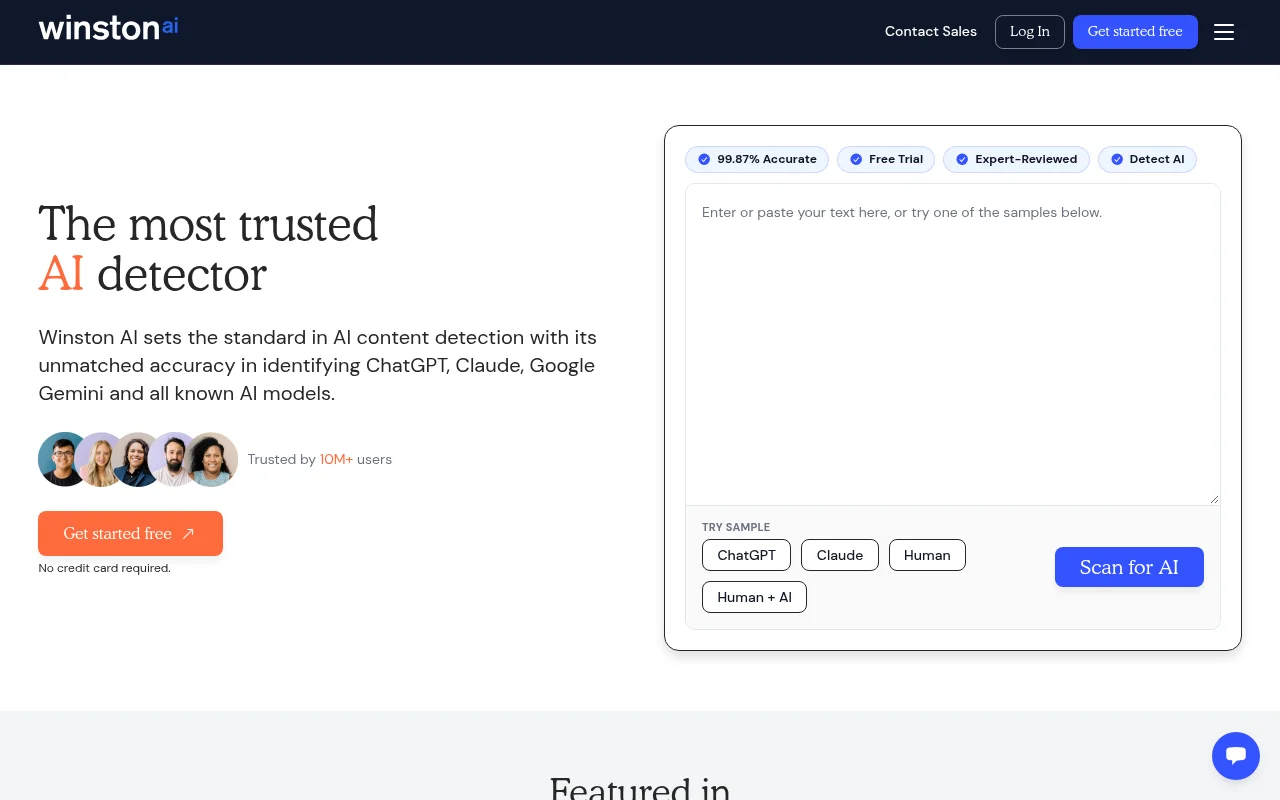
Winston AI targets education and publishing. A practical feature is OCR: you can scan a photo of handwritten or printed text. It also detects AI-generated images and deepfakes.
Key features
- AI text detection for major models
- AI image and deepfake detection
- OCR for handwriting and printed pages
- Plagiarism detection (Advanced plan and up)
- Shareable PDF reports and team members
Pricing (official, USD)
| Plan | Monthly billing | Annual billing | Credits |
|---|---|---|---|
| Free | $0 | n/a | 2,000 credits for 14 days |
| Essential | $18/month | $120/year ($10/month) | 100,000 a month |
| Advanced | $29/month | $192/year ($16/month) | 200,000 a month |
| Elite | $49/month | $312/year ($26/month) | 500,000 a month |
Source: Winston AI Help Center.
My take: Winston’s 99.87% claim is its own. It has not been part of the independent study I cited above, so judge it on its features, which are strong for schools.
6. Turnitin: Best for universities
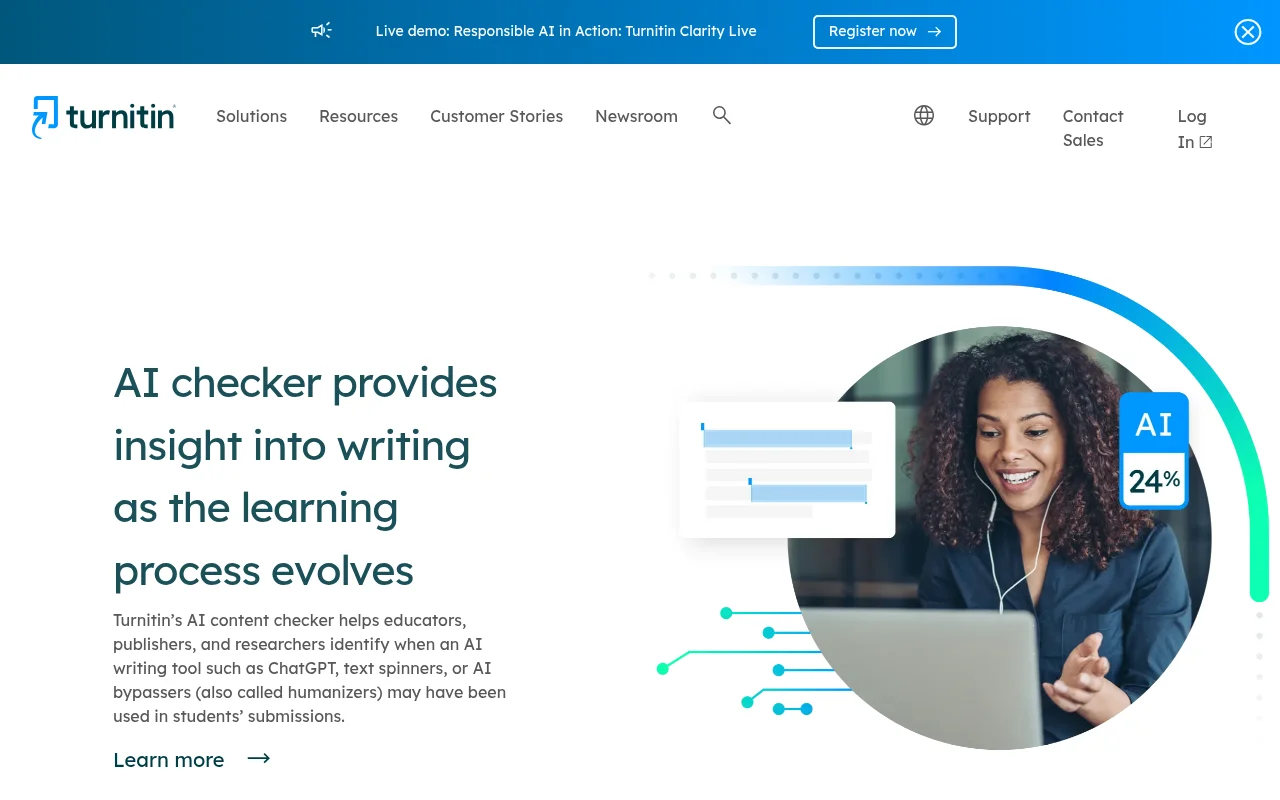
Turnitin is the tool most students will meet whether they like it or not. It says more than 16,000 institutions worldwide partner with it. AI writing detection sits inside its similarity reports, and its newer Turnitin Clarity product shows the writing process behind a submission.
Key facts
- Sold to institutions, not individuals. There is no public price list.
- Document-level false positive rate under 1% for documents with 20% or more AI writing, according to Turnitin.
- Sentence-level false positive rate around 4%, according to Turnitin.
- AI scores from 1% to 19% are shown with an asterisk instead of a number.
My take: If you are a student and Turnitin flags you, ask to see the full report and show your drafts and version history. Ask how the score was used, because a percentage alone should never decide the outcome.
7. Grammarly AI Detector: Best for people who already use Grammarly
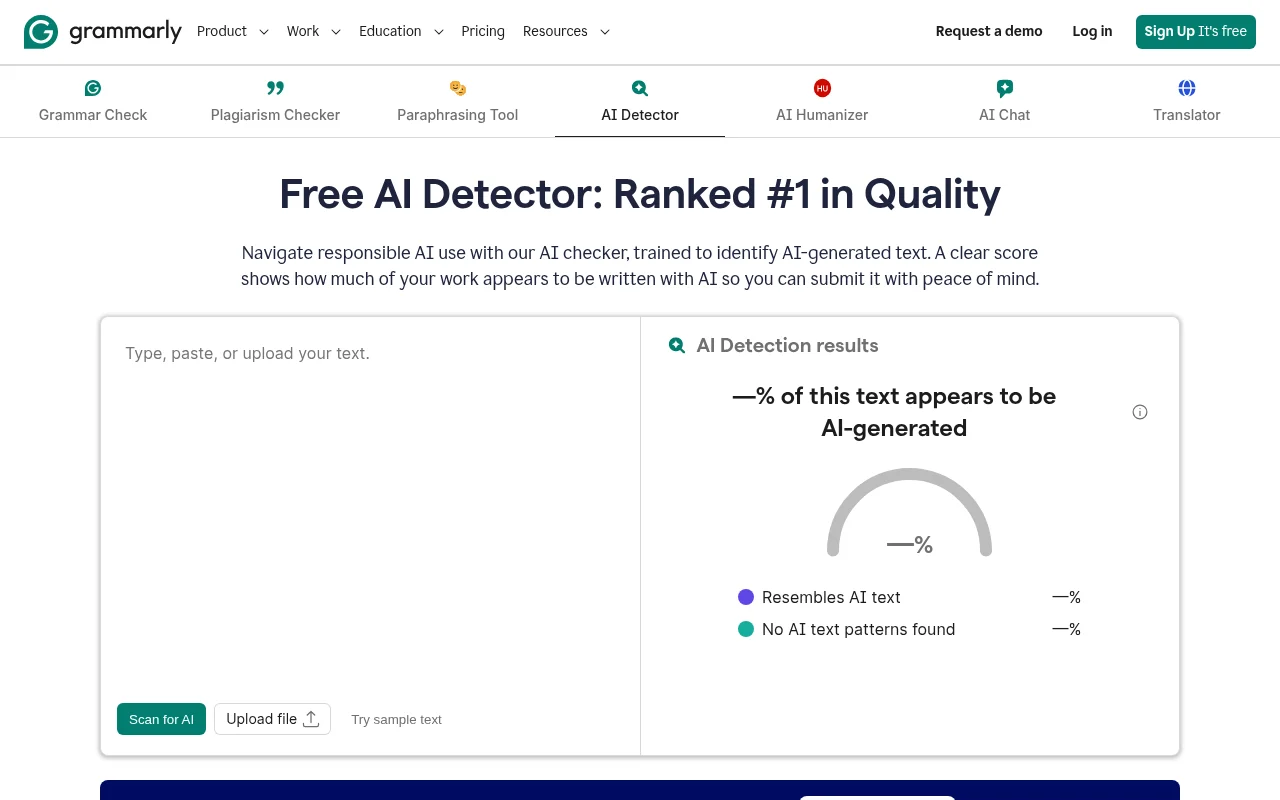
Grammarly offers a free AI detector on its website. It gives a percentage score and, unlike most free tools, explains why a phrase looks AI-written and offers a one-click rewrite. Grammarly is now part of Superhuman, which also owns GPTZero.
Key features
- Free web-based checker with a clear score
- Explanations for flagged phrases
- Works with Grammarly’s plagiarism checker, citation tools and Authorship
- Grammarly says it ranks #1 on the RAID benchmark
Pricing (official): The web detector is free. Grammarly Pro costs $12 per member per month billed annually ($144 a year) or $30 billed monthly, according to Grammarly Support. In India, Grammarly shows a separate Plus plan at ₹392 per member per month billed annually.
My take: Grammarly’s Authorship feature is more useful to an honest writer than any detector. It records how a document was written, which is real evidence if you are ever questioned.
8. QuillBot AI Detector: Best free detector for quick checks
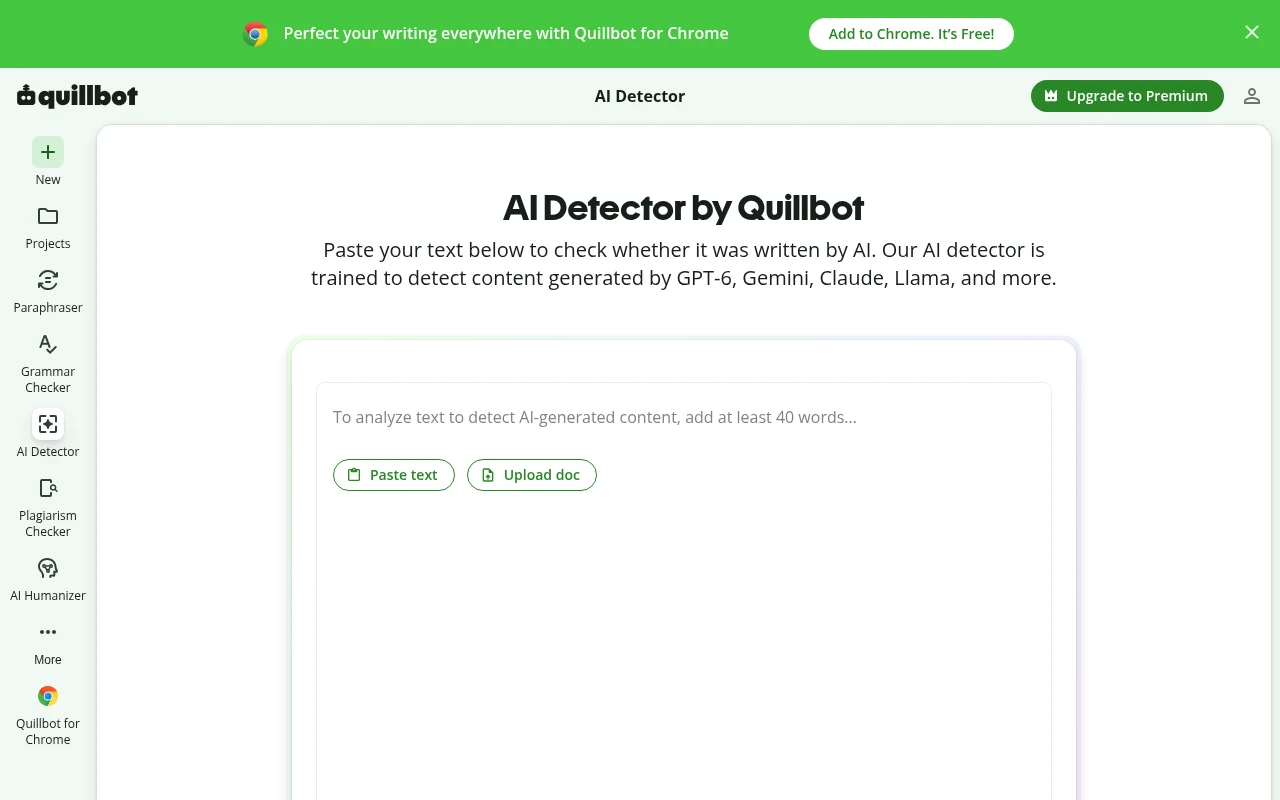
QuillBot’s AI detector is free. It needs at least 80 words and separates text into AI-generated, AI-refined and human-written, which is helpful because a lot of writing today is “human plus AI editing.”
Key features
- Free, no word fee
- Labels AI-generated, AI-refined and human-written text
- Multilingual support and downloadable reports
- Chrome extension
Pricing (official): The detector is free. QuillBot Premium, which unlocks its other writing tools, costs $8.33 a month billed annually ($99.95 a year), $39.95 every three months, or $19.95 billed monthly, according to QuillBot’s own FAQ.
My take: I like that QuillBot’s page says plainly that scores are “signals, not verdicts.” That is the right attitude for any free checker.
9. Scribbr AI Detector: Best free option for students
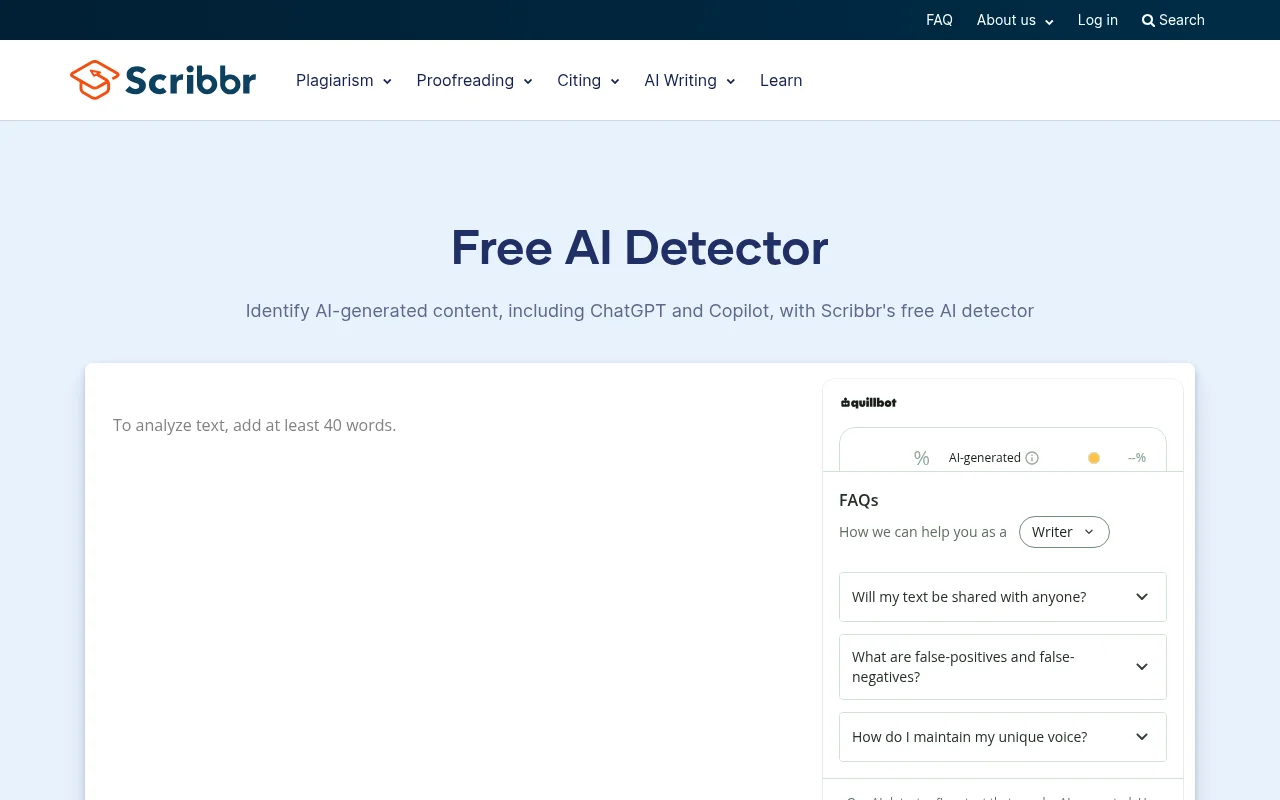
Scribbr is known for proofreading and citation tools for students. Its AI detector is free with unlimited checks of up to 1,200 words each, and you do not need an account.
Key features
- Unlimited free checks, 1,200 words per check
- No sign-up required
- Paragraph-level feedback
- Separates AI-generated, AI-refined and human-written text
- Supports languages including German, French and Spanish
Pricing: Free.
My take: Scribbr is honest about limits. Its own page says no AI detector can provide complete accuracy. For a student checking their own essay before submission, that is enough.
10. ZeroGPT: Best budget pick for bulk checks
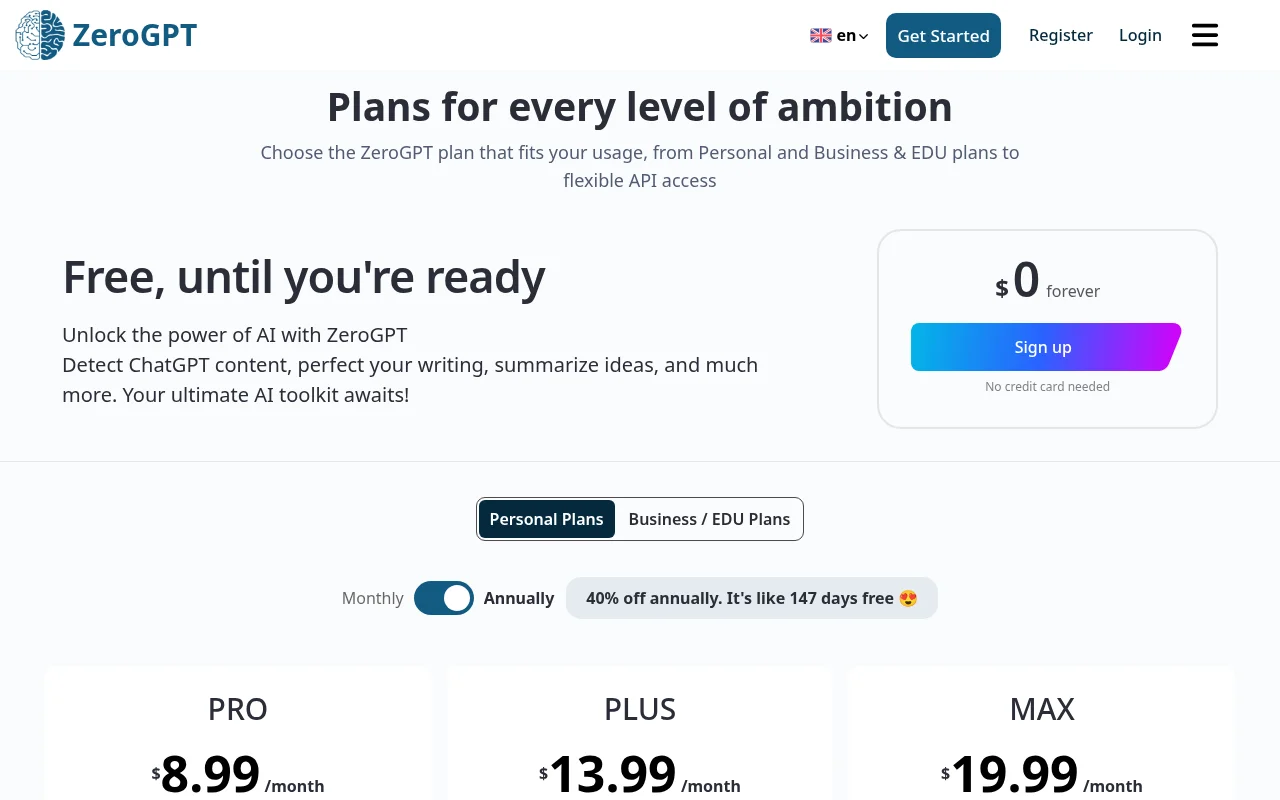
ZeroGPT is a popular free detector with a low-cost paid tier. Paid plans add batch file uploads, PDF reports and larger character limits, plus a bundle of writing tools.
Pricing (official)
| Plan | Annual billing | Monthly billing | AI detection limit |
|---|---|---|---|
| Free | $0 | $0 | Basic |
| Pro | $8.99/month ($107.88/year) | $14.99/month | 100,000 characters per check, 50 batch files |
| Plus | $13.99/month ($167.88/year) | $21.99/month | 100,000 characters, 60 batch files |
| Max | $19.99/month ($239.88/year) | $30.99/month | 150,000 characters, 75 batch files |
My take: ZeroGPT claims 98.4% accuracy and under 1% false positives, but those are its own figures. I would use it for quick, low-stakes checks, not to judge a person.
11. Sapling: Best for short texts and developers
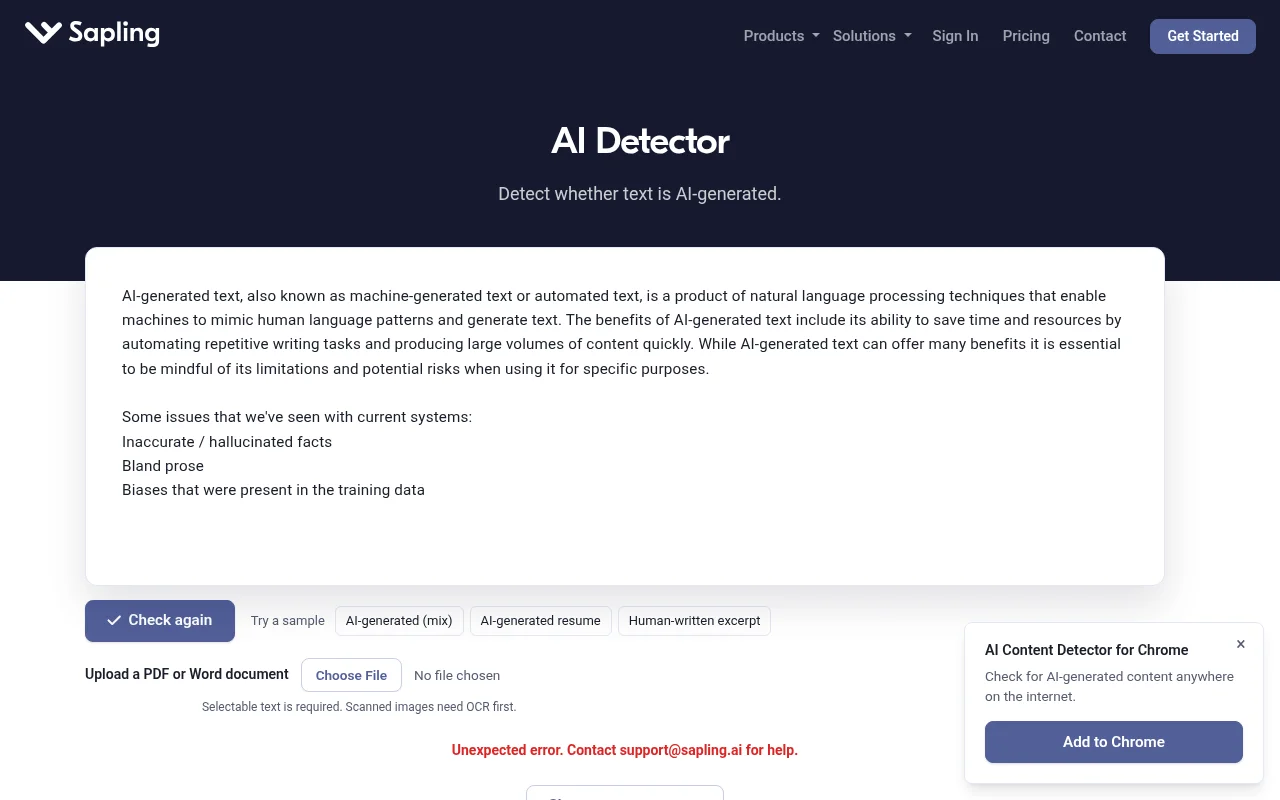
Sapling is a writing assistant for business teams that also offers an AI detector and a metered API. It says plainly that its detector “becomes much more accurate after 50 or so words” and that false positives and negatives will happen.
Pricing (official)
| Plan | Price | AI detector limit |
|---|---|---|
| Free | $0 | 2,000 characters per check |
| Pro | $25/month, or $12/month billed annually | 100,000 characters per check |
| Enterprise | From $15 per seat per month, 10-seat minimum | 100,000 characters per check |
| API | Usage-based, $5 minimum | For developers |
Supported languages include English, Spanish, Portuguese, French, German and Japanese.
AI Detector Pricing Compared
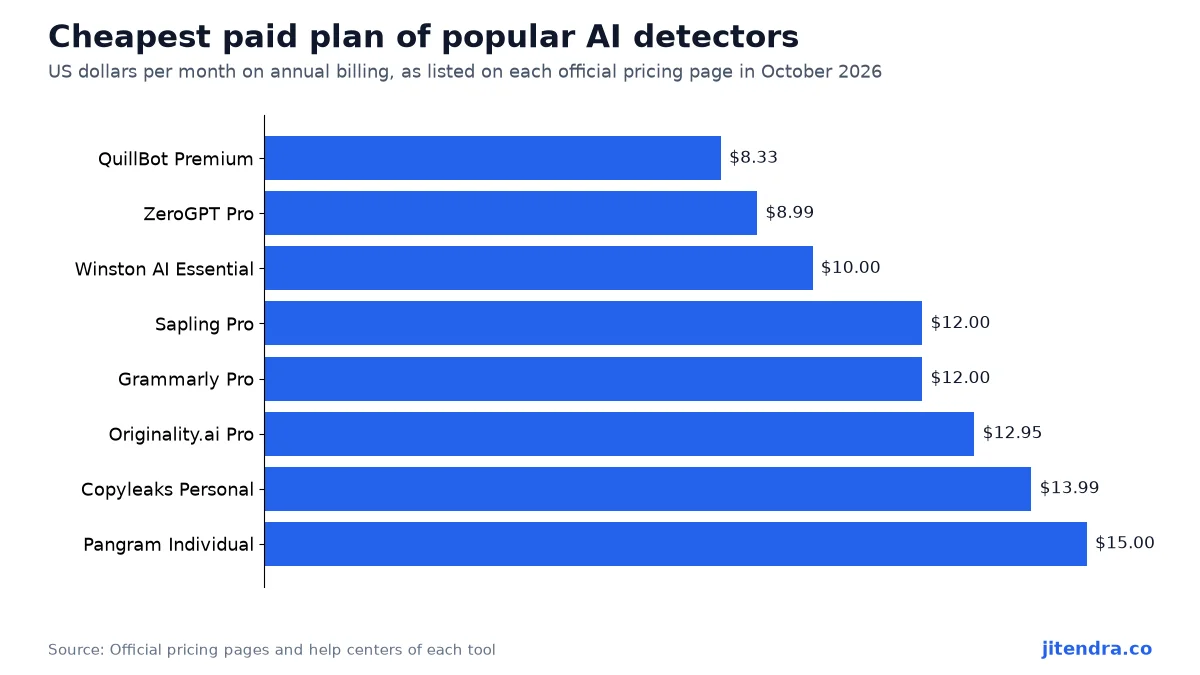
Here is the cheapest paid plan of each tool, on annual billing, in US dollars.
| Tool | Cheapest paid plan | Price per month (annual billing) | Monthly billing |
|---|---|---|---|
| QuillBot | Premium | $8.33 | $19.95 |
| ZeroGPT | Pro | $8.99 | $14.99 |
| Winston AI | Essential | $10 | $18 |
| Grammarly | Pro | $12 | $30 |
| Sapling | Pro | $12 | $25 |
| Originality.ai | Pro | $12.95 | Shown on its site |
| Copyleaks | Personal | $13.99 | Shown on its site |
| Pangram | Individual | $15 | $20 |
| GPTZero | Premium | ₹599 in India | Shown on its site |
| Turnitin | Institutional | Not public | Not public |
| Scribbr | Free | $0 | $0 |
Which AI Detector Should You Use?
- You are a teacher: GPTZero or Turnitin (if your school has it). Use writing replay or version history before you act on any score.
- You are a student checking your own work: Scribbr or QuillBot for free. If you get flagged unfairly, keep your drafts and Google Docs history.
- You run an SEO agency or publish content: Originality.ai for site-wide scans, or Pangram if false accusations against writers are your biggest worry.
- You work in several languages: Copyleaks.
- You need an API: Pangram, Originality.ai, GPTZero, Copyleaks and Sapling all offer one.
- You want the lowest error rate on human writing: Pangram, based on current independent research.
Do AI Detectors Matter for SEO?
This is the question I get most from bloggers and agency owners. My short answer: Google does not use a public “AI detector” score to rank pages, and you should not chase a “0% AI” score for SEO.
Google Search Central’s guidance from February 2023 says Google rewards high-quality content “however it is produced.” What Google penalizes is low-value content made mainly to manipulate rankings. Since March 2024, its spam policies call this “scaled content abuse,” and it applies whether the pages are written by AI, humans or both.
So here is how I use AI detectors in an SEO workflow:
- As a quality filter for freelance content. A very high AI score on a paid article is a reason to look closer. It is not proof by itself.
- To find thin pages at scale. Full-site scans can surface pages that were mass-produced and never edited.
- Never as the final judge. I read the content. Does it add experience, data or a view you cannot get elsewhere? That is what ranks.
With so much AI-assisted content being published now, standing out matters more than ever. My blogging statistics page shows how crowded the content space has become.
If you want to go deeper on how AI is changing search itself, listen to my conversation with Liam Quirk on the new rules of ChatGPT SEO and my episode on how to rank inside ChatGPT AI search. For a broader view of what makes content trustworthy, my interview with Cyrus Shepard is worth your time. And if you want free tools beyond detectors, see my list of the best free AI apps.
How to Use an AI Detector Fairly
- Check long enough text. Most tools are unreliable under 50 to 80 words.
- Run two different detectors. If they disagree, treat the result as unclear.
- Look at highlighted sentences, not just the total. One AI-polished paragraph can push the score up.
- Ask for drafts and history. Version history is stronger evidence than any score.
- Be extra careful with non-native English writers. Research shows they are flagged far more often.
- Never punish someone on a score alone. Several detector companies say this themselves.
AI Detector vs Plagiarism Checker: What Is the Difference?
People often mix these two up, but they answer different questions.
| AI detector | Plagiarism checker | |
|---|---|---|
| Question it answers | Was this text likely written by AI? | Was this text copied from an existing source? |
| How it works | Looks for statistical patterns common in AI writing | Compares the text against web pages, papers and databases |
| What the result looks like | A probability or percentage | Matched passages with links to the original sources |
| Can it prove anything? | No, it gives a likelihood | It shows the exact matching source |
A text can be 100% AI-written and still pass a plagiarism check, because AI usually writes new sentences rather than copying old ones. That is why tools like Originality.ai, Copyleaks, Winston AI and Grammarly bundle both checks together. If you edit or buy content, run both.
What to Do If an AI Detector Flags Your Writing
False positives happen, and they can be stressful. If your own work is flagged, here is what I suggest:
- Stay calm and ask for the report. Find out which tool was used and which sentences were highlighted.
- Show your process. Version history in Google Docs or Microsoft Word, early drafts, notes and research links are strong evidence that you wrote the work.
- Use a writing-process tool next time. Grammarly Authorship and GPTZero’s writing replay record how a document was written, which is better evidence than any score.
- Point to the research. Independent studies, including the Stanford study on non-native English writers, show detectors can be wrong. Several detector companies say a score should not be used alone.
- Offer to discuss the work. Being able to explain your ideas and sources in your own words is often the quickest way to settle it.
How I Chose These AI Detectors
I did not run a private lab test, and I will not pretend I did. Instead, I used:
- Independent research, mainly the 2025 University of Chicago study, plus Stanford’s 2023 study on bias and Turnitin’s own published error rates.
- Official pricing and feature pages, checked in October 2026, with screenshots from each official website.
- My experience as an SEO consultant reviewing content from writers and agencies, which shapes the “best for” picks.
I left out tools that have shut down or no longer sell AI detection as a main product, such as OpenAI’s own classifier.
FAQs About AI Detectors
What is the most accurate AI detector in 2026?
Based on independent research, Pangram. In a 2025 University of Chicago study of about 2,000 passages, it had a false positive rate of essentially zero and was the only tool that kept “policy-grade” performance across four AI models. GPTZero and Originality.ai also kept false positives under 1%.
Is there a free AI detector that works?
Yes. Scribbr offers unlimited free checks up to 1,200 words each, QuillBot’s detector is free, GPTZero gives 10,000 free words a month, and Originality.ai allows 3 free scans a day. Free tools are fine for self-checks, not for judging others.
Can AI detectors be wrong?
Yes. Every detector makes mistakes. A 2023 Stanford study found seven detectors wrongly flagged 61.22% of essays by non-native English speakers as AI. Turnitin reports a sentence-level false positive rate of around 4%.
Can Turnitin detect ChatGPT?
Turnitin includes AI writing detection in its reports and says its document-level false positive rate is under 1% for documents with at least 20% AI writing. It shows an asterisk instead of a score when it detects 1% to 19% AI writing, because low scores are less reliable.
Does Google penalize AI-generated content?
Not because it is AI-written. Google says it rewards helpful content however it is produced. It does act against “scaled content abuse,” which means mass-produced pages made mainly to manipulate rankings, whether by AI or humans.
Is GPTZero owned by Grammarly?
Yes, in effect. Superhuman, the company formerly called Grammarly, announced it would acquire GPTZero on June 23, 2026, and confirmed the deal on September 30, 2026. GPTZero is still available as a standalone tool.
How many words does an AI detector need?
Most detectors become more reliable after about 50 to 80 words. QuillBot needs at least 80 words, and Sapling says its detector gets much more accurate after about 50 words. Very short texts are hard for every tool.
Can AI detectors catch paraphrased or “humanized” AI text?
Sometimes. Some tools, such as QuillBot and Scribbr, label text as “AI-refined,” and several vendors say they detect paraphrasing tools. But the University of Chicago researchers describe detection as an arms race with humanizer tools, so no detector catches every rewrite.
Sources
- Jabarian, B. and Imas, A., “Artificial Writing and Automated Detection,” Becker Friedman Institute, University of Chicago (2025)
- Chicago Booth Review, “Do AI Detectors Work Well Enough to Trust?” (December 2, 2025)
- Liang, W. et al., “GPT detectors are biased against non-native English writers,” Patterns (2023)
- OpenAI, “New AI classifier for indicating AI-written text” (January 2023, updated July 20, 2023)
- Turnitin, “Understanding the false positive rate for sentences of our AI writing detection capability” (June 2023) and Turnitin homepage
- Superhuman blog, “GPTZero is Now Part of Superhuman” (September 30, 2026); Superhuman acquisition announcement (June 23, 2026)
- Pangram official homepage and pricing page
- GPTZero official homepage and pricing page
- Originality.ai official pricing page
- Copyleaks official AI detector and pricing pages
- Winston AI Help Center, “How much does Winston AI cost?”
- Grammarly AI Detector page and Grammarly Support, “How much does Grammarly Pro cost?”
- QuillBot AI Detector page and QuillBot FAQ, “How much is QuillBot Premium?”
- Scribbr AI Detector page
- ZeroGPT official pricing page
- Sapling AI Detector and pricing pages
- Google Search Central, guidance on AI-generated content (February 2023) and spam policies (March 2024)

Jitendra Vaswani is a globally recognized expert in SEO and AI-driven digital marketing. He has spoken at leading international events and is the founder of Digiexe, a results-driven digital marketing agency; Venuelabs, a platform that helps brands amplify their voice with expert PR and marketing solutions; and AffiliateBooster, an affiliate marketing news site. With over a decade of hands-on experience, Jitendra has empowered countless businesses to thrive online. His bestselling book, Inside A Hustler’s Brain: In Pursuit of Financial Freedom, has sold more than 20,000 copies worldwide, reflecting his influence and dedication to helping digital marketers achieve success. Follow Jitendra on Instagram, X/Twitter, Facebook, and LinkedIn.