The best SERP rank tracking tool for most businesses in 2026 is SE Ranking, which tracks 2,000 keywords and 100 AI prompts daily from $129 a month. Semrush is best as a full SEO suite, AccuRanker suits agencies that need speed, and Advanced Web Ranking gives the most keywords per dollar.
Last updated: October 12, 2026. All prices checked on each tool’s official pricing page the same week.
Best Rank Tracking Tools: Quick Picks
| Tool | Best for | Entry plan (official) | Keywords on entry plan | Update frequency | AI search tracking |
|---|---|---|---|---|---|
| SE Ranking | Best overall value | $129/month ($103.20 billed annually) | 2,000 + 100 AI prompts | Daily | Yes, AI Overviews, AI Mode, ChatGPT, Perplexity (add-on for full module) |
| Semrush | All-in-one SEO suite | $139/month ($117.33 billed annually) | 500 | Daily | Yes, AI Overviews and LLM prompts |
| Ahrefs | Backlink and SEO research teams | $129/month | 750 + 5 AI prompts | Weekly in Rank Tracker | Yes, AI Overviews and Brand Radar |
| AccuRanker | Agencies needing fast, on-demand data | $249/month ($224 billed yearly) | 2,000 | Daily, on-demand | Yes, via AccuLLM |
| Advanced Web Ranking | Most keywords per dollar | $139/month | 7,000 | Daily, weekly or on demand | Yes, AI visibility, citations and mentions |
| Nightwatch | Unlimited team seats | €79/month billed yearly | 500 + 50 AI prompts | Daily | Yes, ChatGPT, Claude, Gemini, Perplexity, AI Mode, AI Overviews |
| Pro Rank Tracker | White-label agency reporting | $99/month | 1,000 terms | Daily | Yes, AI Overviews, AI Mode, ChatGPT, Gemini, Copilot, Perplexity |
| Wincher | Small businesses | $49/month ($41 billed yearly) | 500 | Daily | Not a main focus |
| Mangools SERPWatcher | Beginners and bloggers | $18.85/month billed annually | 200 | Weekly (daily on Agency) | Separate AI Search Watcher included |
| Moz Pro | Moz metrics fans | $99/month ($79 billed annually) | 300 | See plan details | Yes, 150 tracked prompts across 4 AI models |
| SEO PowerSuite Rank Tracker | Unlimited keywords on a budget | $349/year (about $29/month) | Unlimited | You choose (desktop software) | Yes, Google AI Overviews |
| Serpstat | Budget all-in-one | $50/month with annual discount | 10,000 position checks | Flexible schedule | Yes, Google AI Overviews |
Sources: official pricing and product pages of each tool, checked October 2026.
What Is a SERP Rank Tracker?
A SERP rank tracker is a tool that checks where your website appears in search results for the keywords you choose, and records it over time. You pick the keywords, the search engine, the location and the device, and the tool checks positions on a schedule, usually daily or weekly.
You could check rankings by searching Google yourself, but your results are personalized and change by location. A rank tracker checks from a neutral setting at the exact city or ZIP code you choose, and stores the history so you can see trends.
Good rank trackers now also tell you:
- Which SERP features you own, such as featured snippets, local packs, videos and People Also Ask
- Whether your page appears in Google’s AI Overviews and AI Mode
- How often your brand is mentioned or cited by AI assistants like ChatGPT, Gemini and Perplexity
- How you compare with competitors, through share of voice and visibility scores
Why Rank Tracking Changed in 2026
Rank tracking used to be simple: you were #3, then #2. Search no longer works like that.
- AI answers sit above the blue links. Google’s AI Overviews and AI Mode answer many questions directly. A #1 ranking can sit below an AI summary, so most serious trackers now record when an AI Overview appears and whether your site is cited in it.
- People search inside AI assistants. OpenAI says ChatGPT now reaches 1.2 billion weekly users. Tools such as Semrush, SE Ranking, Nightwatch, Pro Rank Tracker, AccuRanker and Moz now track “prompts” in AI assistants alongside keywords.
- Pricing moved to prompts and credits. Many tools now sell a keyword allowance plus a separate AI prompt allowance. Compare both before you buy.
My advice as an SEO consultant: keep tracking keywords, because organic clicks still pay the bills for most sites. But add a small set of AI prompts for your most important commercial topics. That is where you will see the next big shift first.
The 12 Best SERP Rank Tracking Tools in 2026
I have not run a private side-by-side accuracy test, and I will not pretend I did. The details below come from each company’s official pricing and product pages, plus my experience using rank trackers for client SEO work.
1. SE Ranking: Best overall value
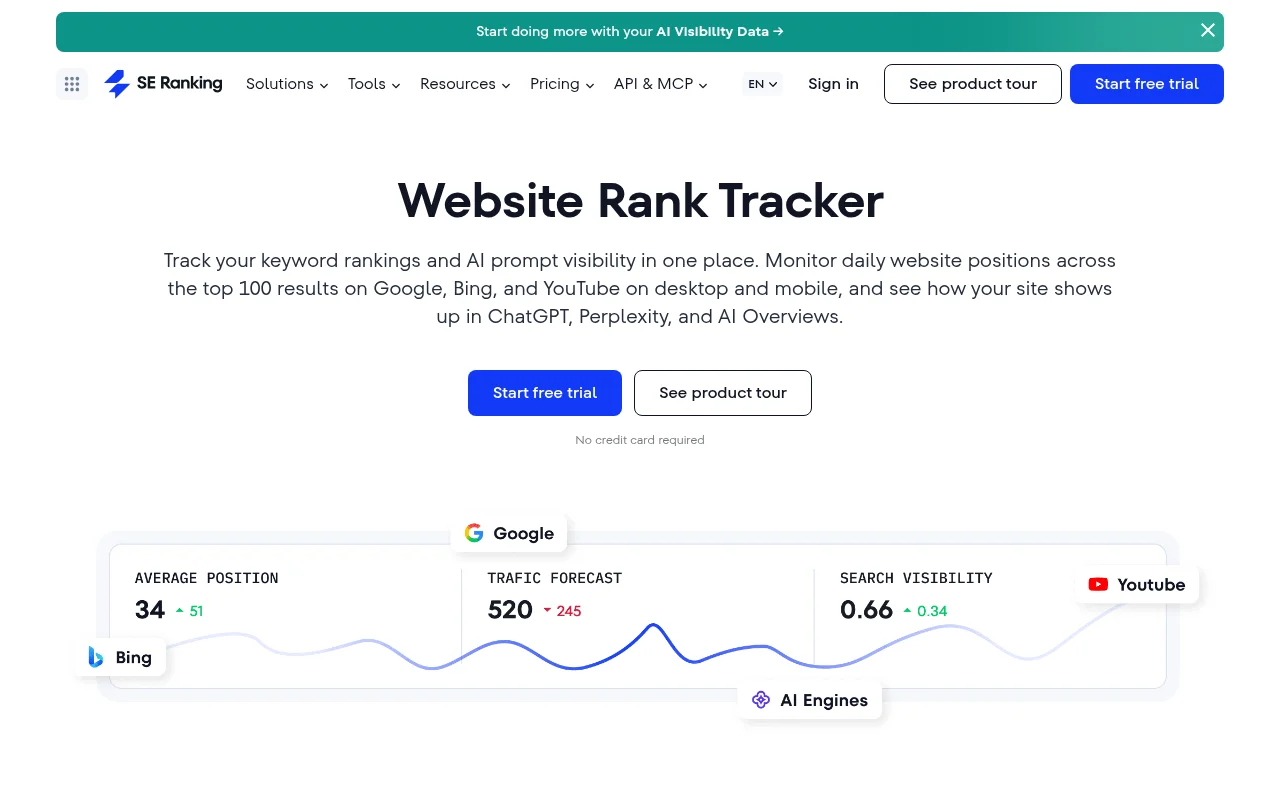
SE Ranking started as a rank tracker and grew into a full SEO platform. It still offers one of the most generous keyword allowances at its price, and it now tracks AI search too.
Key features
- Daily rank tracking across major search engines, locations and devices
- 2,000 keywords and 100 AI prompts tracked daily on the entry plan
- AI Results Tracker for AI Overviews, AI Mode, Perplexity and ChatGPT (AI Search add-on)
- Keyword, competitor and backlink research, plus site audits
- Looker Studio, Google Analytics and Search Console integrations
- API and MCP access
Pricing (official)
| Plan | Monthly | Billed annually | Limits |
|---|---|---|---|
| Core | $129/month | $103.20/month | 10 projects, 2,000 keywords and 100 prompts daily, 1 manager seat |
| Growth | $279/month | $223.20/month | 30 projects, 5,000 keywords and 250 prompts daily, 3 manager seats |
| Enterprise | Custom | Custom | Custom limits |
| AI Search add-on | $89/month | $71.20/month | 200 prompts across AI Overviews, AI Mode, Perplexity and ChatGPT |
| Agency Pack add-on | n/a | $69/month (annual only) | White-label reports and client seats |
There is a 14-day free trial with no credit card required.
My take: For a small agency or an in-house team, SE Ranking gives you the best balance of keywords, AI tracking and extra SEO tools for the money.
2. Semrush Position Tracking: Best all-in-one SEO suite
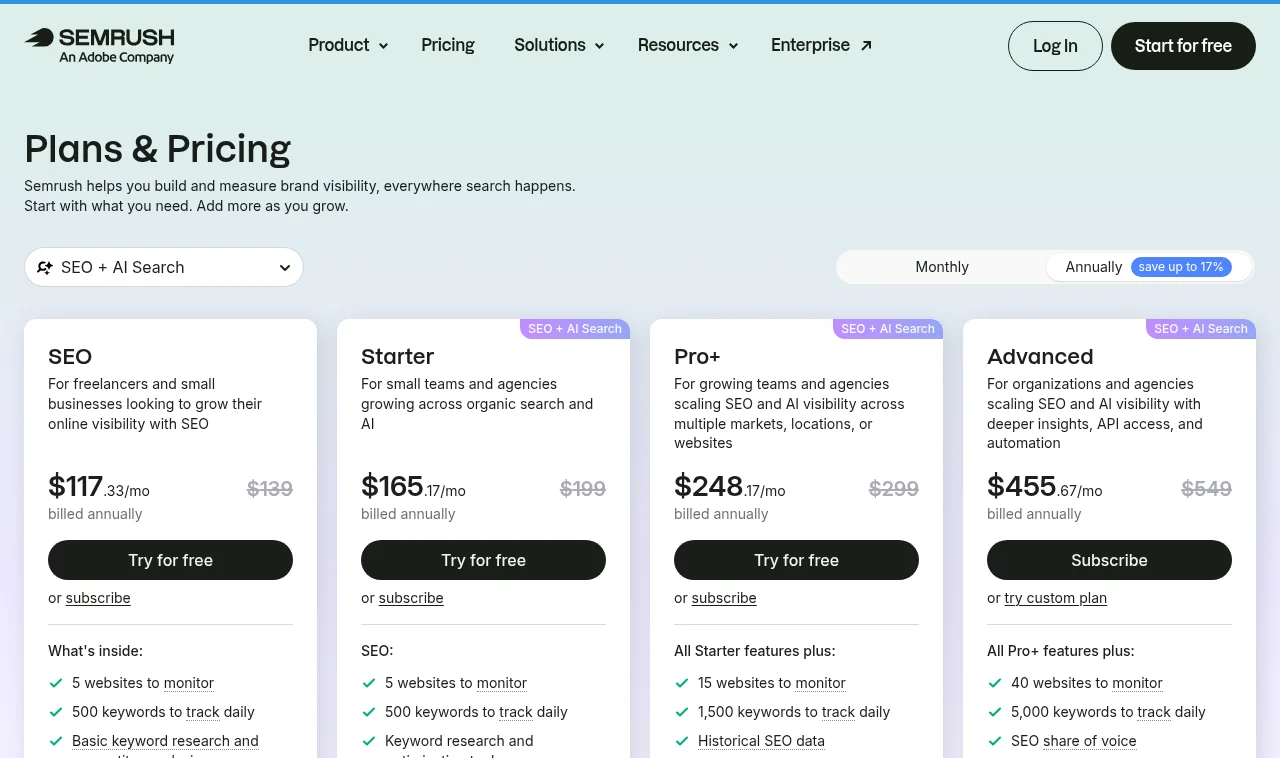
Semrush’s rank tracker is called Position Tracking. It is part of the wider Semrush platform, so you also get keyword research, competitor analysis and site audits in the same account.
Key features
- Daily ranking updates for keywords in search engines and prompts in LLMs
- Track up to 20 competitors side by side
- See when keywords trigger featured snippets, video carousels, AI Overviews and local packs, and whether you appear in them
- Potential growth, Personal Keyword Difficulty and Topical Authority metrics
- White-label reporting, alerts and automated email reports
Pricing (official)
| Plan | Monthly | Billed annually | Keywords tracked daily |
|---|---|---|---|
| SEO | $139/month | $117.33/month | 500 (5 websites) |
| Starter SEO + AI Search | $199/month | $165.17/month | 500, plus 50 AI prompts daily |
| Pro+ SEO + AI Search | $299/month | $248.17/month | 1,500, plus 100 AI prompts, multi-location and device tracking |
| Advanced SEO + AI Search | $549/month | $455.67/month | 5,000, plus 200 AI prompts, share of voice and API |
There is also a free plan with one demo project. If you are buying, check my Semrush coupon code page for the latest trial offers.
My take: Semrush is not the cheapest way to track keywords, but if you already need its research tools, Position Tracking is a strong, reliable add-on rather than a separate bill.
3. Ahrefs Rank Tracker: Best for teams already using Ahrefs
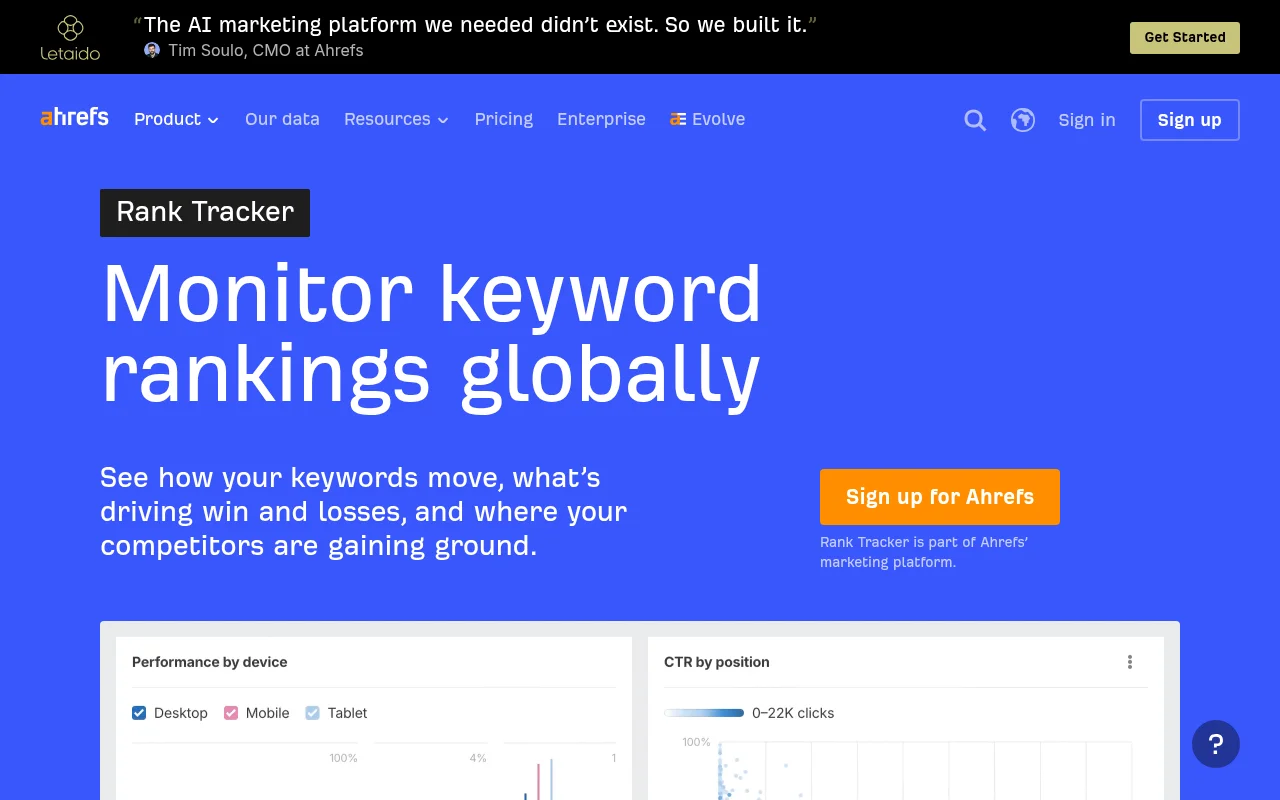
Ahrefs is best known for backlink data. Its Rank Tracker covers more than 190 locations, down to city and ZIP code, on mobile and desktop.
Key features
- 19 SERP features tracked, including AI Overviews
- Share of voice, share of traffic value, average position and position distribution
- Compare against 10 competitors
- Import ranking history from Site Explorer
- Cannibalization warnings when several of your URLs rank for one keyword
- Brand Radar for AI search visibility (separate add-on)
Pricing (official)
| Plan | Price | Tracked keywords | Tracked AI prompts |
|---|---|---|---|
| Lite | $129/month | 750 | 5 |
| Standard | $249/month | 2,000 | 10 |
| Advanced | $449/month | 5,000 | 20 |
Ahrefs says paying annually saves up to 17%. Its Rank Tracker page lists the update frequency as weekly, so it is not the right tool if you need daily movement.
My take: Choose Ahrefs for research and links, and use its Rank Tracker for weekly trend reporting. For daily tracking, pair it with a dedicated tool.
4. AccuRanker: Best for agencies that need speed
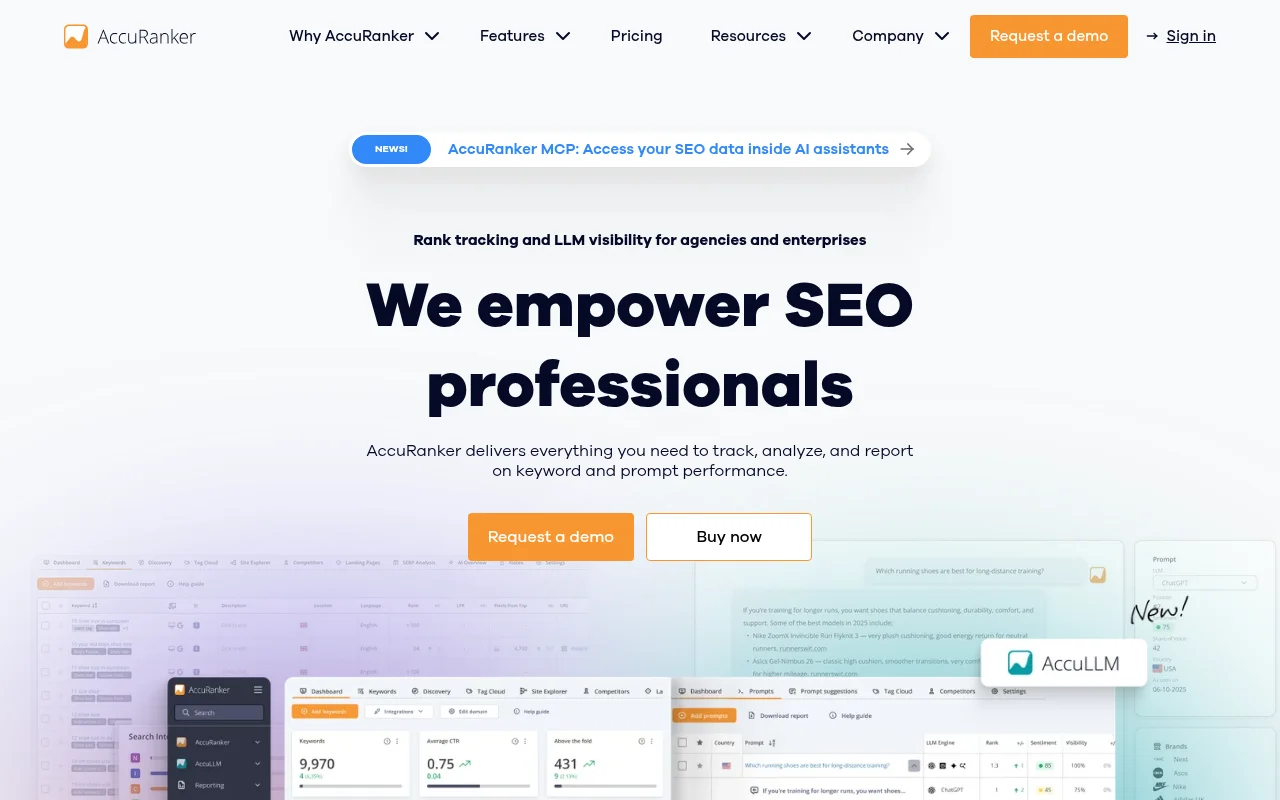
AccuRanker is a dedicated rank tracker built for agencies and enterprises. It focuses on fast, daily keyword updates, flexible tagging and filters, and integrations.
Key features
- Daily keyword updates with on-demand refreshes
- Tagging, dynamic tags and 50+ filters
- Search intent, keyword research and AI-based CTR and search volume metrics
- Google Search Console and Google Analytics integrations, Looker Studio and BigQuery (higher plans)
- AccuLLM for tracking visibility in ChatGPT, Perplexity, AI Overviews and AI Mode
- MCP server so you can query your data in AI assistants
Pricing (official): Professional starts at $249 a month for 2,000 keywords, or $224 a month billed yearly (options up to 5,000 keywords). Expert starts at $764 a month billed yearly for 10,000 keywords (options up to 25,000). Above 25,000 keywords, Enterprise pricing is custom. AccuRanker says annual payment gives a 10% discount, and the price rises with the number of keywords you pick.
My take: AccuRanker is a specialist tool. You pay more than for a suite, but you get speed and flexible data handling, which matters when you report on tens of thousands of keywords for clients.
5. Advanced Web Ranking (AWR): Most keywords for the money
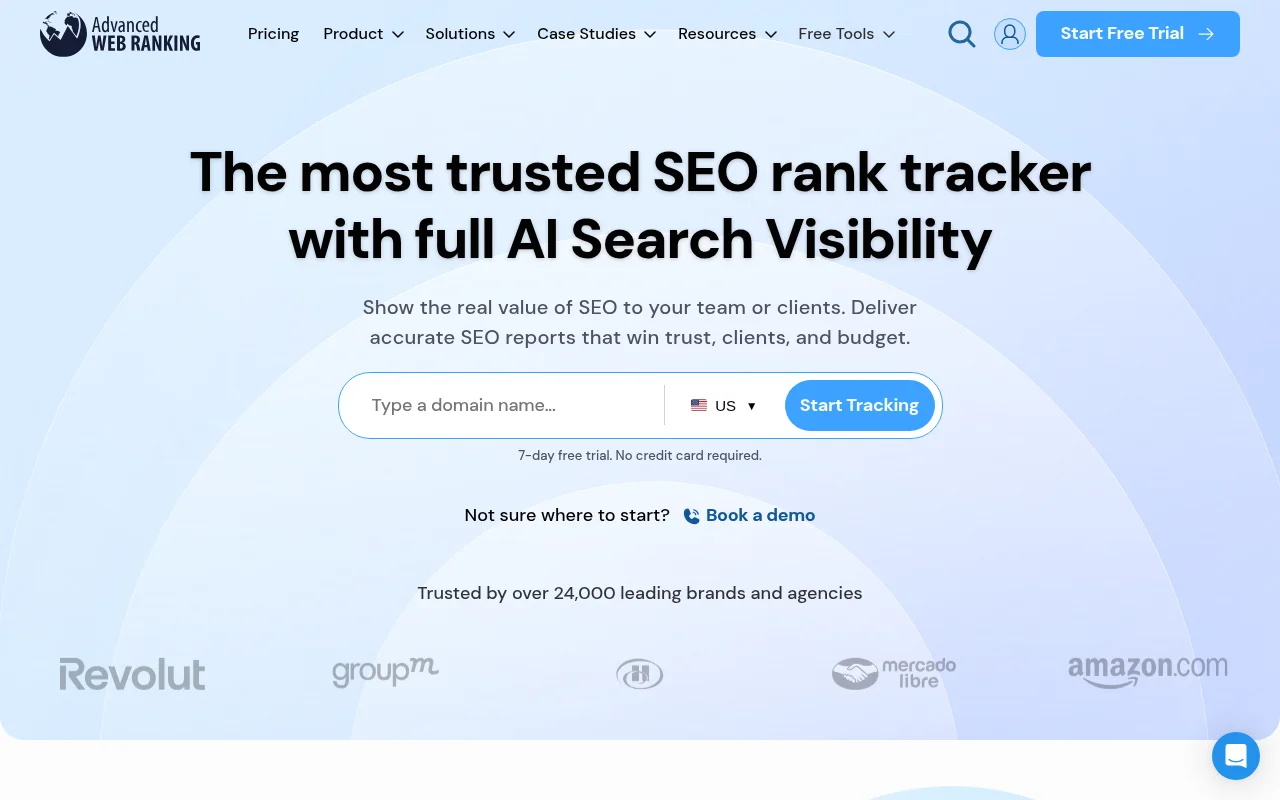
Advanced Web Ranking has more than 20 years in rank tracking. Its entry plan tracks 7,000 keywords with unlimited projects and users, far more than most rivals at a similar price.
Key features
- 4,000+ search engines, including YouTube, Amazon, Bing, Yahoo, Naver and Baidu
- Daily, weekly, bi-weekly, monthly or on-demand updates
- Local, maps and mobile tracking
- AI visibility tracking with AI citations and mentions
- SEO forecasting, market share and pixel-position analysis
- Looker Studio and API on higher plans
Pricing (official)
| Plan | Price | Keywords |
|---|---|---|
| Pro | $139/month | 7,000 |
| Agency | $279/month | 14,500 |
| Enterprise | $699/month | 35,500 |
| Enterprise Plus 50k | $980/month | 50,000 |
Annual payment saves 10%, and every plan has a 30-day money-back guarantee.
My take: If keyword volume is your biggest cost driver, AWR is hard to beat.
6. Nightwatch: Best for teams that hate per-seat fees
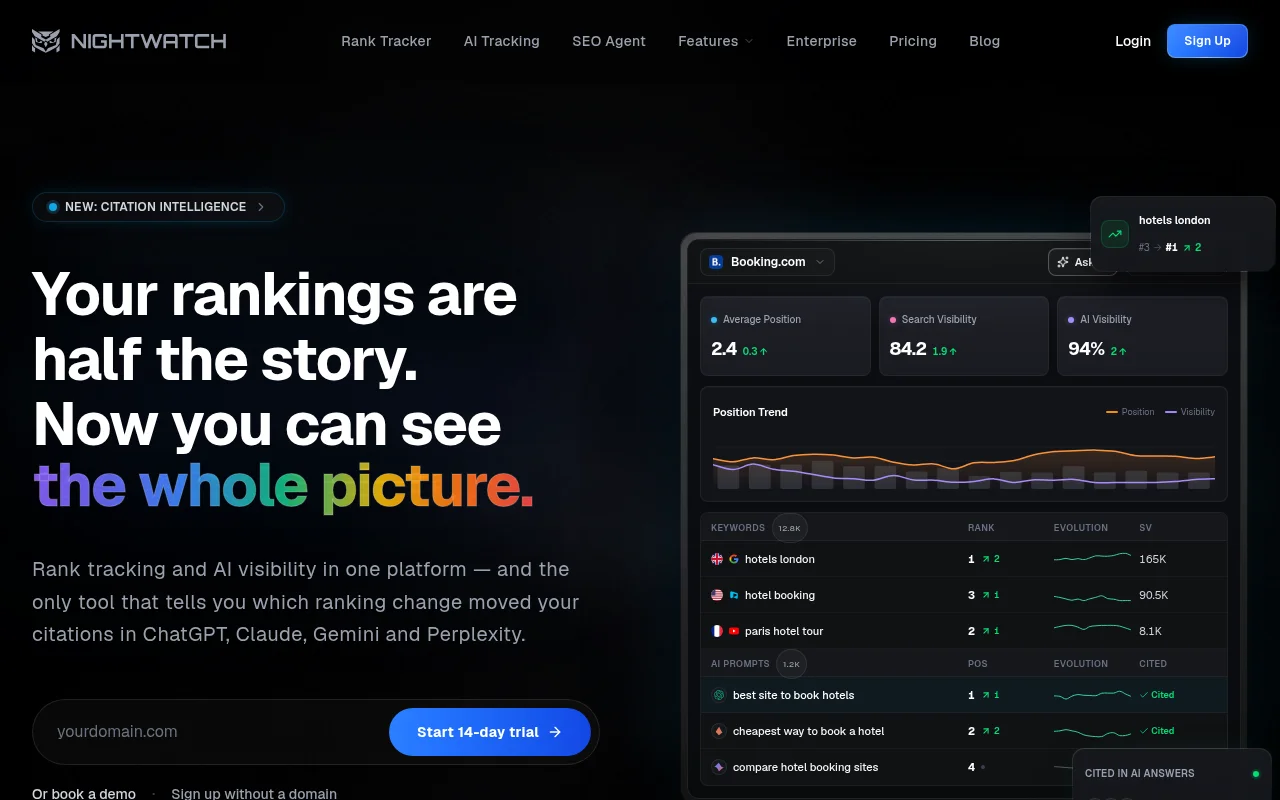
Nightwatch includes every tool and unlimited team seats on every plan. You pay only for the number of keywords and AI prompts you track.
Key features
- Tracks Google, YouTube, Bing, Yahoo, DuckDuckGo and Google Maps
- AI tracking on ChatGPT, Claude, Gemini, Perplexity, AI Mode and AI Overviews
- Real-time on-demand checks
- Site audit, keyword research, prompt research and an SEO agent
- White-label reports, Looker Studio and API on Professional and above
Pricing (official, billed yearly)
| Plan | Price | Keywords | AI prompts |
|---|---|---|---|
| Starter | €79/month (€948/year) | 500 | 50 |
| Professional | €159/month (€1,908/year) | 2,500 | 150 |
| Agency | €399/month (€4,788/year) | 7,500 | 500 |
There is a 14-day free trial with no credit card required.
My take: Nightwatch has one of the widest AI platform lists I found. If you manage a large team, unlimited seats can save real money compared with per-user pricing.
7. Pro Rank Tracker: Best for white-label agency reports
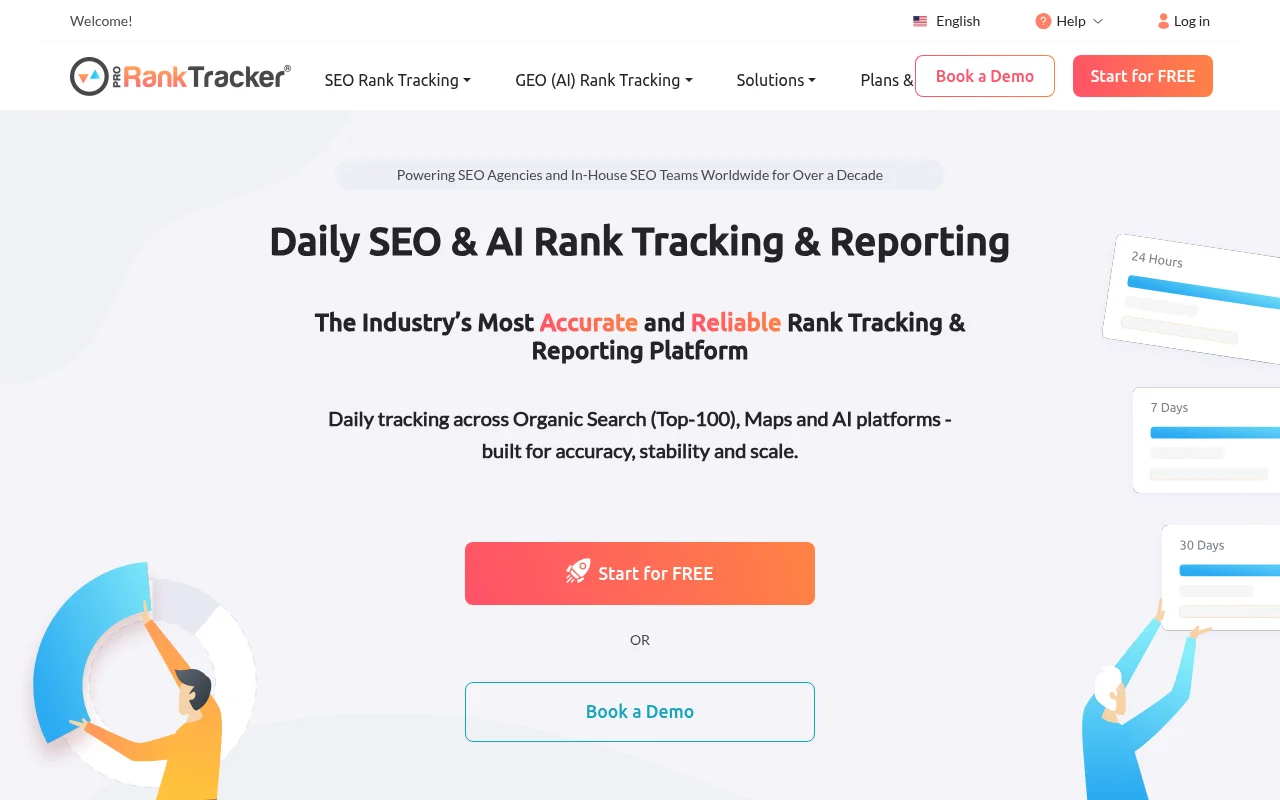
Pro Rank Tracker (PRT) is a specialist that has focused on rank tracking and reporting for more than a decade. It tracks the top 100 results daily across organic search, Google Maps, video and AI platforms.
Key features
- Daily top-100 Google rankings on desktop and mobile, any location and language
- Google Business Profile, local 3-pack and Maps tracking
- YouTube and Google video rankings
- AI tracking on AI Overviews, AI Mode, Gemini, ChatGPT, Copilot and Perplexity
- White-label reports and a client app
Pricing (official, monthly)
| Plan | Price | Terms |
|---|---|---|
| Free trial | $0 for 7 days | 100 terms |
| Starter | $99/month | 1,000 |
| Pro | $149/month | 2,000, 10 users |
| Agency | From $199/month | 3,000 to 20,000+, API access, unlimited users |
PRT bills in “terms,” not keywords. One organic keyword for one URL, engine, location and device uses 1 term. One AI prompt uses 2 terms. Annual billing saves 10%.
8. Wincher: Best for small businesses
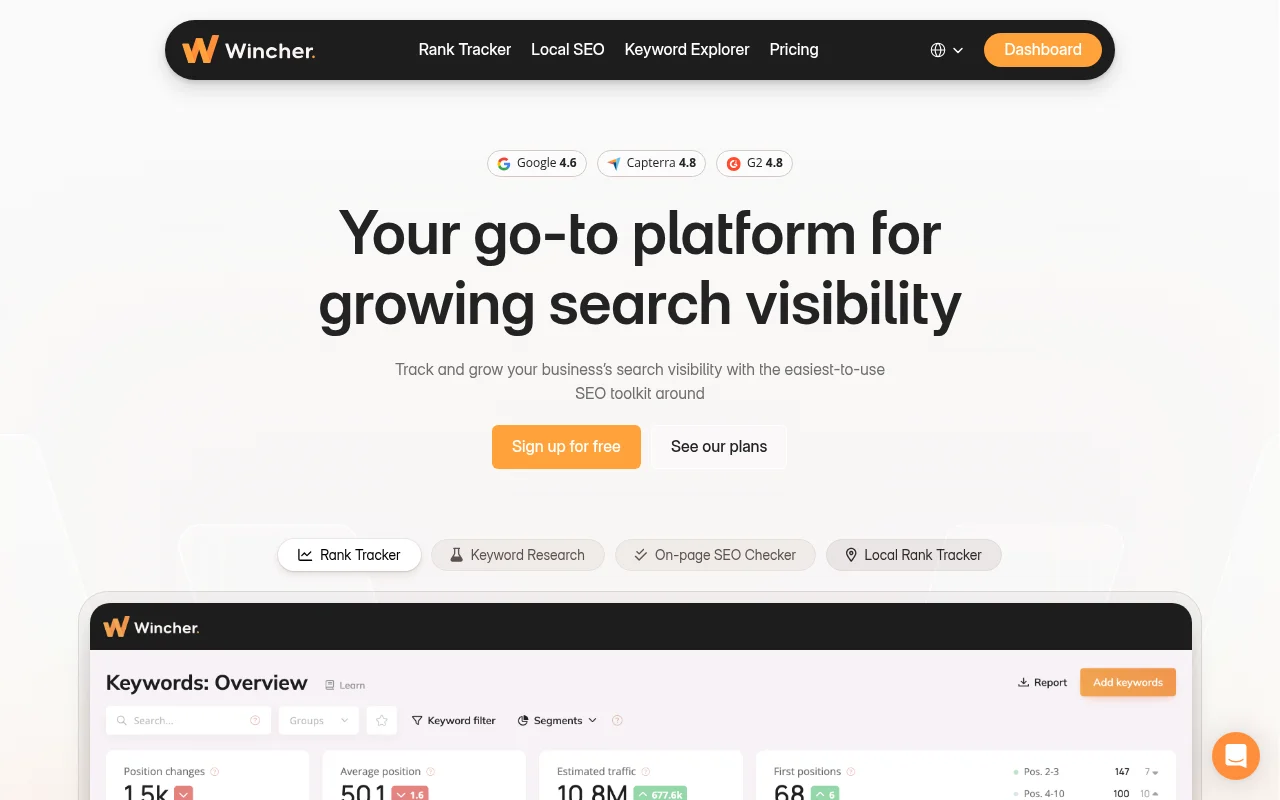
Wincher is a simple, affordable rank tracker with daily updates on every plan. It also includes a local rank tracker for Google Maps and a keyword explorer.
Key features
- Daily ranking updates on all plans, on-demand updates on Standard and above
- Competitor tracking (5 to 20 per website)
- SERP features, keyword grouping and annotations
- Local Maps tracking with weekly updates
- On-page SEO checker and AI content outliner
Pricing (official)
| Plan | Price | Keywords | Websites |
|---|---|---|---|
| Basic | $49/month ($41 billed yearly) | From 500 | Up to 10 |
| Standard | $89/month ($74 billed yearly) | From 1,000 | Unlimited |
| Professional | $319/month ($266 billed yearly) | From 5,000 | Unlimited |
Wincher offers a free trial on the Basic plan.
My take: If you run one or two business websites and want clean daily data without a big suite, Wincher is a sensible choice.
9. Mangools SERPWatcher: Best for beginners
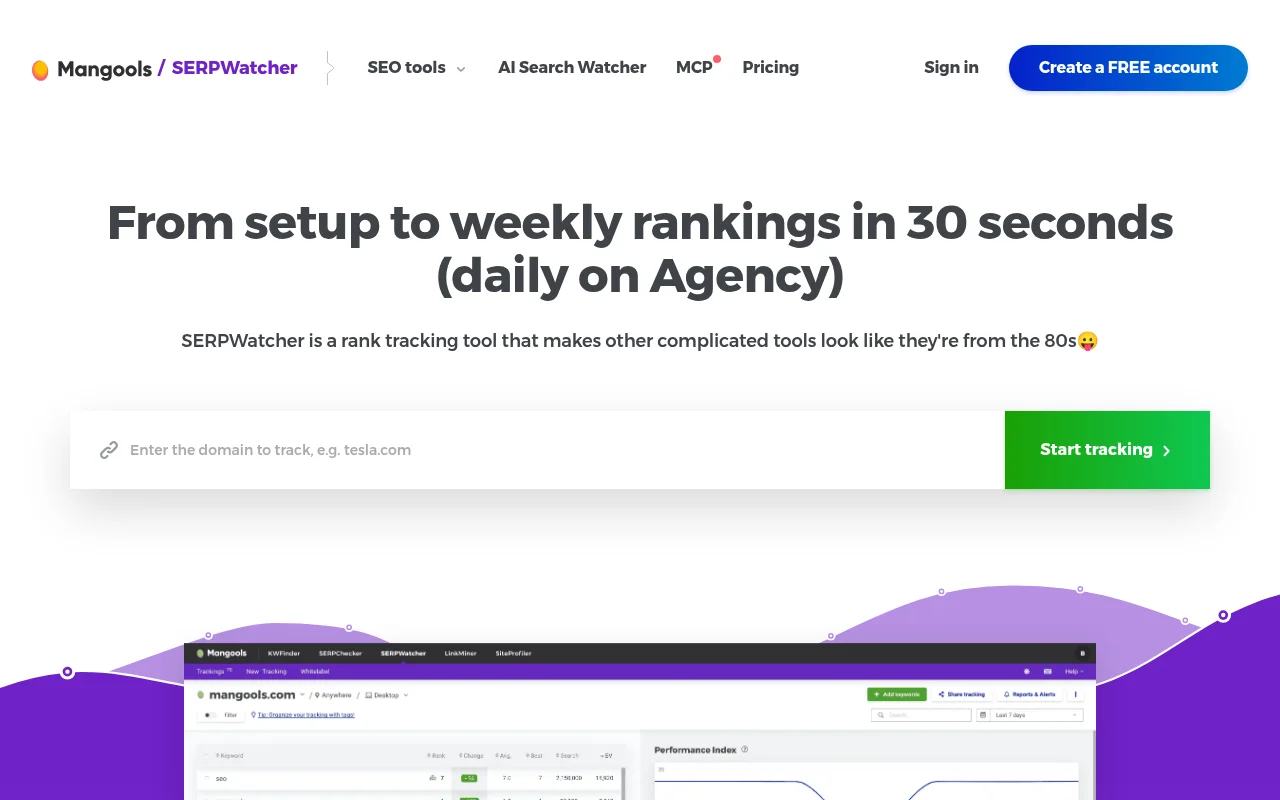
SERPWatcher is part of the Mangools bundle, along with KWFinder and other tools. It is one of the easiest rank trackers to set up, and it shows a “Performance Index” based on your positions and search volumes.
Pricing (official, billed annually)
| Plan | Price | Tracked keywords | Update frequency |
|---|---|---|---|
| Basic | $18.85/month ($226.20/year) | 200 | Weekly |
| Premium | $26.35/month ($316.20/year) | 700 | Weekly |
| Agency | $48.85/month ($586.20/year) | 1,500 | Daily |
All plans include Mangools’ AI Search Watcher, API and MCP access. Mangools offers a 48-hour money-back guarantee.
My take: Great for bloggers who want weekly trends and keyword research in one cheap bundle. Agencies will want daily data.
10. Moz Pro: Best for Moz metrics fans
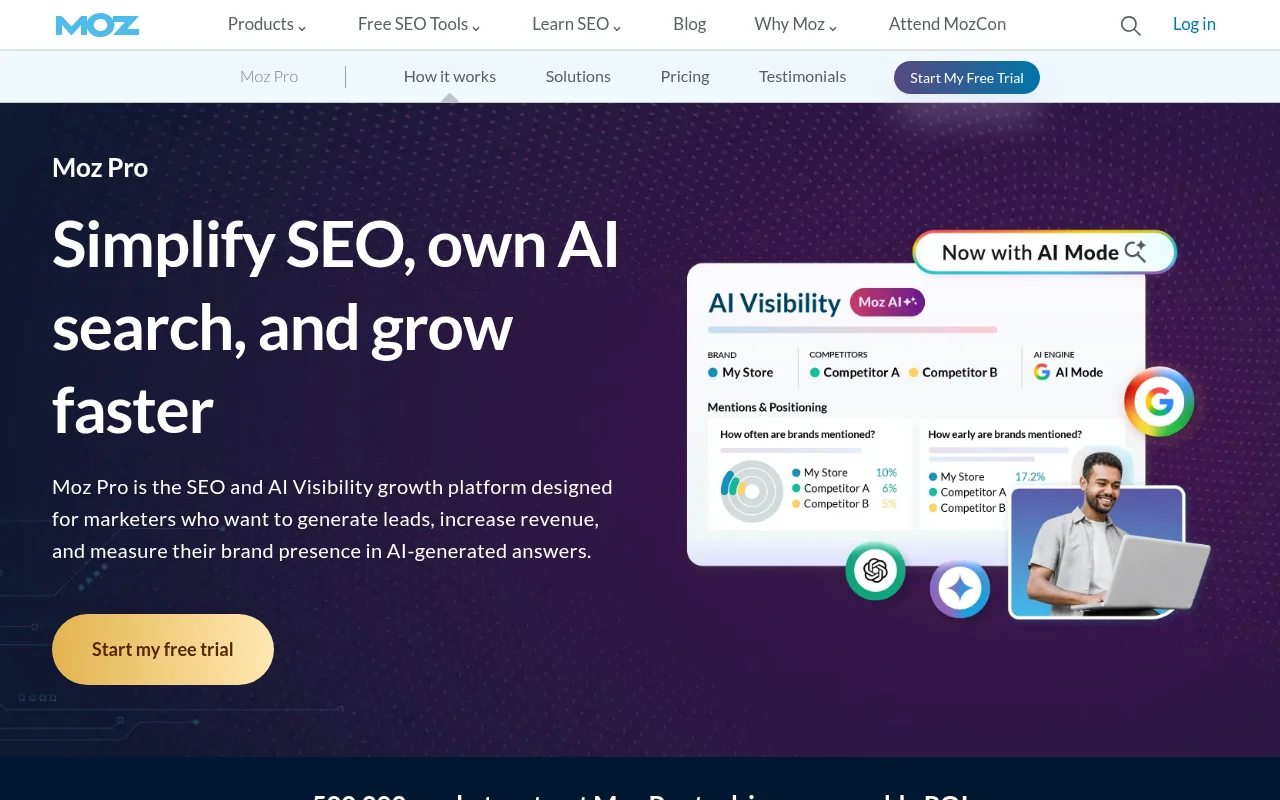
Moz Pro bundles rank tracking with Moz’s well-known metrics such as Domain Authority, plus newer AI visibility features.
Pricing (official)
| Plan | Monthly | Billed yearly | Tracked keywords | AI prompts tracked |
|---|---|---|---|---|
| Starter | $49/month | n/a | For one website | n/a |
| Standard | $99/month | $79/month | 300 | 150 |
| Medium | $179/month | $143/month | 1,500 | 300 |
| Large | $299/month | $239/month | 3,000 | 600 |
Moz tracks prompts across four AI models (GPT, Gemini, Google AI Mode and Perplexity) with weekly prompt tracking, and shows AI Overviews by keyword.
My take: Moz Pro’s keyword limits are low for the price. Choose it if your team already relies on Moz metrics.
11. SEO PowerSuite Rank Tracker: Best for unlimited keywords on a budget
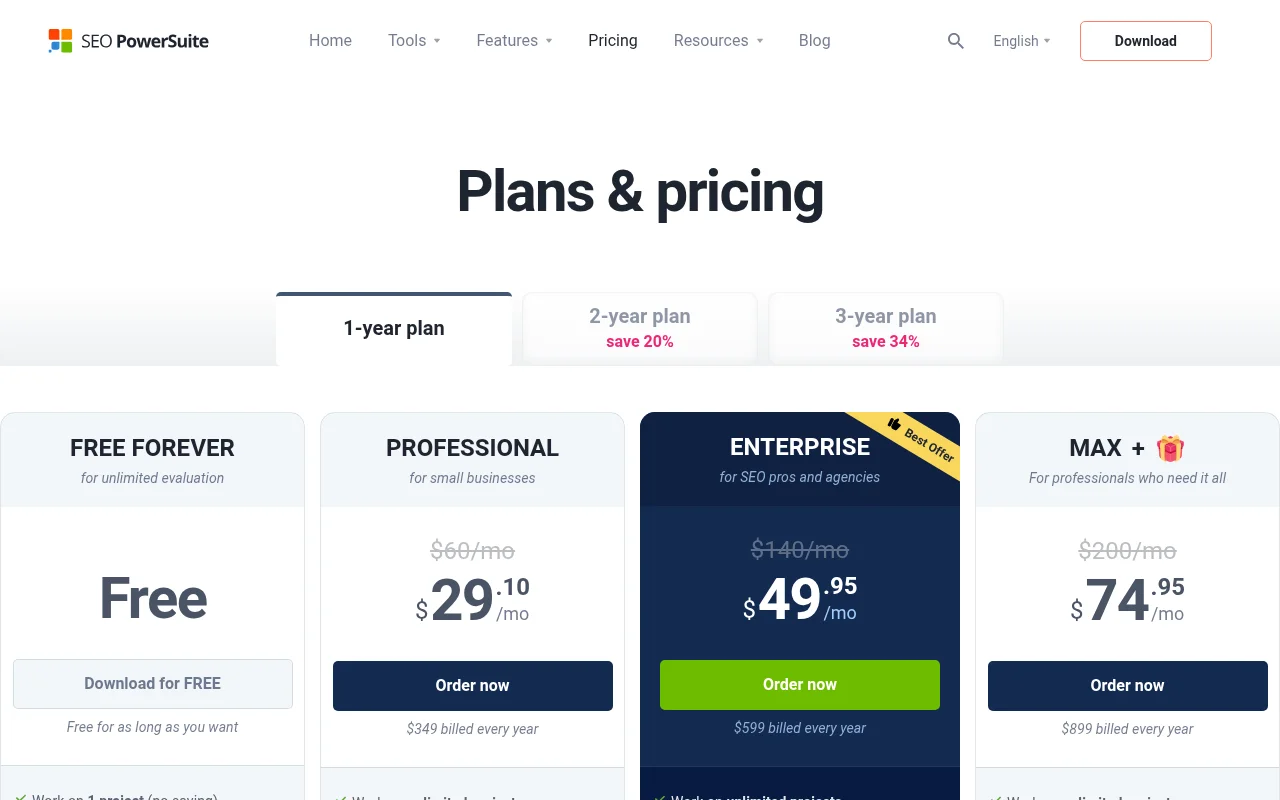
SEO PowerSuite’s Rank Tracker is desktop software, not a cloud app. That is why it can offer unlimited keywords: the checks run from your computer (or a server you set up).
Key features
- Unlimited projects and keywords on paid plans
- 550+ search engines
- Google AI Overviews tracking
- Free version for unlimited evaluation (no saving)
- White-label reports and scheduling on Enterprise
Pricing (official, per year)
| Edition | Price | Notes |
|---|---|---|
| Free | $0 | 1 project, no saving |
| Professional | $349/year (about $29.10/month) | Unlimited keywords, 1-year history |
| Enterprise | $599/year | Adds white-label reports, scheduling and exports |
| Max | $899/year | Adds onboarding and partner perks |
Two-year and three-year plans save 20% and 34%.
My take: If you are comfortable with desktop software and want to track thousands of keywords cheaply, this is the budget winner.
12. Serpstat: Best budget all-in-one
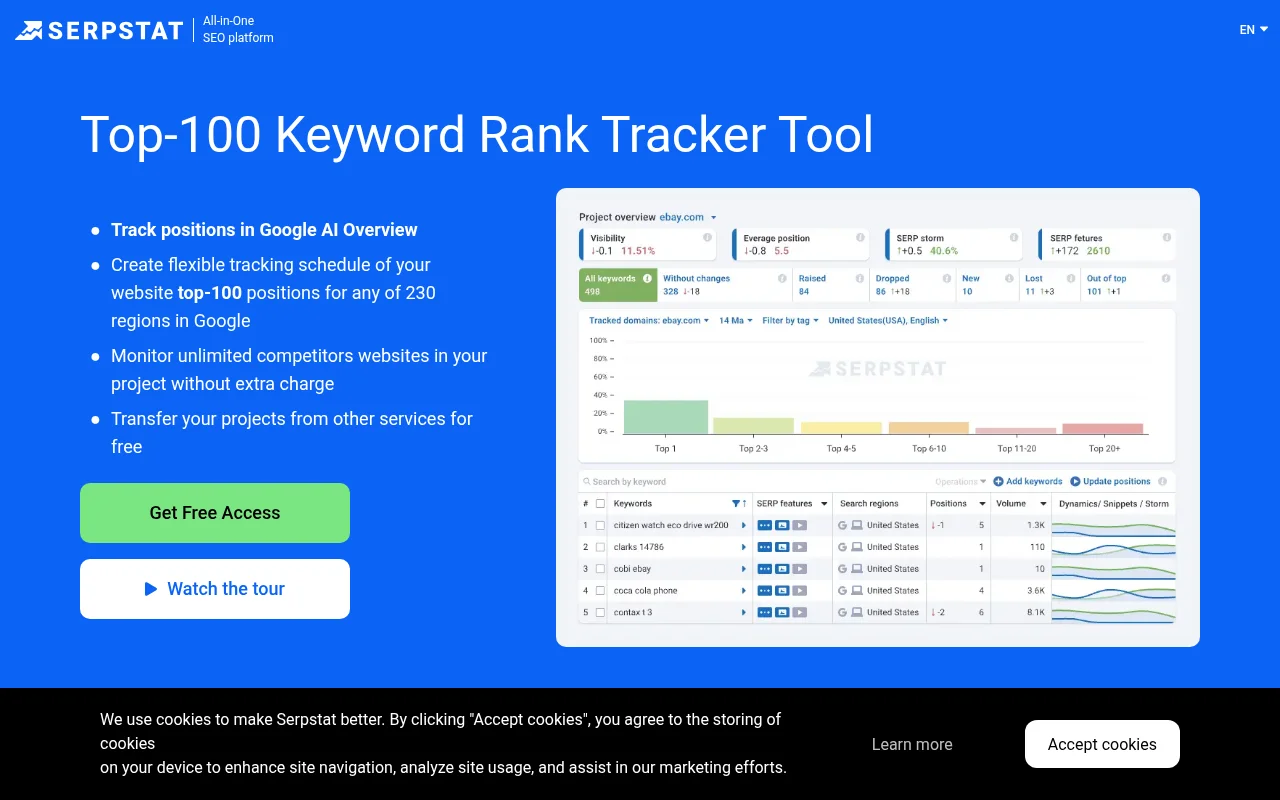
Serpstat is an all-in-one SEO platform with a flexible rank tracker that checks the top 100 positions for any of 230 Google regions.
Key features
- Flexible tracking schedule
- Unlimited competitors per project at no extra charge
- Google AI Overview position tracking
- Paid ad position tracking
- Keyword research, site audit and backlink tools in the same plan
Pricing (official, with annual discount)
| Plan | Price | Keyword position checks |
|---|---|---|
| Individual | $50/month | 10,000 |
| Team | $100/month | 50,000 |
| Agency | $410/month | 500,000 |
Serpstat counts “position checks,” so the number of keywords you can track depends on how often you update them.
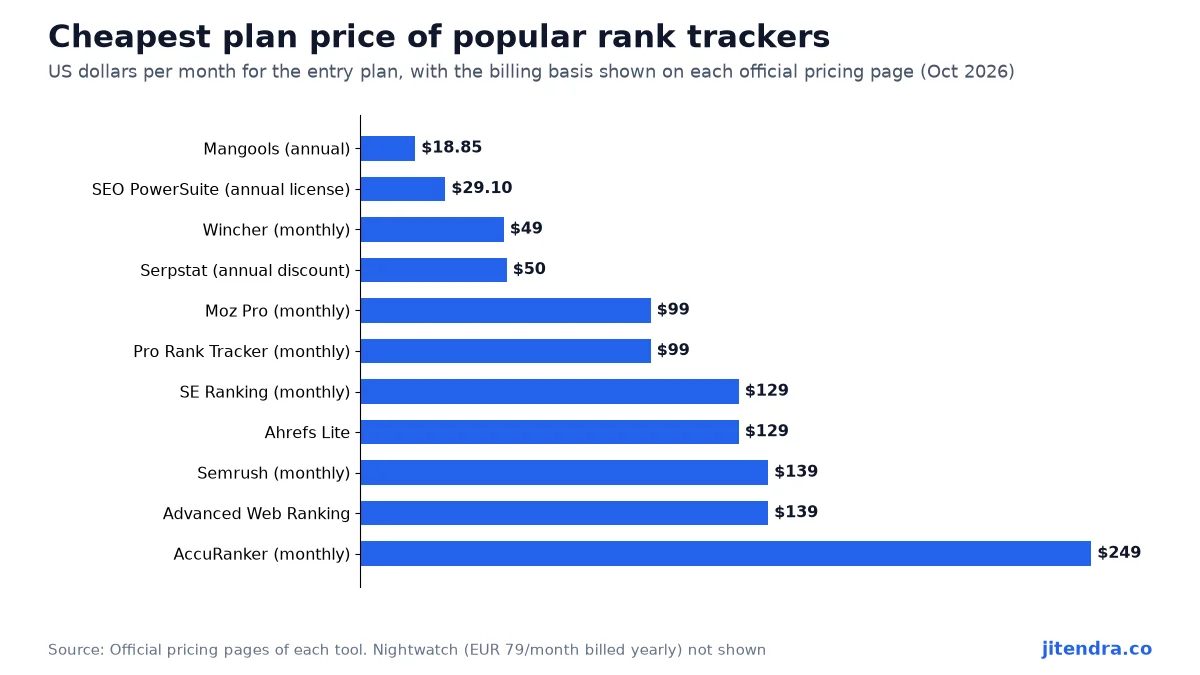
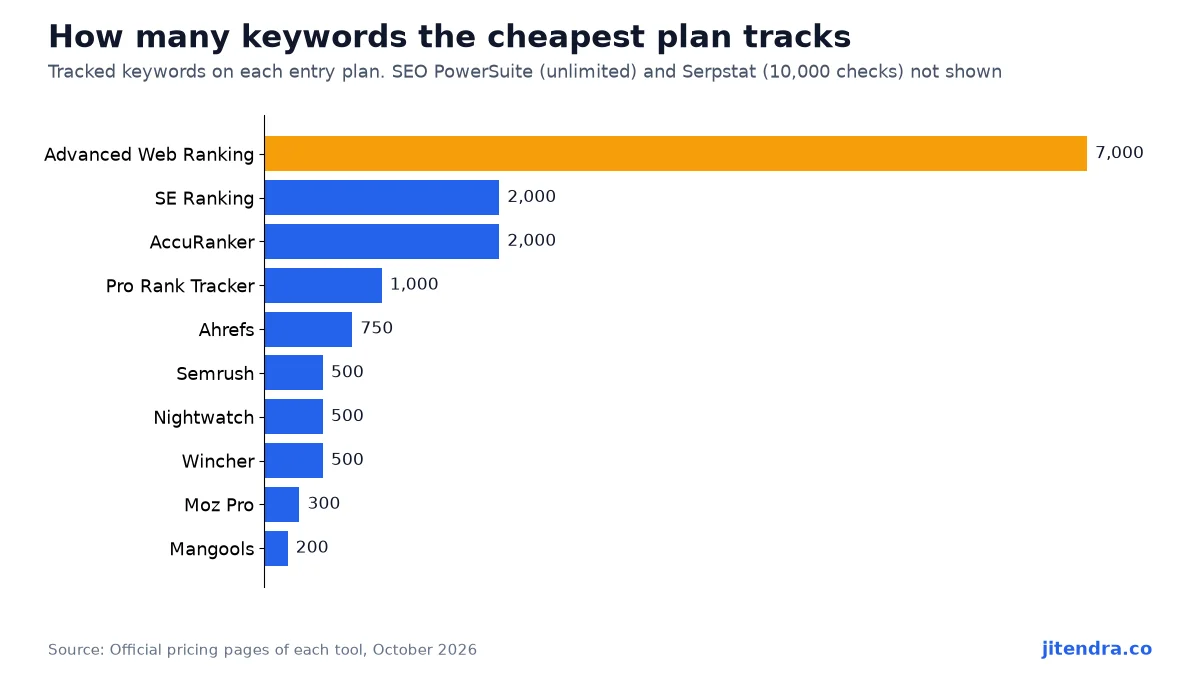
Rank Tracker Pricing Compared
| Tool | Entry price | Billing shown | Keywords on entry plan |
|---|---|---|---|
| Mangools SERPWatcher | $18.85/month | Annual | 200 |
| SEO PowerSuite | $29.10/month | Annual license | Unlimited |
| Wincher | $49/month | Monthly | 500 |
| Serpstat | $50/month | Annual discount | 10,000 checks |
| Nightwatch | €79/month | Yearly | 500 |
| Moz Pro | $99/month | Monthly | 300 |
| Pro Rank Tracker | $99/month | Monthly | 1,000 terms |
| SE Ranking | $129/month | Monthly | 2,000 |
| Ahrefs | $129/month | Monthly | 750 |
| Semrush | $139/month | Monthly | 500 |
| Advanced Web Ranking | $139/month | Monthly | 7,000 |
| AccuRanker | $249/month | Monthly | 2,000 |
Which Rank Trackers Track AI Overviews and ChatGPT?
| Tool | Google AI Overviews | Google AI Mode | ChatGPT and other AI assistants |
|---|---|---|---|
| Semrush | Yes | Not specified | Yes, LLM prompt tracking |
| SE Ranking | Yes | Yes | Yes, ChatGPT and Perplexity (AI Search add-on) |
| Ahrefs | Yes, as a SERP feature | Not specified | AI chatbot visibility via Brand Radar |
| AccuRanker | Yes, via AccuLLM | Yes, via AccuLLM | ChatGPT and Perplexity via AccuLLM |
| Advanced Web Ranking | Not specified | Not specified | AI visibility, citations and mentions |
| Nightwatch | Yes | Yes | ChatGPT, Claude, Gemini, Perplexity |
| Pro Rank Tracker | Yes | Yes | ChatGPT, Gemini, Copilot, Perplexity |
| Moz Pro | Yes, by keyword | Yes | GPT, Gemini, Perplexity |
| Serpstat | Yes | Not specified | Separate LLM Brand Monitor (ChatGPT, Claude, Gemini and more) |
| SEO PowerSuite | Yes | Not specified | Not specified |
| Mangools | Not specified | Not specified | Via AI Search Watcher |
| Wincher | Not specified | Not specified | Not specified |
Sources: official product and pricing pages, October 2026. “Not specified” means I could not confirm it on the official page.
Rank Tracking Metrics Explained
Rank trackers show a lot of numbers. These are the ones worth understanding:
| Metric | What it means | Why it matters |
|---|---|---|
| Position | Where your page ranks for a keyword in one location and device | The basic signal, but only one piece of the story |
| Average position | The average rank across all tracked keywords | Good for trends, but one big keyword can skew it |
| Visibility | An estimate of how much organic traffic your rankings could bring | Better than average position for reporting progress |
| Share of voice | Your share of estimated clicks or visibility compared with competitors | Shows whether you are winning the market, not just moving up |
| SERP features | Snippets, local packs, videos, People Also Ask and AI Overviews on the page | Explains changes in clicks when rankings stay the same |
| AI citations and mentions | How often AI answers mention or link to your brand | The new metric for AI search visibility |
| Cannibalization | Several of your pages ranking for the same keyword | A sign to merge or refocus pages |
If you report to a client or a boss, lead with visibility and share of voice, then explain big position changes. A single “we moved from #6 to #4” is less useful than “our visibility for buying keywords rose 20% this quarter.”
Do You Need a Rank Tracker If You Have Google Search Console?
Google Search Console is free and shows your average position, impressions and clicks from real searches. For a small blog, that may be enough. But a rank tracker adds things Search Console cannot do:
- Competitor tracking. Search Console only shows your own site.
- Exact locations. You can track a keyword in Mumbai, Austin or a single ZIP code.
- Daily history for chosen keywords, including keywords where you do not rank yet.
- SERP feature and AI Overview tracking.
- Client-ready reports and alerts.
I use both. Search Console tells me what real users see on average. A rank tracker tells me exactly where I stand against competitors in the markets I care about.
How to Choose a Rank Tracker
Ask yourself five questions:
- How many keywords do you really need? Most small sites need 200 to 1,000. Agencies need thousands. Keyword volume drives price more than anything else.
- Daily or weekly? Daily data matters for agencies, ecommerce and news sites. Weekly is fine for most blogs.
- Do you need local or mobile tracking? Local businesses should track by city or ZIP code and include Google Maps.
- Do you need AI search tracking? If you sell in competitive categories, add a small set of AI prompts now.
- Do you already pay for an SEO suite? If you use Semrush, Ahrefs, SE Ranking or Moz, start with the tracker you already have before buying another tool.
My quick recommendations:
- Solo bloggers: Mangools SERPWatcher or Wincher
- Small businesses: SE Ranking or Wincher
- In-house SEO teams: SE Ranking or Semrush
- Agencies: AccuRanker, Advanced Web Ranking or Pro Rank Tracker
- Tight budget with many keywords: SEO PowerSuite or Serpstat
My Rank Tracking Tips From Client Work
Some lessons I keep coming back to:
- Track topics, not just keywords. Group keywords by topic and page. One page ranking for 200 related terms tells you more than one “money keyword.”
- Watch SERP features. A drop in clicks with a stable ranking often means an AI Overview or video carousel appeared above you.
- Tag by intent. Separate commercial, informational and branded keywords. Your reports become far more useful.
- Compare with Search Console. A rank tracker shows positions from one location; Google Search Console shows average positions across all real searches. Use both.
- Do not panic over daily swings. Look at weekly averages before you change anything.
For more SEO strategy, my podcast conversations with Craig Campbell on top SEO strategies and Cyrus Shepard cover how experienced SEOs measure what matters. You can find more episodes in my list of the best SEO podcasts, and if video is part of your strategy, my video SEO statistics show why YouTube rankings deserve tracking too.
How I Picked These Tools
- Official data only. Prices, keyword limits and features come from each tool’s official pricing and product pages, checked in October 2026.
- Active products only. I left out trackers that have shut down or stopped selling rank tracking as a main product.
- Experience-based picks. The “best for” labels reflect my experience running SEO for clients and my own sites. I did not run a private accuracy test, so I do not rank tools by accuracy.
FAQs About Rank Tracking Tools
What is the best SERP rank tracking tool in 2026?
For most businesses, SE Ranking offers the best value, with 2,000 keywords and 100 AI prompts tracked daily from $129 a month. Semrush is best as part of a full SEO suite, and AccuRanker and Advanced Web Ranking are strong choices for agencies.
Is there a free rank tracker?
Yes, with limits. SEO PowerSuite’s Rank Tracker has a free version for unlimited evaluation without saving projects, Semrush has a free plan with one demo project, and Pro Rank Tracker offers 100 terms free for 7 days. Google Search Console is also free and shows your average positions.
Which rank tracker tracks Google AI Overviews?
Most major trackers do now, including Semrush, SE Ranking, Ahrefs, AccuRanker, Nightwatch, Pro Rank Tracker, Moz Pro, Serpstat and SEO PowerSuite. Several also track brand visibility in ChatGPT, Gemini and Perplexity.
How often should I check keyword rankings?
Weekly is enough for most blogs and small sites. Agencies, ecommerce and news sites benefit from daily tracking. Avoid reacting to single-day changes, and look at weekly trends instead.
Why are my rankings different in Google Search Console?
Search Console shows your average position across all real searches, locations and devices. A rank tracker checks from one location and device at one moment. Both are correct; they measure different things.
What is the cheapest rank tracker with daily updates?
Among the tools here, Mangools Agency costs $48.85 a month billed annually and updates 1,500 keywords daily. Wincher Basic starts at $49 a month with daily updates on 500 keywords. SEO PowerSuite costs about $29 a month on its annual license and lets you run checks whenever you want, but it is desktop software.
Sources
- SE Ranking, official pricing and rank tracker pages
- Semrush, official pricing page and Position Tracking feature page
- Ahrefs, official pricing page and Rank Tracker page
- AccuRanker, official homepage and pricing page
- Advanced Web Ranking, official pricing page
- Nightwatch, official pricing page
- Pro Rank Tracker, official homepage and plans and pricing page
- Wincher, official pricing page
- Mangools, official pricing and SERPWatcher pages
- Moz, official Moz Pro pricing page
- SEO PowerSuite (Link-Assistant.com), official pricing page
- Serpstat, official pricing plans and rank tracker pages
- OpenAI, “DevDay 2026 Recap” (September 29, 2026)

Jitendra Vaswani is a well-known expert in SEO and AI-driven digital marketing. He has spoken at international events and founded Digiexe, a digital marketing agency, and AffiliateBooster, WordPress plugin designed specifically for affiliate marketers. With over 10 years of experience, Jitendra has helped many businesses succeed online. His bestselling book, Inside A Hustler’s Brain: In Pursuit of Financial Freedom, with over 20,000 copies sold globally, underscores his influence and commitment to empowering digital marketers.