Shopify statistics for 2026 start with $459 billion in GMV across the latest four reported quarters, including $119.1 billion in the third quarter alone.
Estimates put live Shopify stores at about 3.35 million, and Shop and Shop Pay reach more than 400 million verified shoppers.
This page covers Shopify revenue, GMV, payments, market share, store counts and the trends that matter.
Shopify Statistics: Latest Highlights
- Trailing four-quarter Shopify revenue reached $14.17 billion, with $3.74 billion in the third quarter of 2026, up 32% year over year.
- Merchants generated $459 billion in GMV over those same four quarters, including $119.1 billion in the third quarter.
- Shopify Payments processed $81.4 billion in the third quarter, or 68% of GMV, up from 65% a year earlier.
- Monthly recurring revenue stood at $230 million at the end of the third quarter, up 19% year over year.
- Estimates put live Shopify stores at about 3.35 million, including about 56,000 Shopify Plus merchants.
- Shopify merchants accounted for more than 14% of US ecommerce in the most recent full year.
- Shop and Shop Pay now reach more than 400 million verified shoppers worldwide.
How Many People Use Shopify?
Shopify does not publish one official user total, but it says millions of businesses in more than 175 countries use the platform, estimates put live Shopify stores at about 3.35 million, and Shop and Shop Pay reach more than 400 million verified shoppers.

Those Shopify numbers of users describe different groups, so they should not be added together. The 3.35 million figure is an estimate of live storefronts, which is the cleanest way to talk about Shopify merchant statistics. Shopify itself only confirms that millions of businesses trade on the platform in more than 175 countries.
The 400 million shoppers are buyers who use Shop and Shop Pay, not merchants. If you want a wider view of who is online, the internet statistics 2026 page puts that shopper base in context.
What this means: These Shopify statistics split users in two directions: merchants who run stores, and shoppers who buy from those stores. Keep those counts separate.
How Many Shopify Stores Are There?
Estimates put the number of live Shopify stores at about 3.35 million, and that count is still growing.
Shopify does not release an official store census, so every store count in these Shopify statistics is an estimate. I am using a live-storefront series, not a wider count of every domain or test shop, because those methods produce much larger totals that should not be mixed together.
How Many Shopify Plus Stores Are There?
Estimates put Shopify Plus at about 56,000 distinct merchants and about 84,200 domains. The two figures differ because a Plus merchant can run more than one domain. Plus is still a small slice of all Shopify stores, but it is the plan built for higher-volume brands.
Shopify Stores by Country
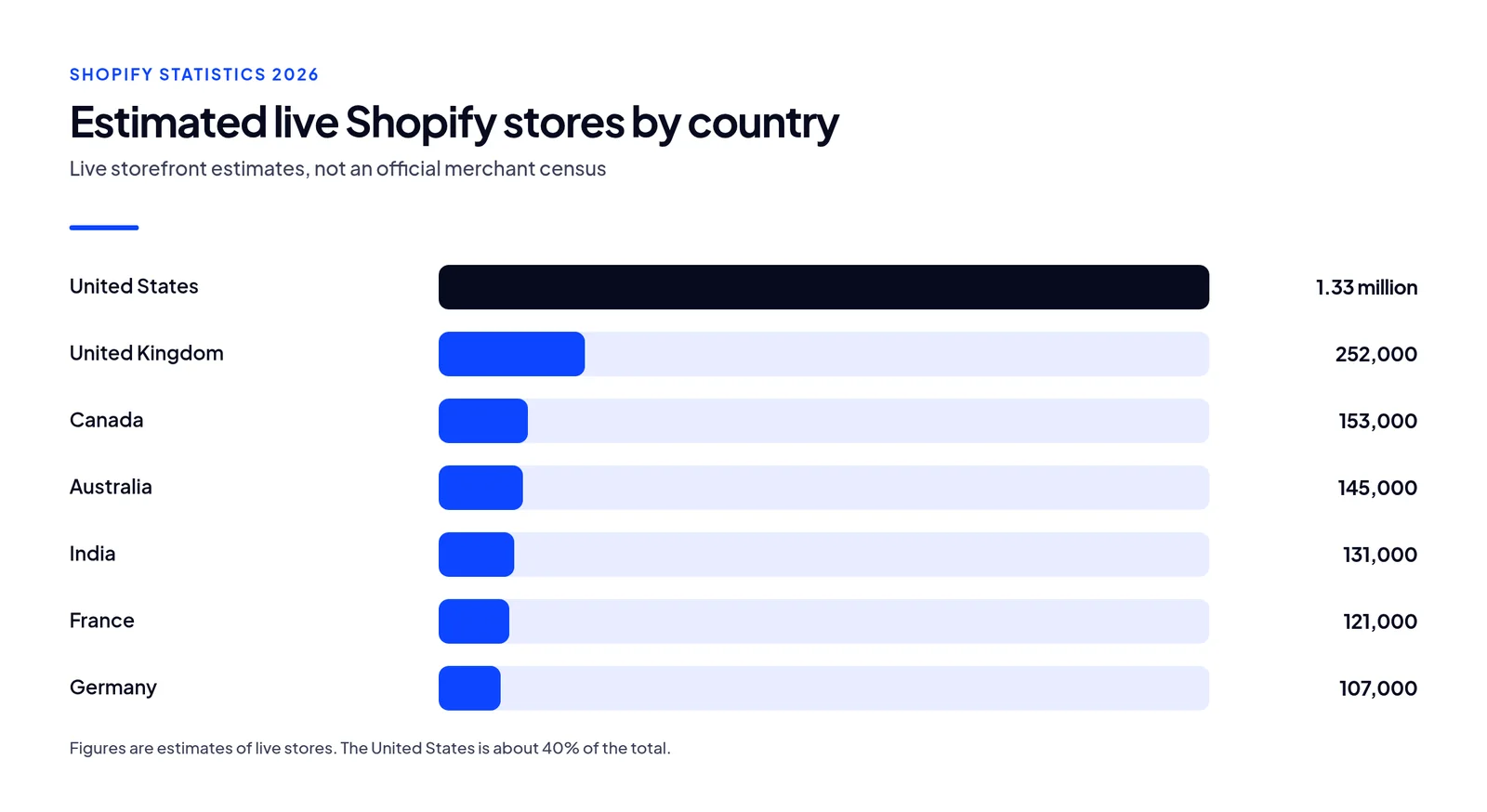
The United States is the largest estimated market, with about 1.33 million live Shopify stores, or about 40% of the total. The United Kingdom, Canada, Australia, India, France and Germany are the next largest country totals.
| Country | Estimated live stores | Share |
|---|---|---|
| United States | 1.33 million | 39.6% |
| United Kingdom | 252,000 | 7.5% |
| Canada | 153,000 | 4.5% |
| Australia | 145,000 | 4.3% |
| India | 131,000 | 3.9% |
| France | 121,000 | 3.6% |
| Germany | 107,000 | 3.2% |
Shopify Plus Stores by Country
Estimated Plus storefronts follow a similar pattern, with the United States first at about 30,400 domains, or 36%. The United Kingdom, Germany and France then make up a larger Plus share than they do in the all-store mix.
| Country | Estimated Plus storefronts | Share |
|---|---|---|
| United States | 30,400 | 36.1% |
| United Kingdom | 6,480 | 7.7% |
| Germany | 5,800 | 6.9% |
| France | 4,580 | 5.4% |
| Australia | 3,950 | 4.7% |
| Canada | 3,890 | 4.6% |
| Netherlands | 2,980 | 3.5% |
What this means: In these Shopify statistics, stores look global, but the United States is still the center of gravity for both standard shops and Plus storefronts.
How Many Customers Does Shopify Have?
Shopify does not publish a single official count of every unique buyer, but Shop and Shop Pay reach more than 400 million verified shoppers worldwide.
That 400 million figure is a shopper number, not a merchant number. These Shopify statistics also cannot tell you how many unique customers bought from every Shopify checkout in a year. GMV measures order value, which is the better official signal of customer activity.
For a broader look at online buying, see the ecommerce statistics 2026 page. It sits beside these Shopify statistics when you want platform sales and wider retail context in one place.
What this means: Treat shoppers, merchants and GMV as three different measures. None of them is a complete customer census on its own.
What Do Shopify Revenue Statistics Show?
Shopify collected $14.17 billion in revenue across the latest four reported quarters, including $3.74 billion in the third quarter of 2026, up 32% year over year.
In the most recent full year, 2025, Shopify revenue was $11.56 billion, up 30%. The later quarters have stayed in that high-growth range in these Shopify statistics. Subscription plans are only part of the story; most of the money now comes from services that scale with merchant sales.
If you are comparing plan prices with this revenue mix, the Shopify pricing 2026 guide sits next to these Shopify revenue statistics.
Shopify Revenue by Solution
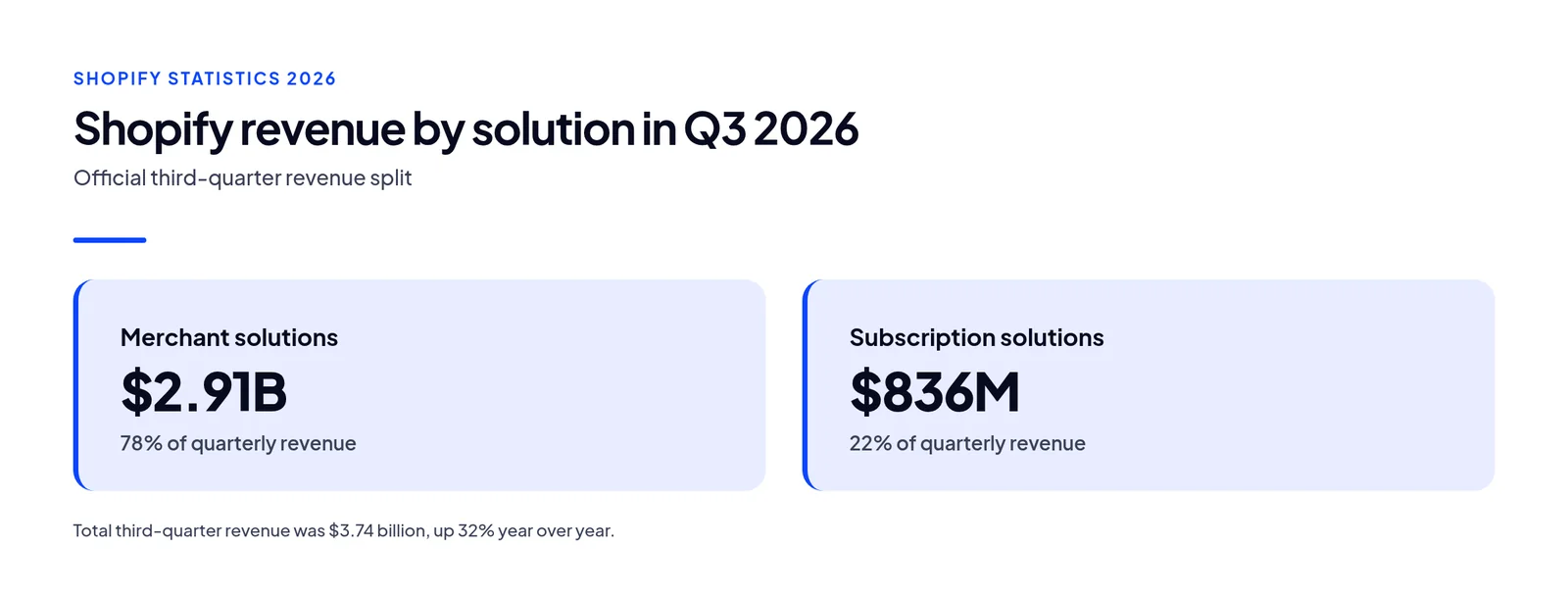
In the third quarter, merchant solutions brought in $2.91 billion, or about 78% of revenue. Subscription solutions brought in $836 million, or about 22%. Across the latest four quarters, the split is the same: $11.00 billion from merchant solutions and $3.17 billion from subscriptions.
| Solution | Q3 2026 revenue | Share |
|---|---|---|
| Merchant solutions | $2.91 billion | 78% |
| Subscription solutions | $836 million | 22% |
Shopify Revenue by Region
The United States accounted for $2.37 billion, or 63%, of third-quarter revenue. Europe contributed 20%, Asia Pacific 10%, Canada 5% and the rest of the world 2%. That mix was unchanged on a year-to-date basis.
| Region | Q3 2026 revenue | Share |
|---|---|---|
| United States | $2.37 billion | 63% |
| Europe | $766 million | 20% |
| Asia Pacific | $362 million | 10% |
| Canada | $172 million | 5% |
| Rest of World | $69 million | 2% |
What this means: Shopify revenue is still US-heavy, but merchant solutions, not monthly plans, now do most of the financial work.
What Do Shopify Financial Statistics Show for the Latest Four Quarters?
The latest four reported quarters are the fourth quarter of 2025 and the first, second and third quarters of 2026, and revenue stayed above $3.1 billion in each of them.
These Shopify financial statistics use the actual reported periods, not a calendar-year set that would mix in an unreported fourth quarter of 2026. Holiday GMV peaked in the fourth quarter of 2025, while revenue and free cash flow made new highs in the third quarter of 2026.
Shopify Financial Statistics for the Fourth Quarter of 2025
Revenue was $3.67 billion, up 31% year over year, and GMV was $123.8 billion. Operating income reached $631 million, and free cash flow was $715 million, a 19% margin. Monthly recurring revenue ended the year at $205 million.
Shopify Financial Statistics for the First Quarter of 2026
Revenue was $3.17 billion, up 34%, and GMV crossed $100.7 billion. Operating income was $382 million, and free cash flow was $476 million, a 15% margin. Monthly recurring revenue rose to $212 million.
Shopify Financial Statistics for the Second Quarter of 2026
Revenue was $3.58 billion, up 34%, and GMV was $115.6 billion. Operating income was $488 million, and free cash flow was $654 million, an 18% margin. Monthly recurring revenue reached $221 million.
Shopify Financial Statistics for the Third Quarter of 2026
Revenue was $3.74 billion, up 32%, and GMV was $119.1 billion. Operating income was $568 million, and free cash flow was $816 million, a 22% margin. Monthly recurring revenue reached $230 million, up 19% year over year.
| Quarter | Revenue | YoY growth | GMV |
|---|---|---|---|
| Q3 2026 | $3.74 billion | 32% | $119.1 billion |
| Q2 2026 | $3.58 billion | 34% | $115.6 billion |
| Q1 2026 | $3.17 billion | 34% | $100.7 billion |
| Q4 2025 | $3.67 billion | 31% | $123.8 billion |
What this means: The holiday quarter still has the biggest GMV, but 2026 revenue and cash flow have kept climbing after that peak.
How Large Is Shopify GMV?
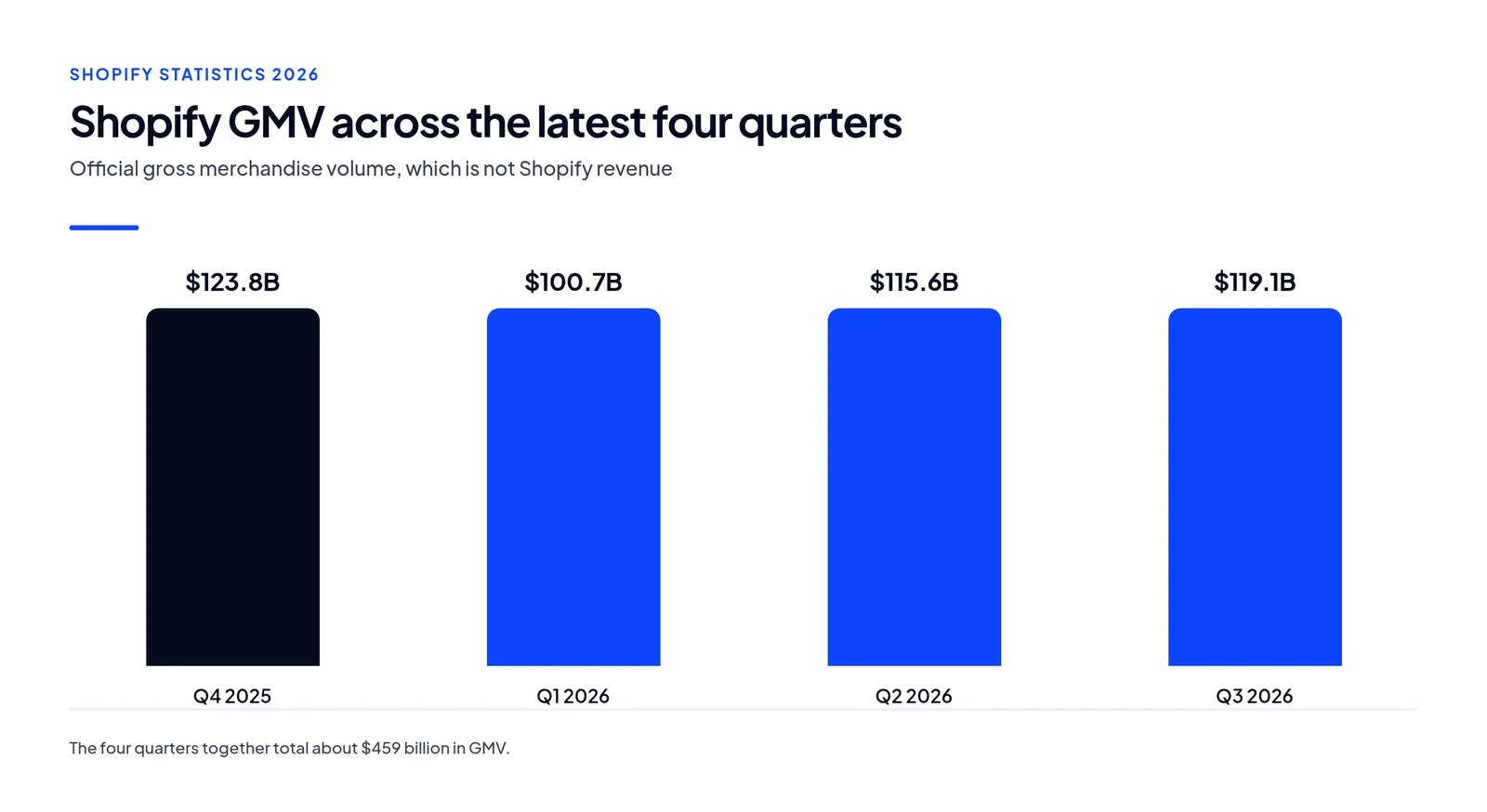
Shopify GMV reached $119.1 billion in the third quarter of 2026, up 29% year over year, and about $459 billion across the latest four reported quarters.
Full-year 2025 GMV was $378.4 billion, up 29%. For the first nine months of 2026, GMV was $335.5 billion, up 32%. In these Shopify statistics, GMV is the value of orders on the platform. It is not Shopify revenue.
Growth was broad in the third quarter. Offline GMV rose 30%, business-to-business GMV rose 74%, and North America GMV rose 28% in constant currency. Shop Pay GMV grew 50% year over year.
What this means: Shopify GMV is now a mid-hundreds-of-billions run rate, and the lift is coming from more than one region and more than one sales channel.
The latest official benchmark is the United States, where Shopify merchants accounted for more than 14% of ecommerce in the most recent full year.
These Shopify statistics do not invent a single official global share. I am not filling that gap with a rival-by-rival ranking. The cleaner official picture is the US share, plus the fact that the United States already supplies 63% of Shopify revenue.
The more-than-14% figure is for 2025, the most recent full year with an official share. An official 2026 US figure has not been published yet, so I am not inventing one. International revenue grew 36% in 2025, which shows the rest of the world is still adding scale around that US base.
Did you know? These Shopify statistics show merchants already accounted for more than 14% of US ecommerce in the most recent full year. For the wider online retail picture, see ecommerce statistics 2026.
What Is Shopify’s Market Capitalization?
Shopify’s market capitalization recently stood near $170 billion, but that figure changes from session to session.
In these Shopify statistics, market cap is the market’s recent valuation of the company, not a sales total and not a cash balance. I am keeping it approximate on purpose, with no exact date, because a single close would be stale almost as soon as it is written.
What this means: Read market cap as a rough recent level, and use revenue, GMV and payments when you want official operating totals.
What Are the Latest Shopify Payments Statistics?
Shopify Payments processed $81.4 billion in the third quarter of 2026, equal to 68% of GMV, up from 65% a year earlier.
For the first nine months of 2026, Shopify Payments also held a 68% penetration rate and processed $226.5 billion. In the first quarter the rate was 67%, or $67.1 billion. For full-year 2025 it was 65.6%, or $248.1 billion. Shop Pay GMV grew 50% year over year in the third quarter, which is one of the cleaner growth lines in these Shopify statistics.
The 68% figure is Shopify Payments’ share of GMV on the Shopify platform, up 3 points year over year. It is not a claim about global card-network share. As more merchants check out through Shopify Payments, merchant solutions revenue rises with GMV.
Checkout and repeat-purchase tools also sit close to social media statistics 2026, because discovery and paid social still send a large share of shoppers to these stores.
What Are the Popular Categories on Shopify?
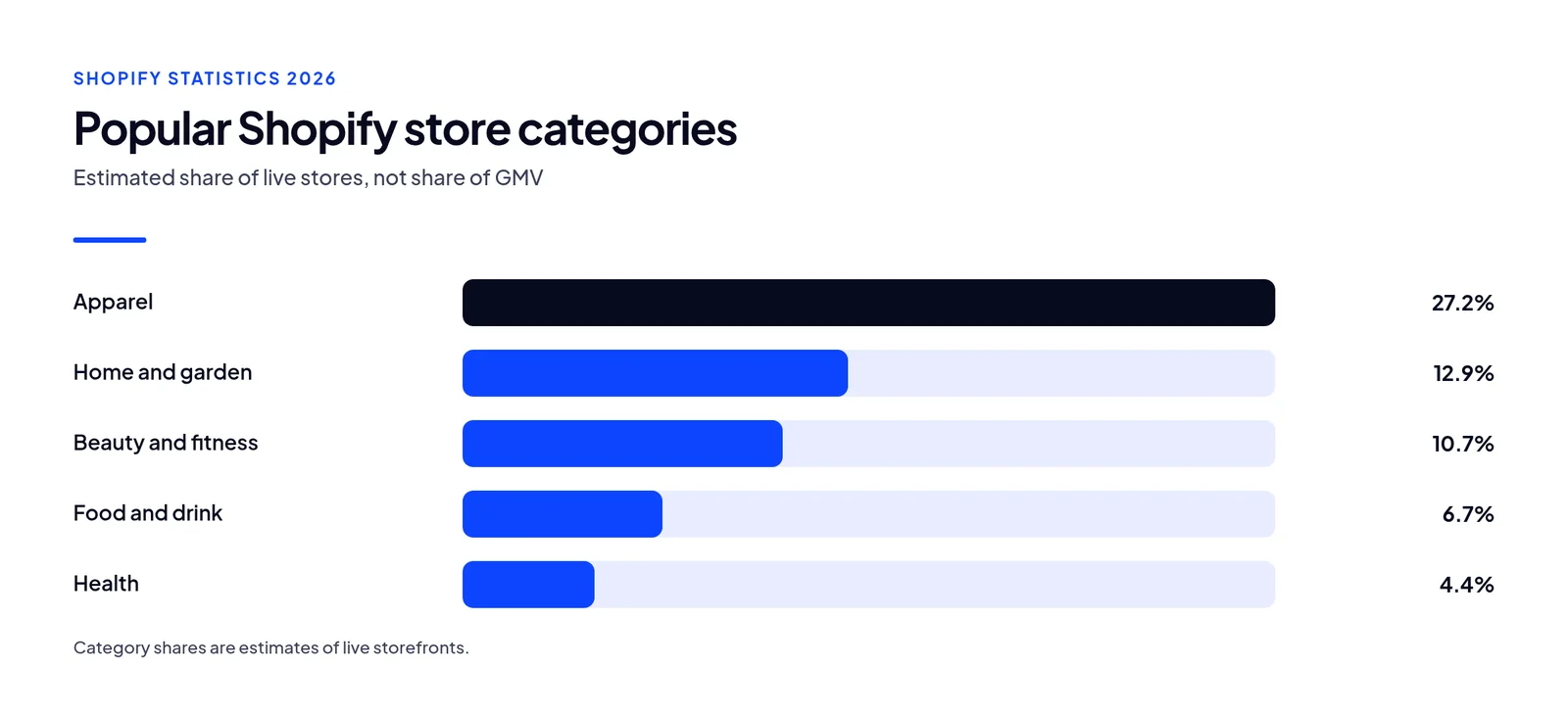
Apparel is the most common estimated category, at about 27% of live Shopify stores, followed by home and garden at about 13% and beauty and fitness at about 11%.
In these Shopify statistics, those are store-count estimates, not GMV shares. A smaller set of large apparel or beauty brands can still outsell a long tail of tiny shops in the same category.
| Category | Estimated share of live stores |
|---|---|
| Apparel | 27.2% |
| Home and garden | 12.9% |
| Beauty and fitness | 10.7% |
| Food and drink | 6.7% |
| Health | 4.4% |
What Do Shopify App Statistics Show?
Estimates put the Shopify App Store at more than 30,000 apps, well above the older public counts that still appear on some marketing pages.
App, theme and domain sales sit inside subscription solutions, so the catalog is part of Shopify revenue as well as merchant setup. These Shopify statistics use a more-than-30,000 estimate because live App Store counts clustered in that range, and I am not treating an older marketing line as a current census.

What this means: The app catalog is large enough that merchants can extend almost every part of a store, and it is still growing.
What Shopify Trends Should You Know?
The Shopify trends to know are rising Payments penetration, a merchant-solutions-heavy revenue mix, faster growth among larger shops, and official guidance for low-thirties revenue growth in the fourth quarter of 2026.
Shopify Payments already handles 68% of GMV, and merchant solutions now supply about 78% of revenue. Offline GMV and business-to-business GMV are growing faster than the core online base, and Plus remains the plan for merchants that want more than a standard store. Those same themes run through the rest of these Shopify statistics.
Shop and Shop Pay give the platform a 400 million-plus shopper base, and Europe plus Asia Pacific already account for 30% of revenue. Those are the Shopify trends to know if you are tracking the next few quarters, not a new headline number.
Pros and Cons of Shopify in 2026
Pros
- Trailing four-quarter revenue reached $14.17 billion, and third-quarter revenue rose 32%.
- Merchants generated $459 billion in GMV across the latest four reported quarters.
- Shopify Payments now processes 68% of GMV, up 3 points year over year.
- Shopify merchants accounted for more than 14% of US ecommerce in the most recent full year.
- Shop and Shop Pay reach more than 400 million verified shoppers worldwide.
- Third-quarter free cash flow was $816 million, a 22% margin.
Cons
- Shopify does not publish an official store or Plus census, so store counts remain estimates.
- An official 2026 US market share figure has not been published yet.
- There is no official success rate, and many live stores still look small.
My verdict on these Shopify statistics is that the official financials are strong and consistent: revenue, GMV and Payments penetration all kept growing through the third quarter of 2026. The gaps are an official store census, an official 2026 US share and a published success rate, so those lines should stay labeled clearly.
Quick Links
- Ecommerce Statistics 2026
- Internet Statistics 2026
- Social Media Statistics 2026
- Video Marketing Statistics 2026
- Video SEO Statistics 2026
- Generation Z Statistics 2026
Frequently Asked Questions About Shopify Statistics
Estimates put live Shopify stores at about 3.35 million. Shopify does not publish an official store census, and it only says that millions of businesses in more than 175 countries use the platform. I treat the 3.35 million figure as an estimate of live storefronts, not every domain or test shop, in these Shopify statistics.
Shopify collected $14.17 billion in revenue across the latest four reported quarters. Third-quarter 2026 revenue was $3.74 billion, up 32% year over year. In the most recent full year, 2025, revenue was $11.56 billion, up 30%. Merchant solutions now supply about 78% of quarterly revenue, and subscription solutions supply about 22%.
GMV is the dollar value of orders facilitated on the platform, not Shopify's own revenue. Merchants generated $119.1 billion in GMV in the third quarter of 2026, up 29% year over year, and about $459 billion across the latest four reported quarters. Full-year 2025 GMV was $378.4 billion, up 29%.
Shopify merchants accounted for more than 14% of US ecommerce in the most recent full year, 2025. That is the latest official share I am using. An official 2026 figure has not been published yet. The United States also remains Shopify's largest revenue market, at 63% of third-quarter revenue.
Estimates put Shopify Plus at about 56,000 distinct merchants and about 84,200 domains. The gap exists because Plus merchants can run more than one domain. I label both figures as estimates, since Shopify does not publish an official Plus census in these Shopify statistics.
Shopify Payments processed $81.4 billion in the third quarter of 2026, equal to 68% of GMV, up from 65% a year earlier. For the first nine months of 2026, the penetration rate was also 68%, or $226.5 billion. In full-year 2025 the rate was 65.6%. That is Shopify Payments' share of platform GMV, not a global payments-network share.
Shopify does not publish a single official count of every unique buyer on the platform. It does say that Shop and Shop Pay reach more than 400 million verified shoppers worldwide. That figure describes shoppers, not merchants. GMV tells you order volume, but it is not the same thing as a unique customer census.
Apparel is the largest estimated category, at about 27% of live Shopify stores. Home and garden follows at about 13%, and beauty and fitness at about 11%. Food and drink and health are smaller but still large groups. These shares are estimates of store counts, not shares of GMV, and they can shift as new shops open.
Shopify does not publish an official success rate, so I do not invent one. Estimates suggest many stores stay small: about 28% of live shops list fewer than 10 products. A thinner group of larger merchants still accounts for a large share of GMV growth. Store count and sales success are not the same measure.
Conclusion: Shopify Statistics 2026
The three headline Shopify statistics for 2026 are $14.17 billion in trailing revenue, $459 billion in trailing GMV, and Shopify Payments at 68% of third-quarter GMV. Around that official core sit about 3.35 million estimated live stores and more than 14% of US ecommerce in the most recent full year. The next test is whether Payments penetration and merchant-solutions revenue keep rising through the holiday quarter.

Jitendra Vaswani is a well-known figure in the SEO and affiliate marketing communities. He is regarded as a legitimate authority due to his deep knowledge and game-changing contributions to the field. He is the founder of Digiexe.com, a digital marketing agency, and VenueLabs.com, a full-service PR marketing agency. His strategic acquisition of AffiliateBooster.com has further solidified his status as a leader, bringing forth groundbreaking solutions that are revolutionizing affiliate marketing. Follow Jitendra on Instagram, Facebook, and LinkedIn