AI chatbot statistics for 2026 start with a hard number: the market reached $14.28 billion, up from $11.06 billion in 2025.
Under 1 billion people now use messaging chatbots, and 49% of US adults say they use an AI chatbot.
This page covers usage, market size, industry adoption, costs, limits and the outlook to 2030.
AI Chatbot Statistics 2026 (Key Highlights)
- The AI chatbot market is $14.28 billion in 2026, up from $11.06 billion in 2025.
- That market is forecast to reach $35.71 billion by 2030, a 25.7% annual growth rate from 2026.
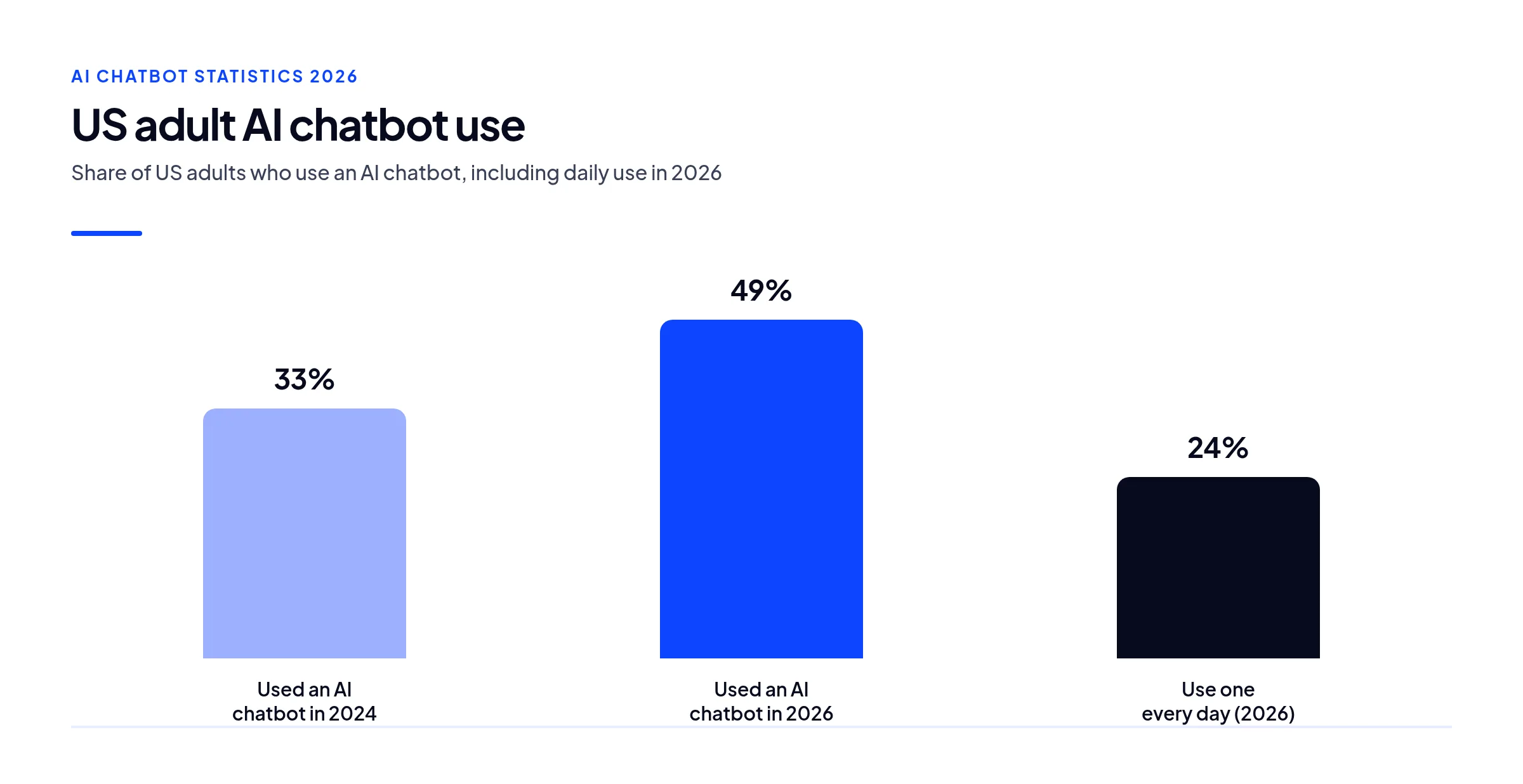
- 49% of US adults now use an AI chatbot, up from 33% in 2024.
- 24% of US adults use an AI chatbot every day.
- 85% of customer service organizations use some form of AI, and 66% now use agentic AI, up from 39% in 2025.
- 55% of large customer experience teams already run customer-facing chatbots.
- Under 1 billion people use messaging chatbots in 2026, heading toward almost 1.9 billion by 2030.
- Only 4% of customer service leaders say they have achieved the return they expected from AI.
How Many People Use AI Chatbots?
Under 1 billion people use messaging chatbots in 2026, and 49% of US adults now use an AI chatbot.
That figure covers messaging-channel chatbots, not every website bot. In the US, use rose from 33% of adults in 2024 to 49% in 2026, and 24% now use one every day. Internet statistics for 2026 help place that share in the wider online population.
What this means: Assume a large share of adults have already tried an AI chatbot. The open question is whether they trust yours enough to come back.
AI Chatbot Market Size
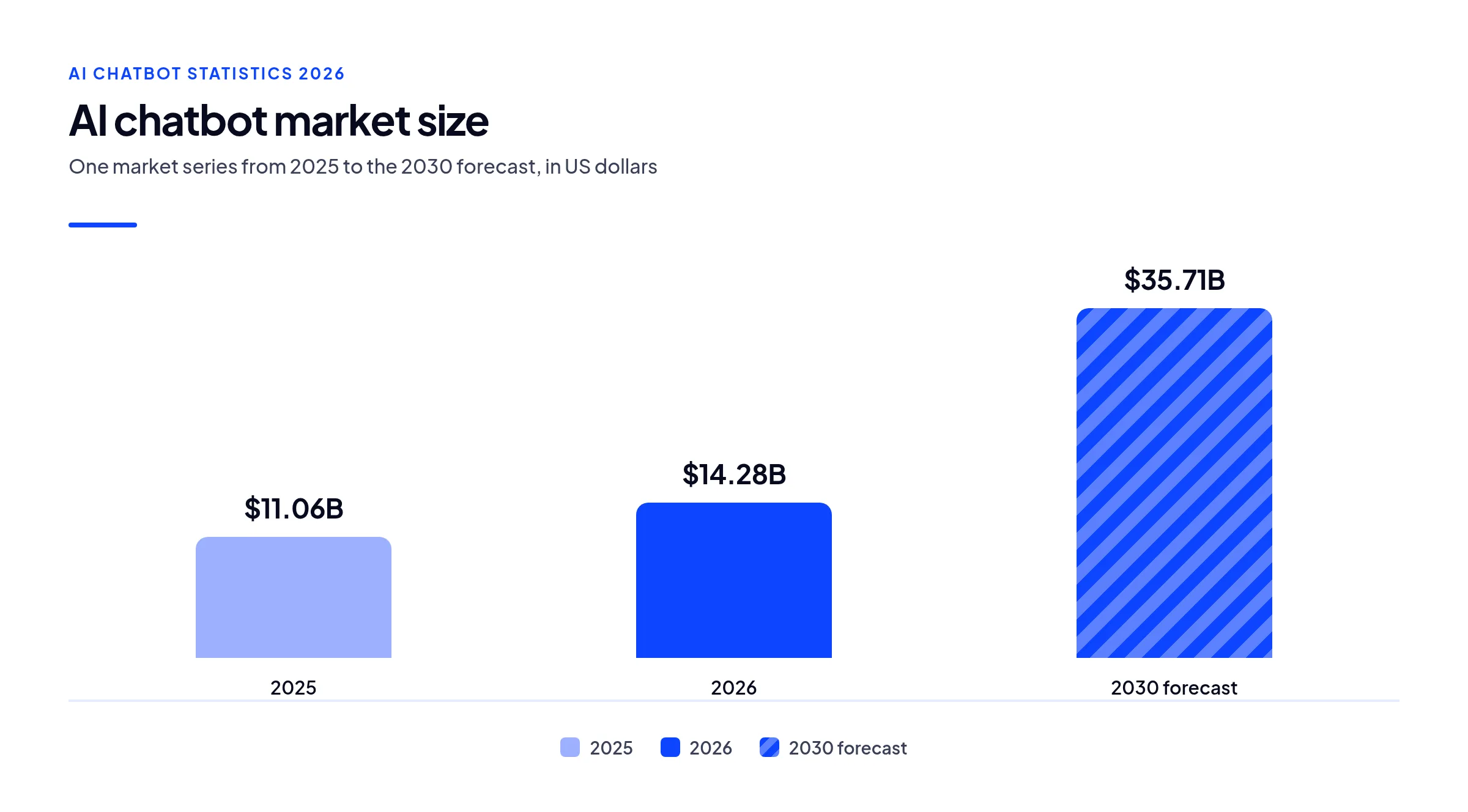
The AI chatbot market size is $14.28 billion in 2026.
That is a 29.2% jump from $11.06 billion in 2025. The same series puts the market on a path to $35.71 billion by 2030, a 25.7% compound annual growth rate from 2026. North America was the largest region in 2025.
| Year | AI chatbot market size |
|---|---|
| 2030 (forecast) | $35.71 billion |
| 2026 | $14.28 billion |
| 2025 | $11.06 billion |
What this means: A $14.28 billion market is no longer a side experiment. You are competing in a real budget line, not a novelty fund.
AI Chatbot Statistics by Industry
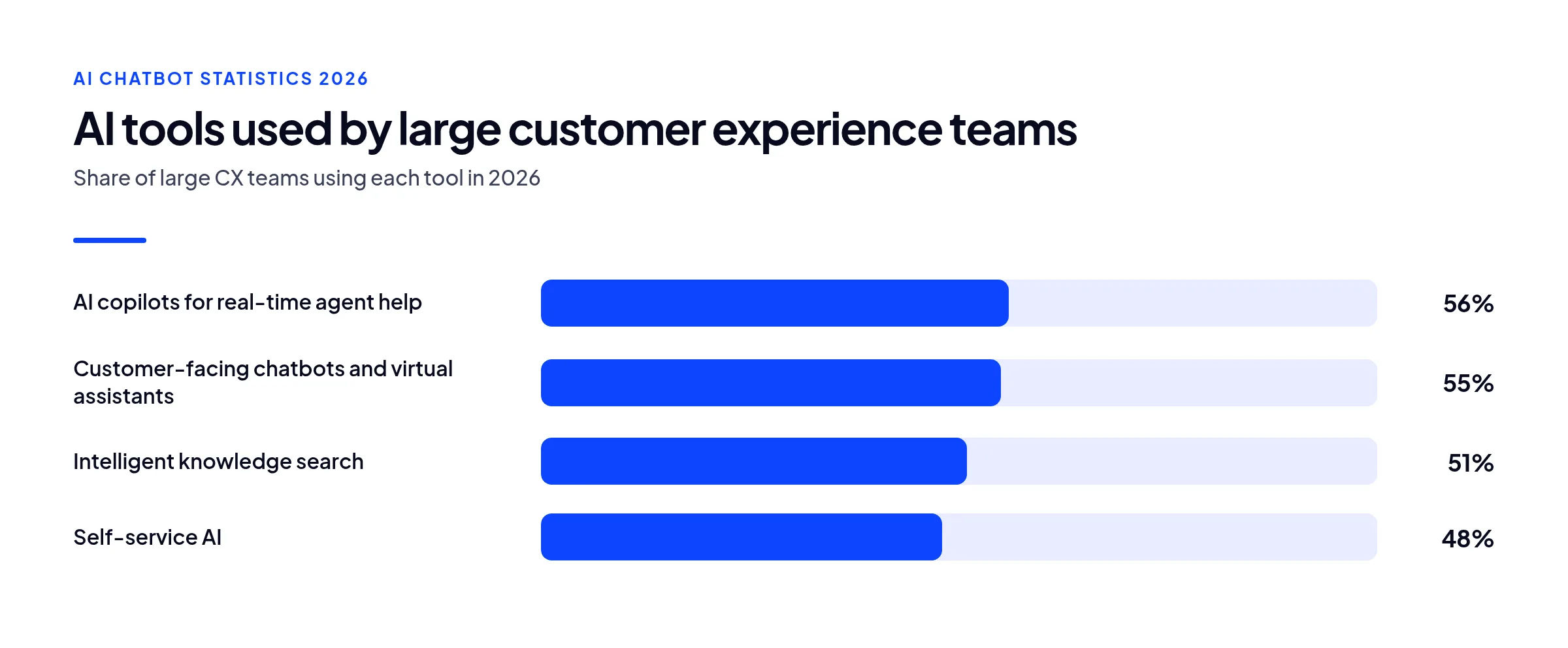
55% of large customer experience teams already use customer-facing chatbots or virtual assistants.
The same teams also lean on AI copilots, knowledge search and self-service AI, as the table shows. In 6 out of 7 major customer experience functions, the main model is a human agent with AI help. Retail feels this first, because shoppers already expect instant answers. My ecommerce statistics page adds the wider retail backdrop.
| Tool used by large CX teams in 2026 | Share |
|---|---|
| AI copilots for real-time agent help | 56% |
| Customer-facing chatbots and virtual assistants | 55% |
| Intelligent knowledge search | 51% |
| Self-service AI | 48% |
What this means: A chatbot is already a normal tool in support and commerce. The edge is making it resolve the right issues, not just launching one.
Customer Support Chatbot Statistics
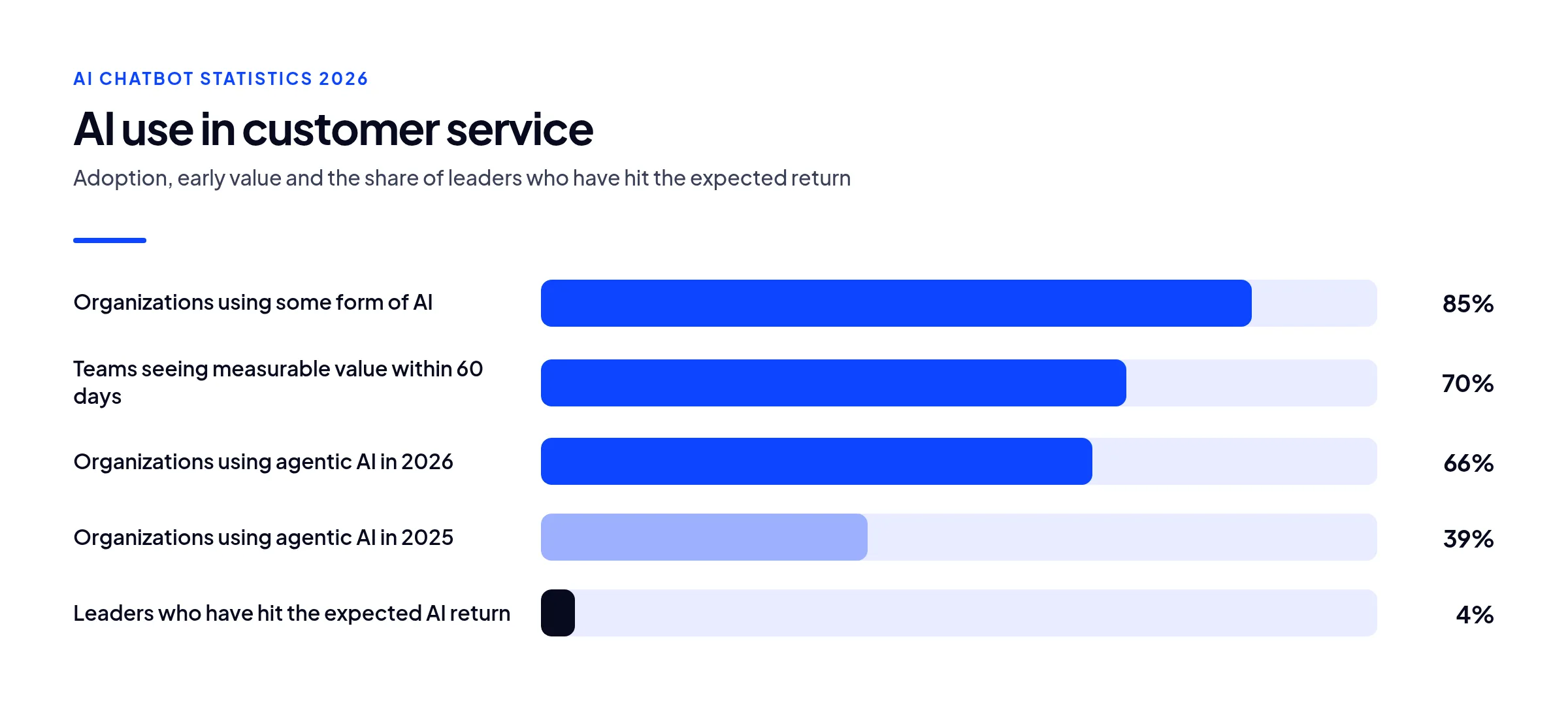
85% of customer service organizations use some form of AI, and 66% now use agentic AI.
That agentic share was 39% in 2025, a 1.7 times rise in a year. 70% of teams that adopt these agents see measurable value within 60 days, and customer satisfaction is the first metric that improves. The catch is that only 4% of service leaders have hit the return they expected. If you still run a human-only queue, see my live chat statistics roundup.
| Customer service measure | Figure |
|---|---|
| Organizations using some form of AI | 85% |
| Teams seeing measurable value within 60 days | 70% |
| Organizations using agentic AI in 2026 | 66% |
| Organizations using agentic AI in 2025 | 39% |
| Leaders who have hit the expected AI return | 4% |
What this means: Buying a support chatbot is easy. Proving it paid for itself is still hard, so budget for training and a human backup, not just a license.
AI Chatbot Usage Statistics for Daily Work
42% of US adults use AI chatbots to search for information, and 38% of employed adults use them for tasks at work.
Those are the two everyday jobs. Fun, image editing, medical advice and fitness tips follow, while news, emotional support and companionship stay much smaller. 30% of US adults say chatbots help their productivity, and 28% say the tools help them stay informed. Productivity statistics already show how much of a workday gets eaten by small tasks.
| What US adults use AI chatbots for | Share |
|---|---|
| Search for information | 42% of adults |
| Tasks at work | 38% of employed adults |
| Fun or entertainment | 25% of adults |
| Create or edit images or videos | 24% of adults |
| Medical advice | 20% of adults |
| Diet and fitness information | 20% of adults |
What this means: Build for search and work first. A companion-style bot serves a much smaller group, and that group carries more risk.
AI Chatbot Statistics by Age
66% of US adults aged 18 to 29 use an AI chatbot, compared with 23% of adults aged 65 and older.
Use is also high in the middle of the market: 61% of adults aged 30 to 49, and 42% of adults aged 50 to 64. Every age band is up versus 2024, and older adults almost doubled from 12% to 23%. My Generation Z statistics page adds color on how younger users already live online.
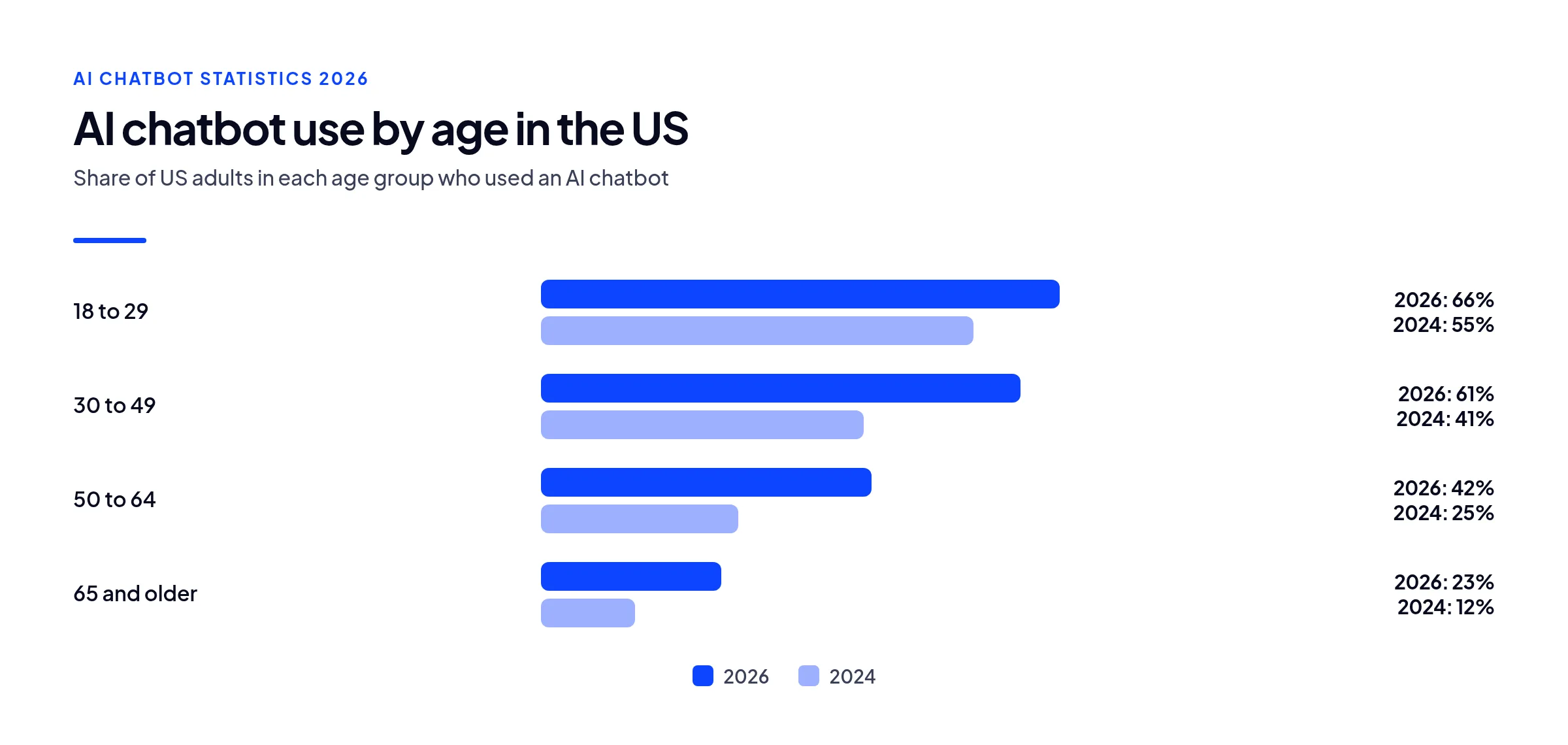
| Age group (US adults) | Used an AI chatbot in 2026 | Used an AI chatbot in 2024 |
|---|---|---|
| 18 to 29 | 66% | 55% |
| 30 to 49 | 61% | 41% |
| 50 to 64 | 42% | 25% |
| 65 and older | 23% | 12% |
What this means: A bot aimed only at teenagers will miss a large working-age audience. Older users are catching up too, from a lower base.
Benefits of AI Chatbots in 2026
70% of customer service teams that adopt agentic AI see measurable value within 60 days, and customer satisfaction is the first metric that improves.
The gains people feel are practical. 30% of US adults say chatbots help their productivity, and 28% say the tools help them stay informed. 24% already use an AI chatbot every day.
What this means: The strongest benefit is faster answers and less busywork. If your bot cannot do those two things well, the rest of the pitch will not matter.
Did you know? 24% of US adults already use an AI chatbot every day, yet only 4% of customer service leaders have earned the return they expected. For the human side of that choice, see my live chat statistics for 2026.
Challenges of AI Chatbots
Only 4% of customer service leaders have achieved the AI return they expected, and average self-service success is still just 14%.
Adoption ran ahead of results. 53% of customers still go straight to a human agent. Trust is the other wall: 71% of US adults think AI will make their personal information less secure, and 63% say AI is advancing too quickly. Privacy fears are not abstract when data breach statistics keep piling up each year.
What this means: A chatbot that hides the path to a person will frustrate users. Design the human handoff before you launch.
AI Chatbot Cost and Savings Statistics
Most service teams still struggle to prove savings: only 4% of leaders have hit the AI return they expected.
That does not mean chatbots never pay off. 70% of teams that deploy agentic AI report measurable value within 60 days. The gap is between feeling an improvement and showing a clean saving. Generative AI cost per resolution is also forecast to rise above $3 by 2030, and rules that protect access to a human agent could lift assisted-service volume by 30% by 2028.
What this means: Do not buy a chatbot only to cut the support bill in half. Price in supervision and failed automations, then judge it on speed and satisfaction.
Future of AI Chatbots: 2026 to 2030 Outlook
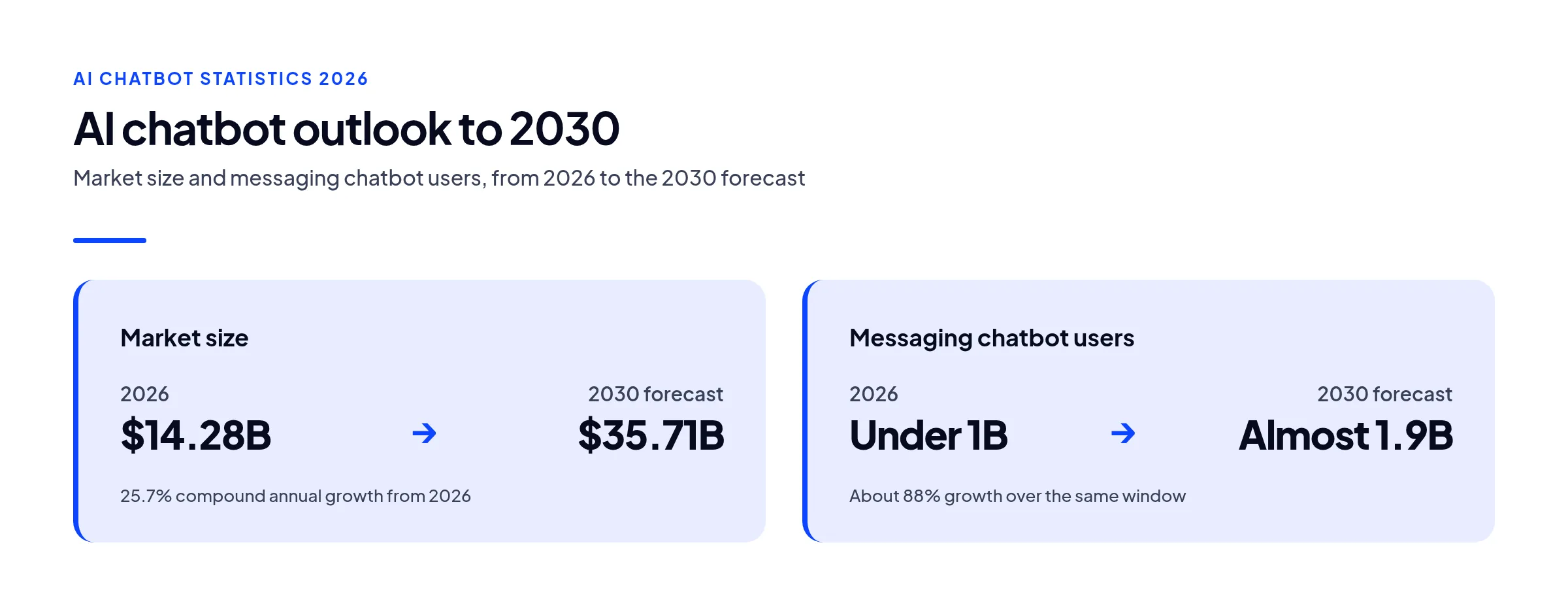
The AI chatbot market is forecast to reach $35.71 billion by 2030, and messaging chatbot users are forecast to reach almost 1.9 billion.
Messaging-channel use is a global story, even though North America was the largest market region in 2025. Those users are forecast to grow 88% worldwide between 2026 and 2030, from under 1 billion to almost 1.9 billion, with rich mobile messaging rising from 64 million users to 519 million. Voice search statistics show a similar shift toward talking to software.
A separate outlook says agentic AI could resolve 80% of common customer service issues on its own by 2029, with a 30% cut in operating costs. I am keeping that as a forecast, not as a current fact.
What this means: The next four years look busy, not automatic. A plan that assumes every ticket is solved by a bot is ahead of the evidence.
Pros and Cons of AI Chatbots 2026
Pros
- The market is already $14.28 billion in 2026, so the category is past the trial stage.
- 49% of US adults now use an AI chatbot, up from 33% in 2024.
- 24% of US adults use an AI chatbot every day.
- 85% of service organizations already use some form of AI.
- 70% of teams that deploy agentic AI see measurable value within 60 days.
- Messaging chatbot users are forecast to reach almost 1.9 billion by 2030.
Cons
- Only 4% of customer service leaders have hit the AI return they expected.
- Average self-service success is still just 14%.
- 71% of US adults think AI will make their personal information less secure.
My verdict on these AI chatbot statistics is simple. The tools are widely used and the market is growing fast, but trust and proven savings still lag. I would test a bot on a narrow set of tasks, keep a path to a human, and only then roll it out more widely.
Quick Links
- Chatbot Statistics 2026
- Live Chat Statistics 2026
- Voice Search Statistics 2026
- Ecommerce Statistics 2026
- Internet Statistics 2026
- Productivity Statistics 2026
- Mobile Apps Statistics 2026
- Data Breach Statistics 2026
Frequently Asked Questions About AI Chatbot Statistics
Under 1 billion people use messaging chatbots in 2026. In the United States, 49% of adults now use an AI chatbot, up from 33% in 2024, and 24% use one every day. Website bots and messaging bots are often counted in different ways, so I would not treat any single global headcount as exact.
The AI chatbot market size is $14.28 billion in 2026, up from $11.06 billion in 2025. This page uses one market series in the intro, highlights and conclusion so the figures stay in sync. The same series forecasts $35.71 billion by 2030.
The AI chatbot market grew 29.2% from 2025 to 2026. From 2026 to 2030, the forecast compound annual growth rate is 25.7%, taking the market from $14.28 billion now to $35.71 billion. The near-term rate is hotter than the longer outlook, which is typical as a market gets larger.
Younger adults use them most. 66% of US adults aged 18 to 29 use an AI chatbot, along with 61% of adults aged 30 to 49. Use drops to 42% among ages 50 to 64 and 23% among ages 65 and older. Every age group is up versus 2024.
Sometimes, but proven savings are still rare. Only 4% of customer service leaders say they have achieved the AI return they expected. At the same time, 70% of teams that deploy agentic AI report measurable value within 60 days. I would track satisfaction and resolved tickets, not just the license cost, before you call it a saving.
The biggest benefit is faster everyday help. 42% of US adults use chatbots to search for information, and 38% of employed adults use them for work tasks. On the business side, 70% of service teams that adopt agentic AI see measurable value within 60 days, with customer satisfaction improving first.
The biggest limit is that many bots still fail to finish the job. Average self-service success is just 14%, and 53% of customers go straight to a human agent. Only 4% of service leaders have hit the AI return they expected. Trust lags too: 71% of US adults think AI will make their personal information less secure.
Yes. The market is $14.28 billion in 2026, up from $11.06 billion in 2025, and is forecast to reach $35.71 billion by 2030. US adult use rose from 33% in 2024 to 49% in 2026. Messaging chatbot users are also forecast to grow 88% by 2030, from under 1 billion to almost 1.9 billion.
It depends on the job, not on a brand name. A ready-made AI chatbot is usually faster and cheaper to test for common questions. A custom bot can follow your policies more closely, but costs more to keep updated. With only 4% of service leaders hitting expected AI returns, start narrow and measure real resolutions first.
Conclusion: AI Chatbot Statistics 2026 in Numbers
AI chatbot statistics for 2026 come down to three figures I would remember. The market is $14.28 billion this year, up from $11.06 billion in 2025. 49% of US adults now use an AI chatbot, and 24% use one every day. The same market is forecast to reach $35.71 billion by 2030, with messaging chatbot users heading toward almost 1.9 billion. The growth is real. The next step is to build bots people will trust.

Jitendra Vaswani is a well-known figure in the SEO and affiliate marketing communities. He is regarded as a legitimate authority due to his deep knowledge and game-changing contributions to the field. He is the founder of Digiexe.com, a digital marketing agency, and VenueLabs.com, a full-service PR marketing agency. His strategic acquisition of AffiliateBooster.com has further solidified his status as a leader, bringing forth groundbreaking solutions that are revolutionizing affiliate marketing. Follow Jitendra on Instagram, Facebook, and LinkedIn