As of 2026, Morgan Housel net worth is estimated at about $5 million to $15 million, with careful write-ups centering near $10 million. He does not publish a personal balance sheet. Book royalties, his Collaborative Fund partnership and a Markel Group board seat shape the range, not a bank statement.
| Quick facts | Details |
|---|---|
| Net worth | About $5 million to $15 million (estimate; many careful profiles center near $10 million) |
| Full name | Morgan Housel |
| Age | About 42 (per Markel Group proxy filings) |
| Birthplace / base | Seattle area, Washington, United States |
| Nationality | American |
| Profession | Author, investor, financial writer, company director |
| Source of wealth | Book royalties, Collaborative Fund partnership, Markel board pay and stock, speaking |
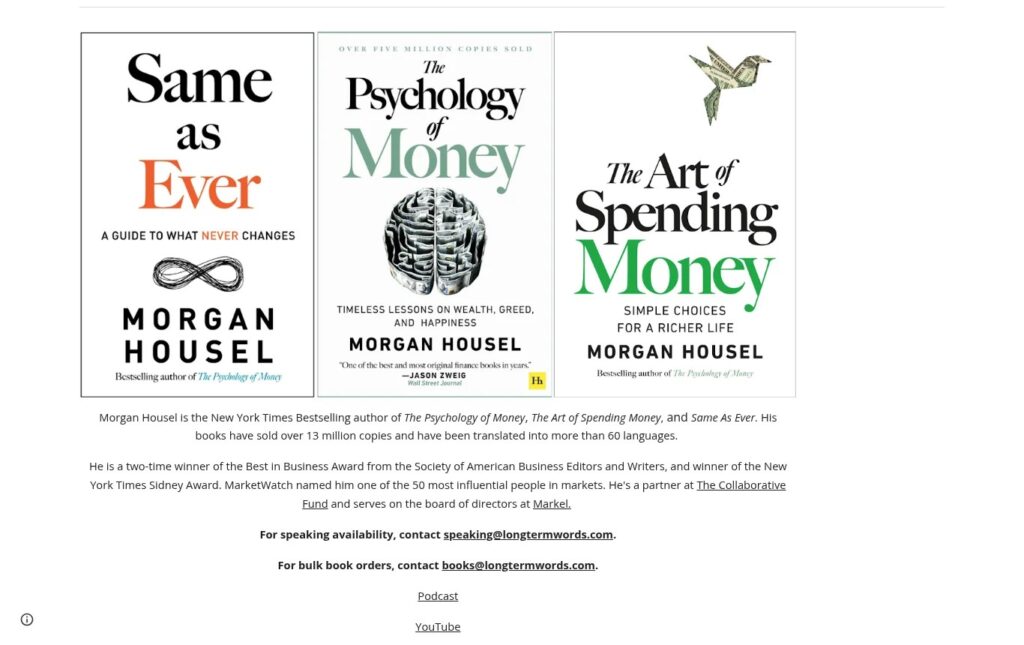
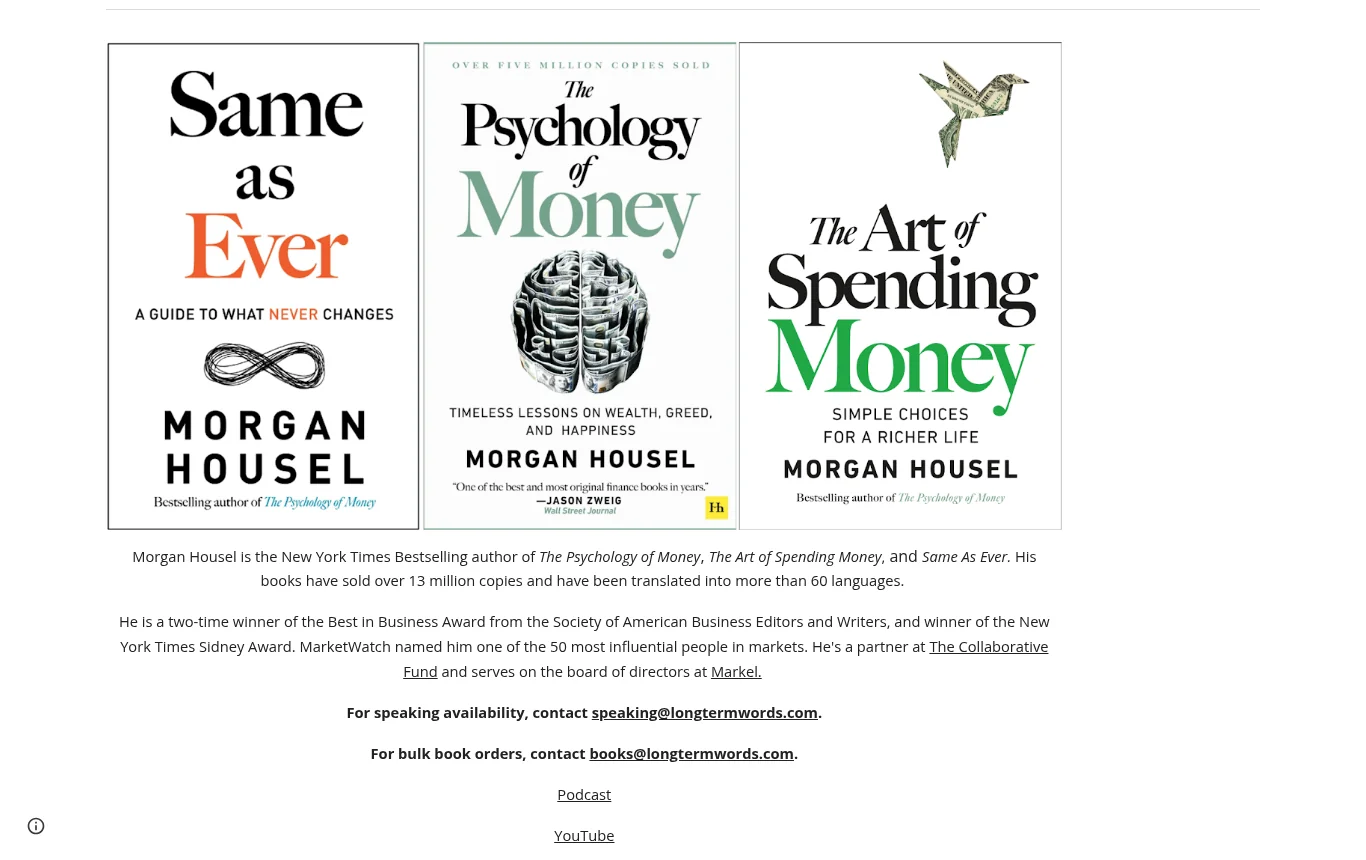
| Notable work | The Psychology of Money, Same as Ever, The Art of Spending Money |
| Known for | Behavioral money writing and long-term investing stories |
| Firm | Partner at Collaborative Fund (since 2016) |
| Board | Independent director at Markel Group (since 2021) |
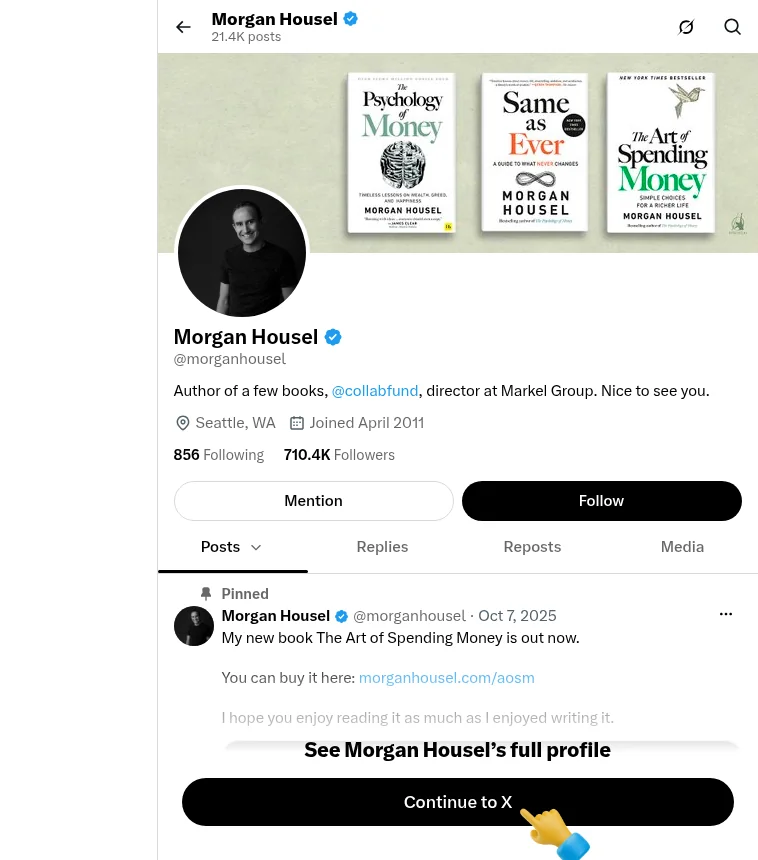
| X | @morganhousel |
Who Is Morgan Housel
Morgan Housel is an American writer and investor who explains money through stories instead of formulas. He is a partner at Collaborative Fund and an independent director at Markel Group. Readers know him for The Psychology of Money, a short book that turned quiet behavioral ideas into a global bestseller.
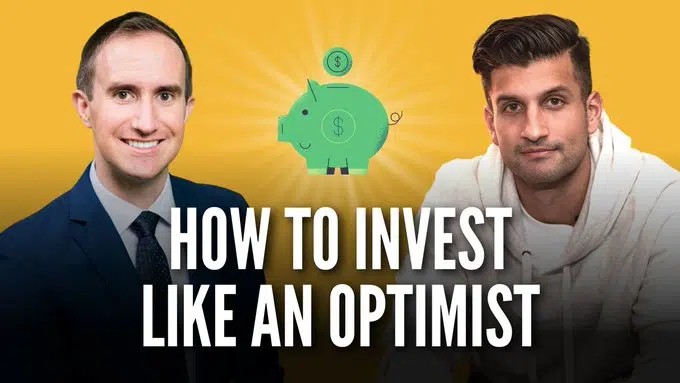
He is not a clinical psychologist. Older blurbs that call him one are wrong. His craft is journalism and investing commentary, built at The Motley Fool and later at a private venture firm.
Morgan Housel Net Worth
Public net worth pages disagree by a wide margin. Some float figures under $1 million. Others invent nine-figure guesses with no math.
The honest band for Morgan Housel net worth sits near $5 million to $15 million, with a working midpoint around $10 million. That midpoint is a reading of filings plus royalty math, not a leaked bank balance.
Only slices of that picture are verifiable. Markel Group filings show board pay near $301,000 in the most recent disclosed year and a growing stake of roughly a thousand shares.
At recent prices that holding has been valued near $1.8 million. Book royalties, fund compensation and speaking fees stay private.
His official site says his books have sold more than 13 million copies across many languages. Markel’s latest proxy put the total nearer 11 million, which shows how fast the count moves.
Sales volume is high confidence. The royalty rate per copy is not.
| Piece of the picture | What is known |
|---|---|
| Markel shares | Roughly 1,000 shares across proxy and Form 4 updates; value moves with the stock |
| Markel board pay | About $301,000 in the latest disclosed year (retainer, stock award, plan discount, charity match) |
| Book sales | Over 11 million to 13 million copies cited across filings and his site |
| Book royalties | Private; rates, agent fees and translation splits are not public |
| Collaborative Fund pay | Private firm; salary, bonus and carry not disclosed |
| Speaking and podcast | Real income of unknown size |
That mix is why careful writers refuse a single sharp number. Treat any Morgan Housel net worth figure as a range with a clear split between filings and estimates.
Early Life and Education
Housel grew up in the Seattle area and has spoken about odd early jobs that shaped how he sees money. Hotel valet work and restaurant shifts sit next to a short investment banking stop in the stories he tells interviewers.
He earned a bachelor’s degree in economics from the University of Southern California. Older pages that say Stanford are wrong. That USC path fed his Motley Fool years more than any Ivy League brand story.
The early hustle shows up in his writing. He likes simple scenes over jargon, and he returns to how ordinary people feel about risk, status and savings.
Career Highlights and Milestones
Motley Fool and Wall Street Journal
Housel joined The Motley Fool around 2007 as a columnist and later worked as a senior analyst. He stayed until 2016. In the mid-2010s he also wrote a column for The Wall Street Journal.
Those years trained his voice. Short stories, clear numbers and a calm tone became the brand readers still expect.
Collaborative Fund partner
In August 2016 he became a partner at Collaborative Fund, a private investment firm. Markel filings describe his work there as investor communications, research, due diligence and portfolio-company board support.
Compensation at private funds can include salary, bonuses and a share of profits. Housel has not published those details, so fund pay remains an estimate inside any net worth range.
Markel Group board
He joined Markel Group’s board as an independent director in November 2021. The seat is the cleanest income line to check because Markel is public. In the latest disclosed year the company reported about $301,000 in total director compensation for him.
That package mixed a cash retainer he largely took as discounted shares, a restricted stock award and a charitable match. The match goes to charity, so personal benefit sits a bit below the headline total. Form 4 filings show his share count rising through awards and plan purchases rather than loud open-market buys.
Books that moved the needle
The Psychology of Money came out in September 2020 from Harriman House and became a rare personal-finance breakout. Same as Ever followed in 2023 as an instant New York Times bestseller. His newest title, The Art of Spending Money, landed more recently under Portfolio in the United States and Harriman House in the United Kingdom.
Together the books drive royalties, speaking demand and the audience that follows his podcast. Sales in the tens of millions of copies make royalties the biggest unknown upside in Morgan Housel net worth estimates.
| Book | Role in the story |
|---|---|
| The Psychology of Money | Flagship bestseller; behavioral money essays for a mass audience |
| Same as Ever | Follow-up on what never changes in markets and life |
| The Art of Spending Money | Newest book on using money so life feels better |
Income Sources and Assets
Book royalties
Royalties are the engine and the fog. Even with 11 million to 13 million copies sold, author pay per copy varies by hardcover, paperback, ebook, audio, discount and translation.
Agents take a cut. Taxes take another.
A back-of-the-envelope table is only illustrative. At half a dollar earned per copy, 13 million copies would gross about $6.5 million before agent fees and taxes.
At a dollar per copy the gross would be about $13 million. Real averages likely sit nearer the lower or middle band once overseas editions and audio deals are mixed in.
Collaborative Fund partnership
A decade as a partner can add meaningful wealth even when numbers stay private. The role also keeps him close to founders and investors, which feeds his writing and speaking calendar.
Markel stake and board cash
The Markel seat adds both yearly compensation and equity that moves with the share price. A $100 move in Markel stock shifts a thousand-share position by about $100,000. Treat any dollar figure on the stake as a snapshot.
Speaking, podcast and other work
Housel hosts The Psychology of Money podcast and takes speaking requests. Fees are not published. Treat this as real income of unknown size rather than inventing a day rate.
Brand, Business and Ventures
His brand is quiet on purpose. He does not sell high-ticket courses or a seminar empire. The businesses that matter are the books, the fund partnership and the Markel seat.
That restraint matches his writing. He argues that real wealth is often what you do not show. His own public filings fit that story more than flashy lifestyle coverage does.
Readers who want louder creator money stories can compare profiles of Seth Godin, Tim Ferriss. Housel’s path looks closer to patient writing and private investing than to a media company.
Awards and Achievements
He has won the Best in Business Award twice from the Society of American Business Editors and Writers. He also received a New York Times Sidney Award and was a two-time finalist for the Gerald Loeb Award.
Those prizes sit next to commercial proof. Multi-million copy sales and a public-company board seat are the clearest markers that the work travels beyond a niche blog audience.
His main public feed is X, where @morganhousel has hundreds of thousands of followers. He posts short notes on wealth, history and investing behavior, plus links to new podcast episodes.
He also points readers to morganhousel.com for essays and book news. Follower counts help distribution. They are not the core of Morgan Housel net worth the way book royalties and private fund economics are.
Wealth Timeline
| Period | What moved the money story |
|---|---|
| Late 2000s to mid-2010s | Motley Fool writing years and Wall Street Journal column work |
| 2016 onward | Collaborative Fund partnership begins |
| 2020 onward | The Psychology of Money becomes a global sales engine |
| 2021 onward | Markel Group board seat adds disclosed pay and stock |
| 2023 onward | Same as Ever extends the book franchise |
| Recent months | The Art of Spending Money adds a third major title |
The timeline shows patience more than a single jackpot. Writing income stacked for years before the breakout book. The board seat then added a verifiable public layer.
Investment Philosophy in Plain Words
Housel writes that people need a money plan that matches their personality, not someone else’s spreadsheet. He pushes long horizons, humility about forecasts and respect for luck.
He also separates being rich from being wealthy. Rich can mean a high income that disappears when the paycheck stops. Wealth is what you keep and what you do not need to flash.
Those ideas matter for reading his own numbers. A quiet Markel stake and private fund economics fit the story better than sports cars and mansion tours.
Lessons From Morgan Housel’s Money Path
Behavior beats trivia. His books argue that how you act with money matters more than memorizing formulas. That idea shows up in his own filings when he takes a retainer in stock and keeps the lifestyle quiet.
Patience compounds. The Motley Fool years, the fund seat and the slow build of The Psychology of Money did not look like overnight fame. The royalty engine arrived after years of short, clear writing.
Sales are not take-home. Thirteen million books sold sounds like a lottery ticket. After agents, publishers, taxes and living costs, the personal pile is smaller than the headline.
The same warning applies to anyone reading David Bach or Brené Brown net worth ranges. Headline sales and personal cash are different columns.
Private pay stays private. Collaborative Fund compensation is a black box. Honest articles label it as unknown instead of inventing a salary.
Compare carefully. Creator fortunes built on courses and events, like parts of the Ankur Warikoo story, use different engines than a writer-partner model. Mixing those playbooks creates bad guesses.
How Estimates Differ Across the Web
Some pages price only the Markel stake and land near $1 million. Others recycle a $5 million to $15 million band without showing work. A few auto-generated posts invent $20 million to $100 million figures with wrong ages or schools attached.
Filings fix the stock and board pieces. Honest royalty math then widens the range. Anything past the mid-teens of millions needs evidence that is not public today.
Compare that approach with rumor-heavy celebrity pages. Finance writers leave a paper trail.
Readers can check proxies and Form 4s even when royalties stay private. That paper trail is why a $5 million to $15 million band beats a made-up single number for Morgan Housel net worth.
Frequently Asked Questions
What is Morgan Housel’s net worth?
Most careful estimates put Morgan Housel net worth near $5 million to $15 million, with a working midpoint around $10 million. He has never published a personal balance sheet, so only parts of the figure can be checked in filings.
How does Morgan Housel make money?
He earns from book royalties, his Collaborative Fund partnership, Markel Group board pay and stock, plus speaking and podcast work. The public pieces are the board package and share count. The rest is private.
How many books has Morgan Housel sold?
His site cites more than 13 million copies across his titles and many languages. A recent Markel proxy put the total nearer 11 million, which shows the count is still climbing.
Is Morgan Housel a billionaire?
No. Nothing in public filings or serious reporting points near that level. A multimillion-dollar range is the realistic band.
Where did Morgan Housel go to college?
He earned a bachelor’s degree in economics from the University of Southern California. Claims that he attended Stanford are incorrect.
Does Morgan Housel work at Collaborative Fund?
Yes. He has been a partner there since August 2016. The firm is private, so his exact pay is not public.
Final Thoughts
Morgan Housel net worth is best read as a verified-plus-estimated stack. Markel filings lock down board pay and a share stake near the low millions. Book sales in the tens of millions of copies imply meaningful royalties, while fund pay and speaking stay opaque.
The useful takeaway matches his own advice. Quiet compounding, patient writing and honest ranges beat invented headlines. For neighboring money-author profiles, see Ryan Holiday and the other links above.

Jitendra Vaswani is a globally recognized expert in SEO and AI-driven digital marketing. He has spoken at leading international events and is the founder of Digiexe, a results-driven digital marketing agency; Venuelabs, a platform that helps brands amplify their voice with expert PR and marketing solutions; and AffiliateBooster, an affiliate marketing news site. With over a decade of hands-on experience, Jitendra has empowered countless businesses to thrive online. His bestselling book, Inside A Hustler’s Brain: In Pursuit of Financial Freedom, has sold more than 20,000 copies worldwide, reflecting his influence and dedication to helping digital marketers achieve success. Follow Jitendra on Instagram, X/Twitter, Facebook, and LinkedIn.